Coyote vs. Acme
By Brian Eggert |
Coyote vs. Acme is an underdog story both on and offscreen. It’s about the little guy who goes up against a soulless corporation, fighting an against-all-odds battle with a business that abuses power and profits from the exploited. But more than that, it’s about art triumphing over commerce. Part Chuck Jones, part John Grisham, the movie follows the beleaguered Looney Tunes character Wile E. Coyote (eatius birdius), who, after years of pursuing the Road Runner (velocitus delectiblus) with all manner of faulty Acme products, has finally had enough. He resolves to lawyer up and sue the company for selling defective merchandise. Blending animation with live-action in a manner recalling Who Framed Roger Rabbit (1988), the film, directed by Dave Green, almost became a victim of studio greed. Why Warner Bros. Discovery ever agreed to finance and produce it in the first place remains curious, given the film’s unmistakable suspicion of vast conglomerates and skepticism about corporate accountability. But be glad that it did; this is one entertaining movie.
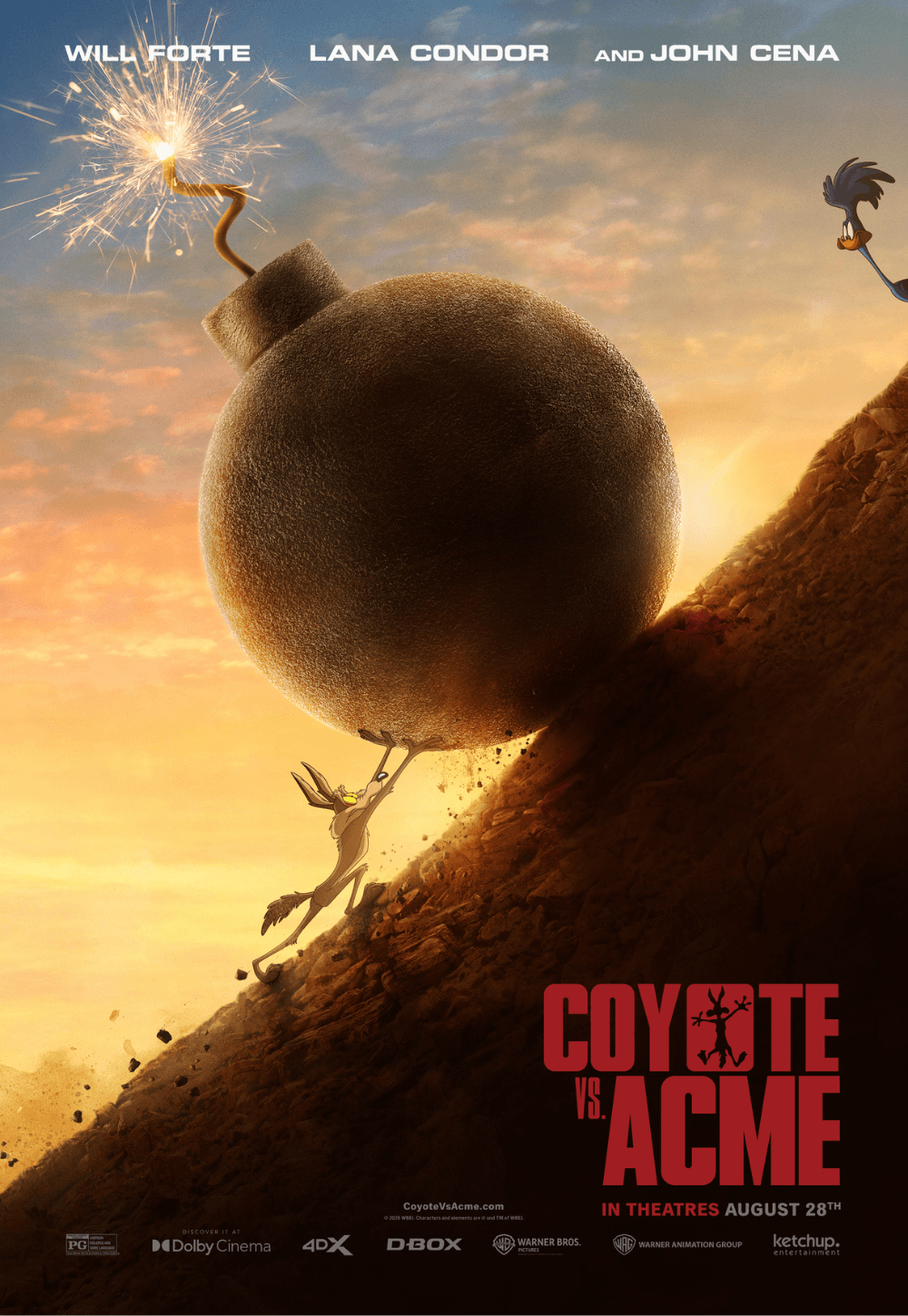
Originally developed at the studio as a streaming original for HBO Max, the movie became another casualty of CEO and President David Zaslav’s attempts to save the company money (which, of course, doesn’t include reducing his personal $165 million compensation package). After producing the movie for around $70 million, the studio announced plans to shelve the project as a tax write-off in 2023. A year earlier, the studio canceled its release of Batgirl, starring Leslie Grace, Brendan Fraser, and Michael Keaton. That $90 million production had already completed principal photography when Zaslav’s studio announced its fate. Although fans decried both decisions, only Coyote vs. Acme was a finished film and even had a “funeral screening” at San Diego Comic-Con. After widespread enthusiasm at the screening and outcries online, the movie floundered until Ketchup Entertainment swooped in to save the day, paying $50 million for the distribution rights.
How fitting, ironic even, that Coyote vs. Acme still opens with the logo of its abandoning parent, Warner Bros. Discovery, and, at least on my digital screener at home, played with the watermark “Property of Ketchup Entertainment” across the screen. James Gunn, Jeremy Slater, and Samy Burch originated the story, and Burch wrote the script—before her excellent work on May December (2024) and Late Fame (2026). Fortunately, the movie is driven by strong storytelling, unlike the studio’s other offerings set in a world where humans and cartoons live side by side, such as the abortive Space Jam movies. Here, toons are reduced to second-class citizens just as they were in Who Framed Roger Rabbit. The movie opens with a conspiratorial prologue involving the cartoon Dr. Peter Lorre, a whistleblower at Acme who wants to expose a corporate cover-up involving faulty products tested on cartoons. Instead, he’s captured by Acme goons and imprisoned inside a cartoon hole.
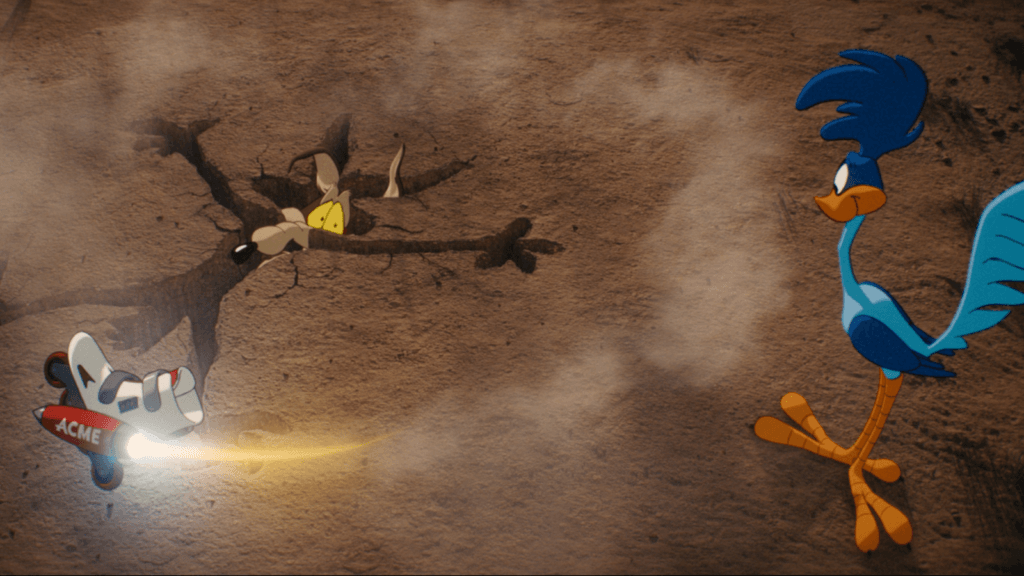
In Coyote vs. Acme, Acme is the biggest corporation in the world, run by Foghorn Leghorn, a Texas fat cat (or is it fat bird?). Acme makes a bit of everything, ranging from technology to beauty products to military weapons, and claims to be a company of “family values” in a promotional video of Acme fighter jets and missile explosions. Coyote has been buying Acme’s high-powered magnets, rocket skates, and explosives for years, since the first Wile E. Coyote and Road Runner cartoon in 1949. After decades of pursuing Road Runner, whose incessant “Beep Beep” has become the ultimate taunt, Coyote resolves to head into the nearby city of Albuquerque to find a lawyer. A few years earlier, he might’ve called Saul Goodman. Instead, he enlists the firm of Avery, Jones, and Maltese, presenting his massive list of malfunctioning Acme products as evidence of a systemic problem within the company.
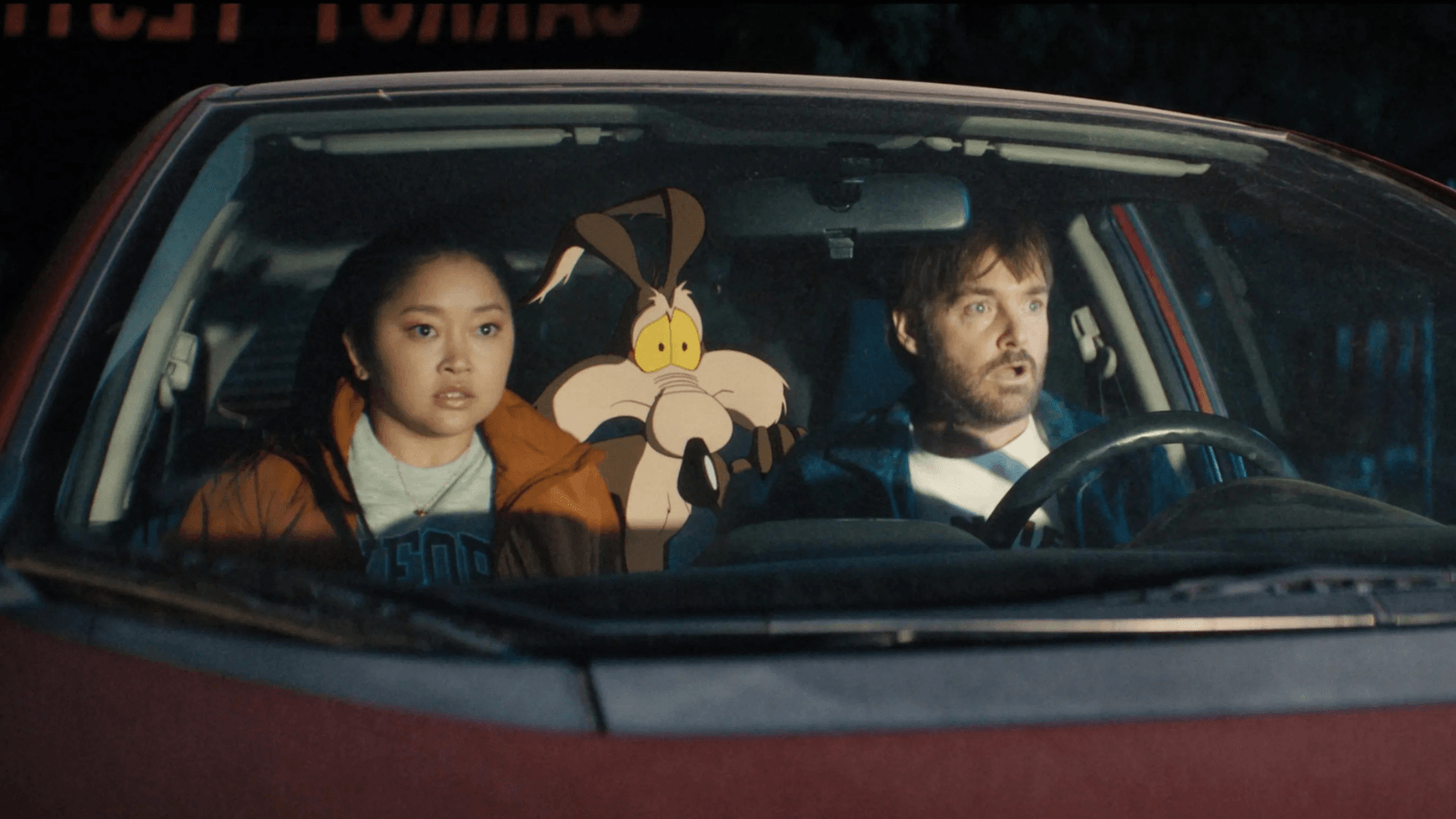
Coyote’s lawyer is Kevin Avery (Will Forte, a human cartoon), who has made a modest career of representing cartoons in small-scale lawsuits against Acme. Despite attending Harvard Law, he’s grown accustomed to settling to earn his clients a quick payday. But with Kevin’s niece Paige (Lana Condor) serving as an ambitious and morally upright intern by their side, Kevin and Coyote try to find evidence of corporate malfeasance. Thanks to a Deep Throat-esque informant, whose carrot-crunching and “What’s up, doc?” refrain give his identity away, they uncover an elaborate scheme involving intimidation and a mysterious program called Project: Sisyphus (a pointed name, reminding us that fighting an all-powerful corporation is an uphill battle and requires doggedness). In the courtroom, Kevin faces his former law school peer, now Acme’s smarmy corporate counsel, Buddy Crane (John Cena), in another David-and-Goliath dynamic. Still, the movie never forgets that Coyote is a resolute carnivore bent on killing and eating a bird, though his futile pursuit deepens the characters. At one point, Kevin loses his cool and tells Coyote, “You’re never gonna catch [the Road Runner]!” The unexpected emotional gut-punch of that statement wounds Coyote and makes him achingly sympathetic.
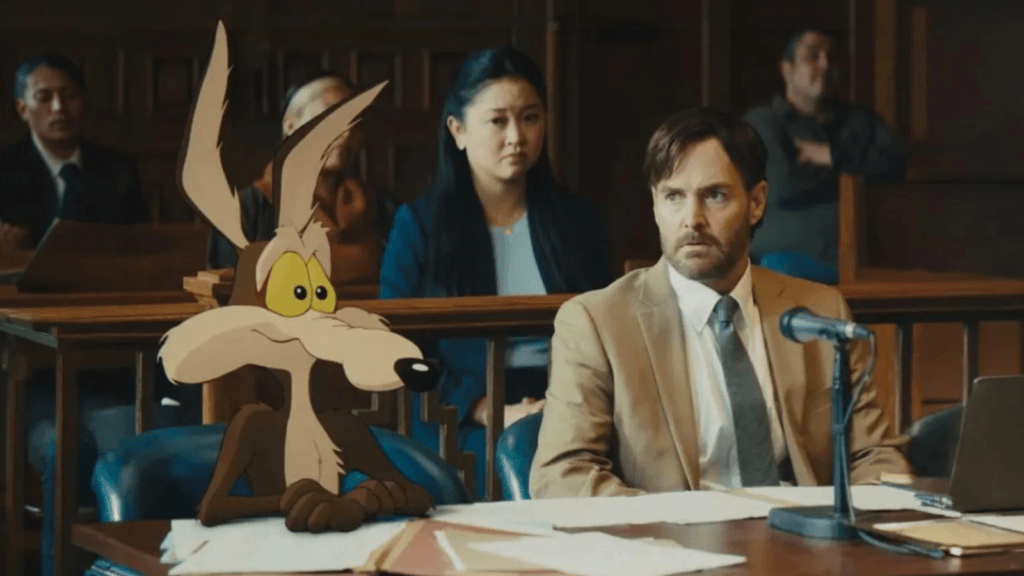
The original Wile E. Coyote and Road Runner cartoons ran about six to eight minutes as short films before a full-length feature presentation. They were only later compiled into half-hour blocks with other Looney Tunes shorts and shown on television. Given Coyote vs. Acme’s more than 100-minute runtime, it’s easy to wonder whether the movie could sustain the viewer’s interest and earn that length. I am pleased to report that the movie is never dull, never slows, and remains hilarious and visually inspired throughout. Green and company infuse most sequences with visual gags galore in a blink-and-you’ll-miss-it approach, with Steven Price’s beep-laden score alternating between charmingly upbeat and furtive when it’s building intrigue. A roster of Looney Tunes characters appears in charming cameos, often riffing on their history. Take Daffy Duck, who has gone, well, daffy from Acme testing products on him. The movie also features a detailed blend of two-dimensional animation, accented with the occasional touch of CGI for those moments when cartoon and reality collide.
Given the movie’s unthinkable journey to the screen, it’s a relief that Coyote vs. Acme deserves not only to be seen but also lauded. It’s funny, smart, and generally well-made. It’s easy to allow one’s imagination to get carried away and suspect that Zaslav screened the movie, recognized its messages about animal testing, corporate deceit, and profiteering, and saw himself in the antagonist’s role. It’s a movie that feels tailored to today’s audiences, who face daily failures in the justice system and unethical business practices. But it’s also a movie about fighting the good fight. And how, when the justice system fails, you should fight back for what’s right and not just settle for a quick payday. As with one of my favorite films, Terry Gilliam’s Brazil (1985), the rocky production history of Coyote vs. Acme curiously echoes the film’s themes. And like Gilliam’s film, Green’s comedy represents the rare example of an artist’s work emerging victorious after an attempt at corporate influence. That’s reason enough to see it. But it’s also, quite simply, a good time that kids and adults alike will enjoy.
Thank You for Supporting Independent Film Criticism
If the work on DFR has added something meaningful to your love of movies, please consider supporting it.
Here are a few ways to show your support: make a one-time donation, join DFR’s Patreon for access to exclusive writing, or show your support in other ways.
Your contribution helps keep this site running independently. However you choose to support the site, please know that it’s appreciated.
Thank you for reading, and for making this work possible.
Brian Eggert | Critic, Founder
Deep Focus Review