Bushido
By Brian Eggert |
(Note: Kazuya Shiraishi’s Bushido was released in Japan in May 2024. Film Movement has picked up the film for US distribution. Look for it in limited theatrical release on March 13, 2026.)
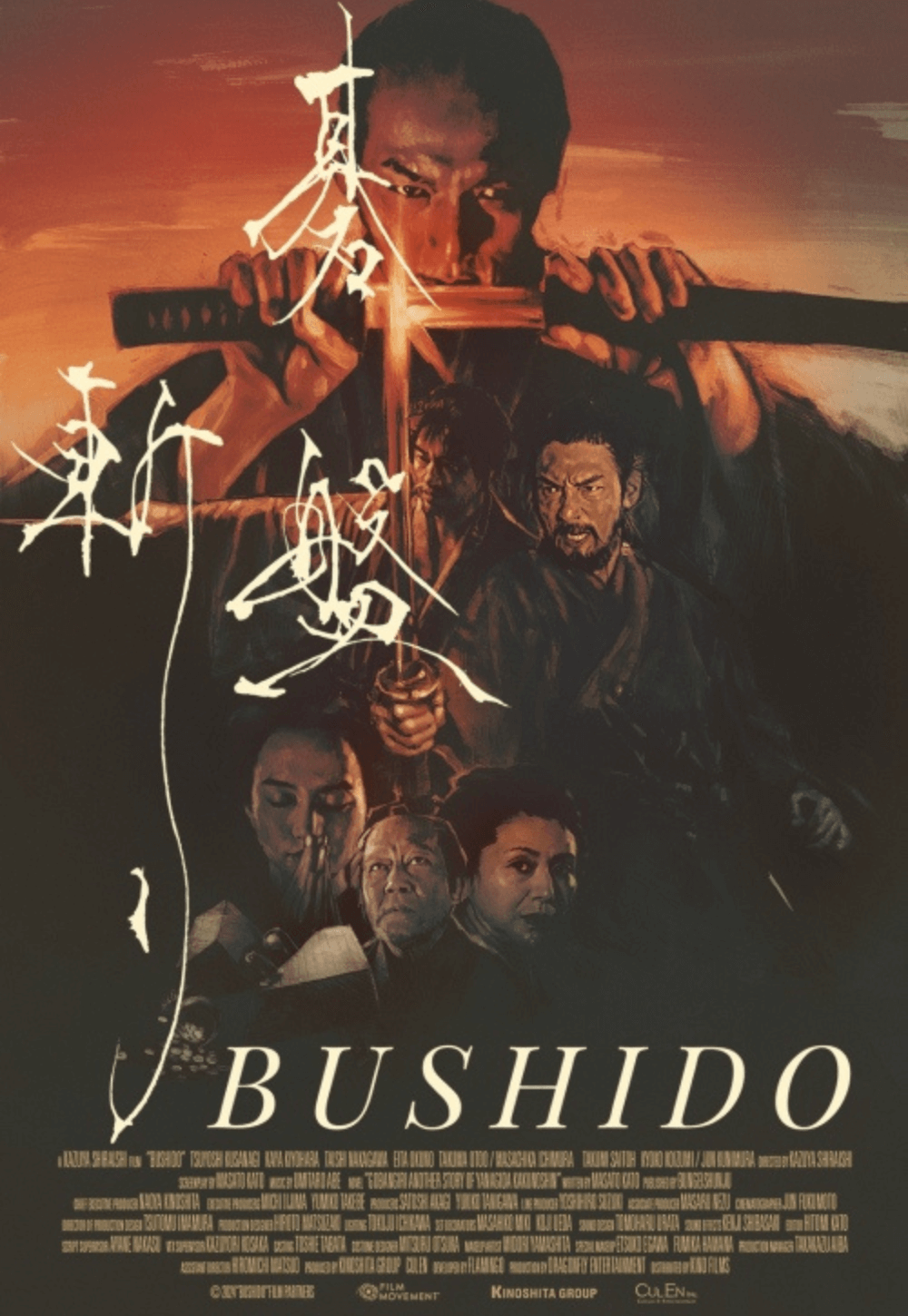
“This place may seem like paradise, but hell lurks in the shadows,” says Madame Okou, who operates a brothel. During the Edo period in Japan, the same sentiment applies to the samurai code, known as Bushido. A moral framework for these knight-like warriors, the book informs samurai on how to live a virtuous life, leaving little room for gray areas. Kazuya Shiraishi’s film Bushido is an elegant period drama that explores how the values of honor and loyalty imparted by the code can become a trap. What seems like an absolute moral system needs only someone willing to know and exploit its rules in an unseemly manner. Whereas many Japanese samurai films aggrandize samurai honor, Shiraishi’s film sees its potential as both a noble way of life and an inescapable prison.
Masato Kato based his screenplay on a classic rakugo performance, in which a single raconteur tells a story while seated on a straw mat, using only a paper fan and a hand towel to punctuate his comic tale. Bushido is no comedy, however; it has more in common with the stark cinema of Masaki Kobayashi, who regularly questioned Japan’s institutions and belief systems. See Harakiri (1962) and Samurai Rebellion (1967). For Kobayashi, codes and politics often failed to adequately support the nuances of human beings, who suffer as a result. For Shiraishi, director of The Blood of Wolves (2018) and its sequel, the Way of the Warrior can supply a path to moral certainty and conviction; it can also cause a considerable toll when followed to the letter.
Case in point: Kakunoshin Yanagida (Tsuyoshi Kusanagi), a “vagrant samurai” who works as an engraver in Edo and owes several months of back rent. Yanagida spends much of his time playing Go, an ancient strategy board game involving black and white stones on a wooden grid, which he teaches to others. A local businessman nicknamed “Stingy Genbei” (Jun Kunimura) has been dominating opponents at the local gambling den. He asks Yanagida for a game and agrees to the samurai’s relatively small stakes: one ryō. Almost immediately, Genbei recognizes the elegiac quality to Yanagida’s gameplay. Genbei plays to win, employing a ruthless strategy. Yanagida plays “fair and square.” And merely being in Yanagida’s presence inspires Genbei to clean up his act, both in Go and in his business, and he thrives because of it.

But playing honestly can be dangerous when others refuse to play by the rules. Five years ago, another samurai named Shibata (Takumi Saitô) made a false accusation that Yanagida stole a valuable Tan’yū scroll from his former master. Rather than defend himself without proof, which might lead to dishonor, Yanagida left his post and moved to Edo with his daughter, Okinu (Kaya Kiyohara). Shibata later forced himself on Yanagida’s wife, who then drowned herself in shame. Bushido follows Yanagida as he navigates another false accusation—this one from Genbei, claiming he stole 50 ryō—and attempts to restore his honor. Though he initially plans to kill himself by committing ritual suicide, his daughter stops him and resolves to become a geisha to get the money back and restore his honor. This leaves Yanagida with a short timeframe to clear his name and buy out Okinu’s contract with Madame Okou.
Shiraishi’s direction is patient and measured. He’s in no rush to get to the swordplay, which doesn’t arrive until the last 20 minutes of this 129-minute feature. He builds tension and motivation through smoldering sequences where the conflict lies just beneath the surface. In such scenes, Kusanagi performs Yanagida with the exterior calm of a master samurai—the rare sort, where no amount of poverty or personal tragedy can cause him to sacrifice his honor. Shiraishi and cinematographer Jun Fukumoto shoot this jidaigeki in a beautiful, soft-filtered perspective, as if looking at the past through halcyon light. Several scenes are augmented by a mild digital glow, whereas the flashbacks to Yanagida’s past look highly saturated and worn, as though shot on 16 mm. Underneath the images is composer Umitarô Abe’s light score, with a tone ranging from mischievous to classical.
Yanagida’s philosophy toward his opponents in Go extends to those he faces in combat. One tactic is called “Under the Stones,” where the player overtakes an opponent’s stones by tricking them into thinking they’re in control of the offensive. As the attacker is confident of their victory, it soon becomes apparent that what appears to be a defensive strategy is actually a longer offensive technique. When Yanagida duels with his enemy, he often fights without touching his sword, bobbing and weaving to avoid Shibata’s blade, which wears out his opponent. Although we could learn much from Yanagida’s worldview, his views can seem self-righteous and hurt those around him. Still, Bushido is about how, when people act honorably, it inspires others to do the same. We need more of that in our world.
Thank You for Supporting Independent Film Criticism
If the work on DFR has added something meaningful to your love of movies, please consider supporting it.
Here are a few ways to show your support: make a one-time donation, join DFR’s Patreon for access to exclusive writing, or show your support in other ways.
Your contribution helps keep this site running independently. However you choose to support the site, please know that it’s appreciated.
Thank you for reading, and for making this work possible.
Brian Eggert | Critic, Founder
Deep Focus Review