The Definitives
Sanjuro (1962)
Essay by Brian Eggert |
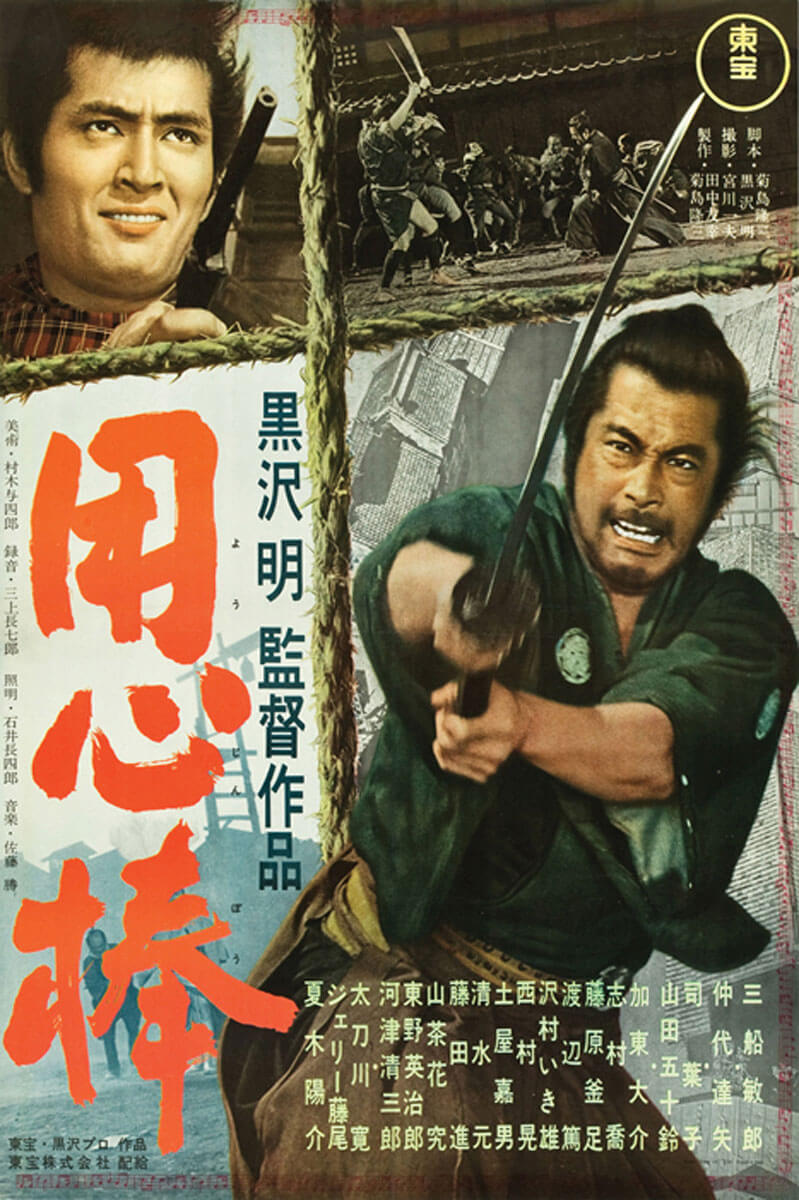
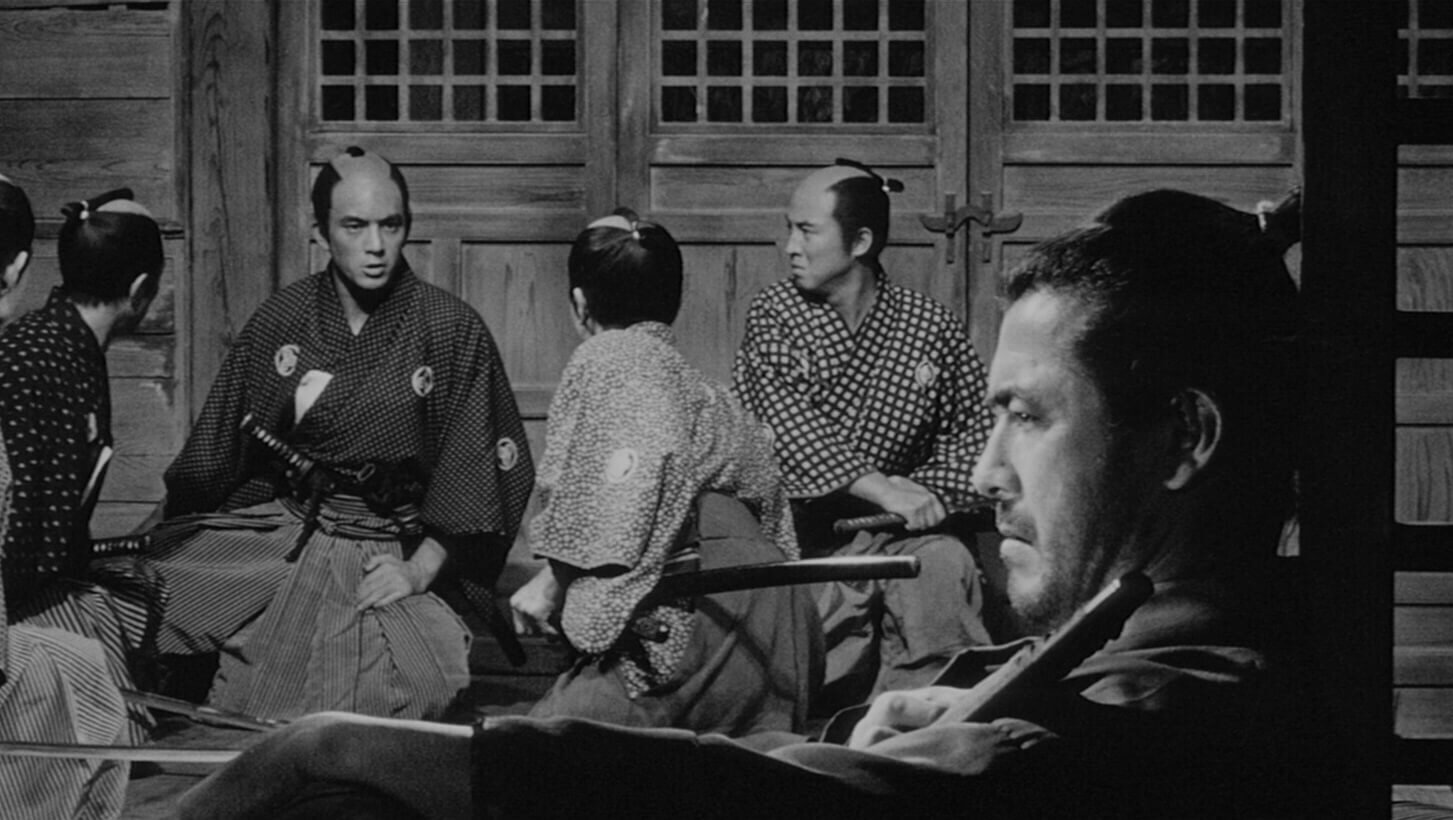
Answering for the violent thrills of Yojimbo, Akira Kurosawa’s sequel Sanjuro modifies its predecessor’s structure and, in a way, condemns its eponymous hero, reprised by Toshiro Mifune, by depicting his violent existence as a tarnished bushido ideal. Instead of sending up the swordfighting chambara genre as Mifune’s Sanjuro mows down gangs of grotesque, bumbling yakuza criminals, against which he appears superior and even righteous, Kurosawa places his unkempt ronin in the middle of a jidai-geki, a dramatic period piece wherein Mifune’s protagonist remains crafty and skilled in combat, but, shamefully, without nobility or willingness to restrain his violent instincts. Redefined through introspection and eventual feelings of disgrace about his lifestyle, Kurosawa’s Sanjuro becomes a tragic figure, his mythic stature marked—or soaked, rather—by the blood of his undisciplined existence.
Along with Ryuzo Kikushima and Hideo Oguni, Kurosawa adapted Sanjuro from the Shugoro Yamamoto novel Hibi Heian (A Break in the Tranquility) before shooting Yojimbo. Yamamoto’s tale, although similarly plotted in its broad strokes to Kurosawa’s eventual adaptation, features a samurai protagonist with less idiosyncrasy or skill than Sanjuro. Author of the source novels for Kurosawa’s upcoming pictures Red Beard and Dodes’ka-den, Yamamoto would be associated with Kurosawa for the rest of their careers. For this picture, Kurosawa intended for Hiromichi Horikawa to direct. Horikawa was a former assistant director to Kurosawa on Seven Samurai and Throne of Blood, among others, and had become a thriving director in the mid-1950s, with many chambara films in his output. Nevertheless, producers at Toho Company insisted that Kurosawa direct, given the popularity of Yojimbo under his headship.
Shooting began on Yojimbo in January 1961 and was completed on April 16. Because Kurosawa edited during production, the film was released four days later on April 20, 1961. And since Sanjuro required only minor rewriting to convert the earlier draft into a sequel to Yojimbo, production commenced on September 25, 1961, and ended December 20, with the finished film premiering January 1, 1962. The speed and artistic showmanship with which these films were shot, edited, and released are staggering, especially when taking into consideration the detail Kurosawa integrates into his pictures. The main setting—a chamberlain’s house and the pond in front, a separating wall with a compound on one side and the sanctuary house on the other—were built as open sets on Toho’s largest stage. Kurosawa oversaw every detail personally, from the vast layout down to the crucial look of the camellias on the trees, which the director insisted be handmade to ensure each one looked just right. At his prime, Kurosawa’s meticulous, even autocratic control over his productions fully justified his nickname: The Emperor.
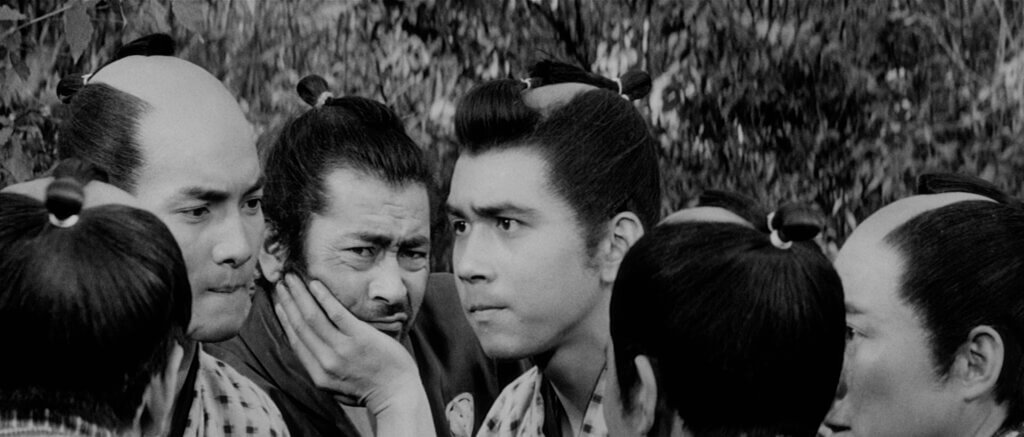
Sanjuro opens with nine young, incompetent samurai assembled in secret at a forest shrine. Their leader, Iori Izaka (Yuzo Kayama), has recently met with his uncle, the chamberlain, with whom Izaka lobbied to permit his fellow samurai to investigate signs of corruption. The chamberlain refused, which led Izaka to suspect the chamberlain was behind the corruption. And so, Izaka turned to the superintendent for advice; the superintendent agreed to help if they all met at the present forest shrine. All at once, Mifune’s Sanjuro yawns from the darkness, and casually steps out to offer his thoughts—that the superintendent is, in fact, the corrupt one and the chamberlain was merely being protective of his nephew. He even suspects the superintendent’s men will double-cross the young samurai at their planned meeting, which, as it turns out, takes place at the forest shrine. When Sanjuro learns this, he looks outside and confirms his suspicions are true, then hides the nine young samurai in the floorboards. The superintendent’s men call for surrender, and Sanjuro emerges, shouting about the noise and knocking several soldiers down. Believing Sanjuro’s deception, the soldiers’ leader, the idealized samurai warrior Muroto (Tatsuya Nakadai, who also played the gunslinger in Yojimbo), so bound to bushido, recognizes Sanjuro’s skill and offers him a job if he wants it.
Mifune’s introduction recalls the one from Yojimbo, where the ronin is asked his name, and in response, he reveals his first name, “Sanjuro [meaning thirty years old]… going on forty.” He then scans the area and settles on some nearby plantlife for his family name. In Yojimbo, he sees a mulberry field and responds “Kuwabatake [mulberry field],” and in Sanjuro, he replies “Tsubaki [camellia]”—an ironic yet apt choice given the camellia’s associations to the chamberlain’s wife and daughter later in the film. In this sequel, Mifune’s Sanjuro proves just as iconic as his performance in the preceding film, only streamlined to highlight those memorable character traits. Unless his sword is drawn, the actor’s arms rarely leave his kimono except to scratch his chin or itch his scalp; along with his character’s minimal dialogue, this places our focus on Mifune’s expressions, ripe with seemingly stoic confidence, interrupted by his anger and unease. Sanjuro’s disdain for the hopeless young samurai and his later discomfort around the chamberlain’s wife and daughter are always comical, making Mifune’s performance a subtly complex combination of characterized gestures and reserved emotions.
After the superintendent’s men depart the forest shrine, Sanjuro and the young samurai realize the chamberlain will probably be arrested or worse, as the superintendent has no doubt deduced that the chamberlain suspects him. They resolve to rescue the chamberlain’s wife and daughter (Takako Irie and Reiko Dan) first, before they too are taken. Contemptuous of the young samurai but impelled to assist (for some cash and food) because, as he tells them, they cannot take care of themselves, Sanjuro leads them to the chamberlain’s house, which is guarded by the superintendent’s men. Despite Sanjuro’s constant insults and berating tone, the young samurai follow his every word “like a centipede,” astonished by his skill. And, after convincing a servant to get the guards drunk, they quietly take out the sentries and move the women into a nearby barn. Here, Kurosawa pauses for a scene to establish Sanjuro’s lasting themes by differentiating the film’s protagonist from everyone else onscreen. The young samurai, the mannerly women, the dignified warriors serving an upper class—they each follow a particular decorum against which Sanjuro seems incongruous.
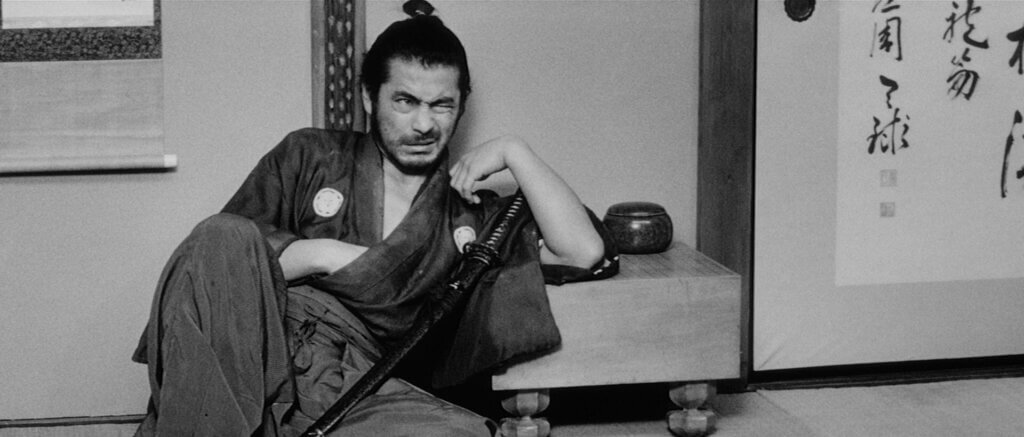
When the women first enter their own barn-turned-hideout, it is a place they have never been; they remark about the lovely smell of hay, the dreamlike quality one feels when resting back on a large mound of the stuff, and reveal their sophisticated obliviousness to the danger of the situation. Their ability to see so much good in the world amid all the bloodshed and unruly politics is not meant to make them appear ignorant; rather, they are elevated beyond such unnecessary concerns, achieving a paradoxical, nescient enlightenment. The chamberlain’s wife asks with polite interest about Sanjuro, and Izaka explains he is a friend. “I hesitate to say this after you so kindly saved us,” remarks the wife, “but killing people is a bad habit. You glisten too brightly… Like a drawn sword… You’re like a sword without a sheath. You cut well, but the best sword is kept in its sheath.” Sanjuro reacts uneasily to this, knowing the wife’s assessment is accurate, but perhaps unwilling to admit it to himself, yet. Sanjuro begins to feel ashamed of his status in the presence of these women’s refined sensibilities. With this, Kurosawa deepens the character throughout the course of the film, allowing Sanjuro to learn something about himself, his eventual victory bittersweet.
One of the young samurai suggests hiding in his house, and Sanjuro agrees, but their group quickly learns that the superintendent is keeping the chamberlain locked up next door, just over a compound wall. By the end, Sanjuro, who deceives his enemies by taking Muroto’s job offer to learn of the chamberlain’s exact location, calls the young samurai to rescue the chamberlain, using a downpour of camellias floating down a stream under the compound’s wall as an elegant signal to attack. With this, bloody violence begins to unfold, while on the other side of the wall, the chamberlain’s wife and daughter clap with enchantment at the beauty of the flowers on the water, a scene played both for humor and to emphasize the nonsensicality of violence against the simpler things in life—a message Sanjuro learns by the conclusion. With the chamberlain rescued, the young samurai realize Sanjuro has gone. They find him in a field, preparing to face off against the distinguished samurai Muroto, whose honor is shamed by Sanjuro’s deception. Muroto insists they duel. Sanjuro cuts down his opponent with incredible speed, and all of the young samurai, shocked, watch with enthusiasm. After a moment of silent awe, one of them declares the display “brilliant.”
The duel itself remains Sanjuro’s most memorable scene, not only because it concludes the film, but because it does so with such an unforgettable “bang”. Positioned face-to-face, Mifune and Nakadai, mirroring their final scene together in Yojimbo, stand off for a clocked 26 seconds of silence, an excruciatingly long period of suspense. The technician who controlled the pressurized pump to spray Muroto’s fake blood (a batch of chocolate syrup and carbonated water) from Nakadai’s torso worried that the effect would not please Kurosawa, and overcompensated by adding thirty pounds of pressure, so when the scene commenced filming, and Mifune cut with split-second speed, fake blood shot out like a geyser. The larger-than-life outcome, wholly staggering and uncharacteristic when compared to the violence in the rest of the film, pleased Kurosawa, as its exaggerated quality echoes the base thrill both the young samurai and the audience feel toward the spectacle, and how, even for a violent film, this last act of violence remains the ugliest and most horrible.
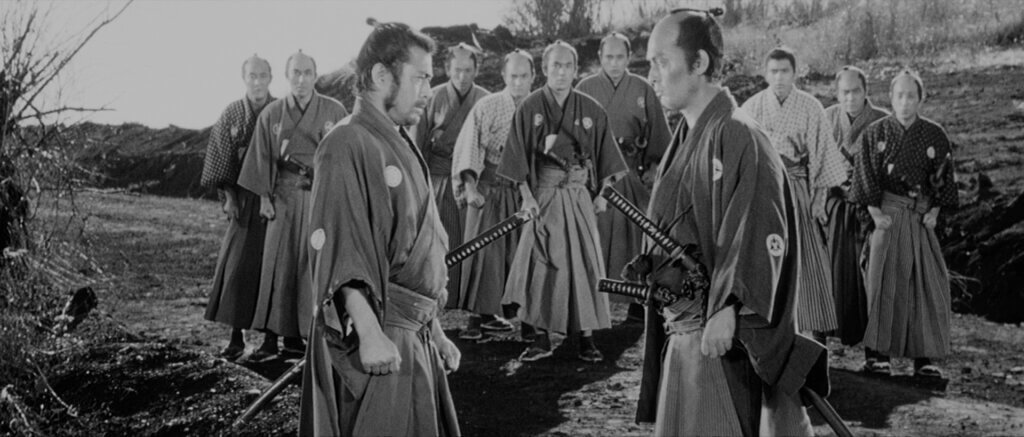
A moment later, Sanjuro, enraged by their response, scorns the young samurai for applauding such violence. “Idiots! What do you know about anything? …He was just like me. A drawn sword that wouldn’t stay in its sheath. But you know, the lady was right. The best sword is kept in its sheath. You’d better stay in yours.” Sanjuro begins to walk away and the young samurai follow. “Stop following me or I’ll kill you!” They pause, drop to their knees in honor of their master, confused and shamed by their own ignorance. Scratching, Sanjuro says curtly, “Abayo” or “Bye” and walks off, as composer Masaru Sato’s theme from Yojimbo sends the disillusioned hero on his way. Forced to cut down his opponent, Sanjuro has learned enough about himself to see a level of self-destruction in killing Muroto. Whereas Sanjuro walks away from Yojimbo unaffected by the violence he has caused, he is not so untouched by the end of this sequel.
With Sanjuro a deeper, more thoughtful hero than he was in Yojimbo, this conclusion does not come as a victory. Despite his attempts to instruct them, Sanjuro’s young students have learned nothing of honor, only the thrill of battle. They remain adolescents, swept up in the illusions of the typical jidai-geki, with all its heroics, courtly politics, and romanticized sword fights, and find themselves drawn by the rapidly unfolding plot. Meanwhile, Sanjuro finds the true meaning of bushido by the end, ironically from the words of an inexperienced, naïve but ultimately astute woman whose ideals are shaped by the strictest of Japanese formality. Whereas the young samurai cling to their chambara-inspired tales of swordplay and violence, Sanjuro realizes he has supplied their myth and feels guilty for his crimes, but ultimately reaches a higher plane of wisdom, aspiring to be more like the strict master swordsman from Seven Samurai.
Among Kurosawa’s most well-balanced films, Sanjuro resounds with equal parts artistic intent and sheer entertainment value—the quality of Kurosawa’s greatest works. An argument can be made that the sequel improves on its predecessor by adding a human dimension to the mythological anti-hero of Yojimbo, who, instead of descending upon a small village like a god to unleash retribution, is brought down to earth by the chamberlain’s wife’s humbling comments. An undefeatable presence between two pathetic yakuza gangs, Sanjuro stands out as a disheveled bum amid the white-collar setting of a jidai-geki, and because of this, he feels shame. Kurosawa redefines the character in his sequel, complicates his mythology, and avoids the typical sequel mistake of giving audiences more of a proven formula. An audience might walk away from Yojimbo and overlook the social implications, mistaking the picture for escapist entertainment void of commentary, but after Sanjuro, no one can deny the powerful message Kurosawa imparts.
Bibliography:
Galbraith IV, Stuart. The Emperor and the Wolf: The Lives and Films of Akira Kurosawa and Toshiro Mifune. Faber and Faber, 2002.
Kurosawa, Akira. Something Like An Autobiography. Random House, 1982.
Richie, Donald. The Films of Akira Kurosawa, Third Edition, Expanded and Updated. With additional material by Joan Mellen. University of California Press, 1996.
Richie, Donald; Schrader, Paul. A Hundred Years of Japanese Film: A Concise History, with a Selective Guide to DVDs and Videos. Kodansha International: Distributed in the U.S. by Kodansha America, 2005.
Like DFR? Support us.
This site exists because readers like you care about film. If DFR has enriched your experience with movies, I’d be grateful for your support. You have a few options:
• Join DFR’s Patreon community
• Make a one-time donation on PayPal
• Buy me a coffee
Whatever option you choose, it helps keep my work independent. And it means a lot to me.
Thank you for reading, and for making this work possible.
Brian Eggert | Critic, Founder
Deep Focus Review