The History of Concrete
By Brian Eggert |
When I first watched the documentary The History of Concrete, I didn’t know much about its director, John Wilson. I knew he had a show on HBO that I hadn’t yet seen, and that’s about it. I imagine many people who stumble upon this film won’t know about him either, unless they’re HBO subscribers interested in idiosyncratic docu-episodes that always seem to meander from comedy to profundity. When I put on his film, I was immediately charmed by his video-essay style, his clever visual metaphors that link image and voiceover, and, as I came to learn, his signature “Wow.” Somehow, his rambling, collage-like approach starts with him struggling to find inspiration between projects, then transforms into a philosophical look at impermanence and the cycle of rebirth. Intrigued, I quickly caught up with all three seasons of How To with John Wilson, which sounds like a lot. But it’s just 18 episodes, most under 30 minutes. Afterward, I returned to The History of Concrete for a second time, and a movie I already admired suddenly bloomed into the year’s best documentary. His deadpan look at our crumbling infrastructure becomes an unexpectedly moving meditation on impermanence—and a reminder that documentaries can be both informative and a source of personal expression.
A lifelong videophile, the 39-year-old filmmaker spent his adolescence making a short film every day. He got his professional career underway with a short film intended for a David Byrne tour (though it’s more concerned with two escaped convicts) and another about the Sundance Film Festival. He eventually met Nathan Fielder, whose approach to self-help television is just as hilarious, introspective, and sweepingly existential as Wilson’s work. Together, they developed Wilson’s show (Fielder is an executive producer). Episodes of How To with John Wilson have titles such as “How to Clean Your Ears” and “How to Throw Out Your Batteries,” where he starts with a simple objective but then roams around New York City to wherever his subjects take him. The second episode of the first season, “How to Put Up Scaffolding,” features Wilson investigating how and why so many local buildings need this unsightly support. He uncovers a lucrative scaffolding industry that depends on infrastructural degradation, often from old or inadequate concrete, to sustain itself.
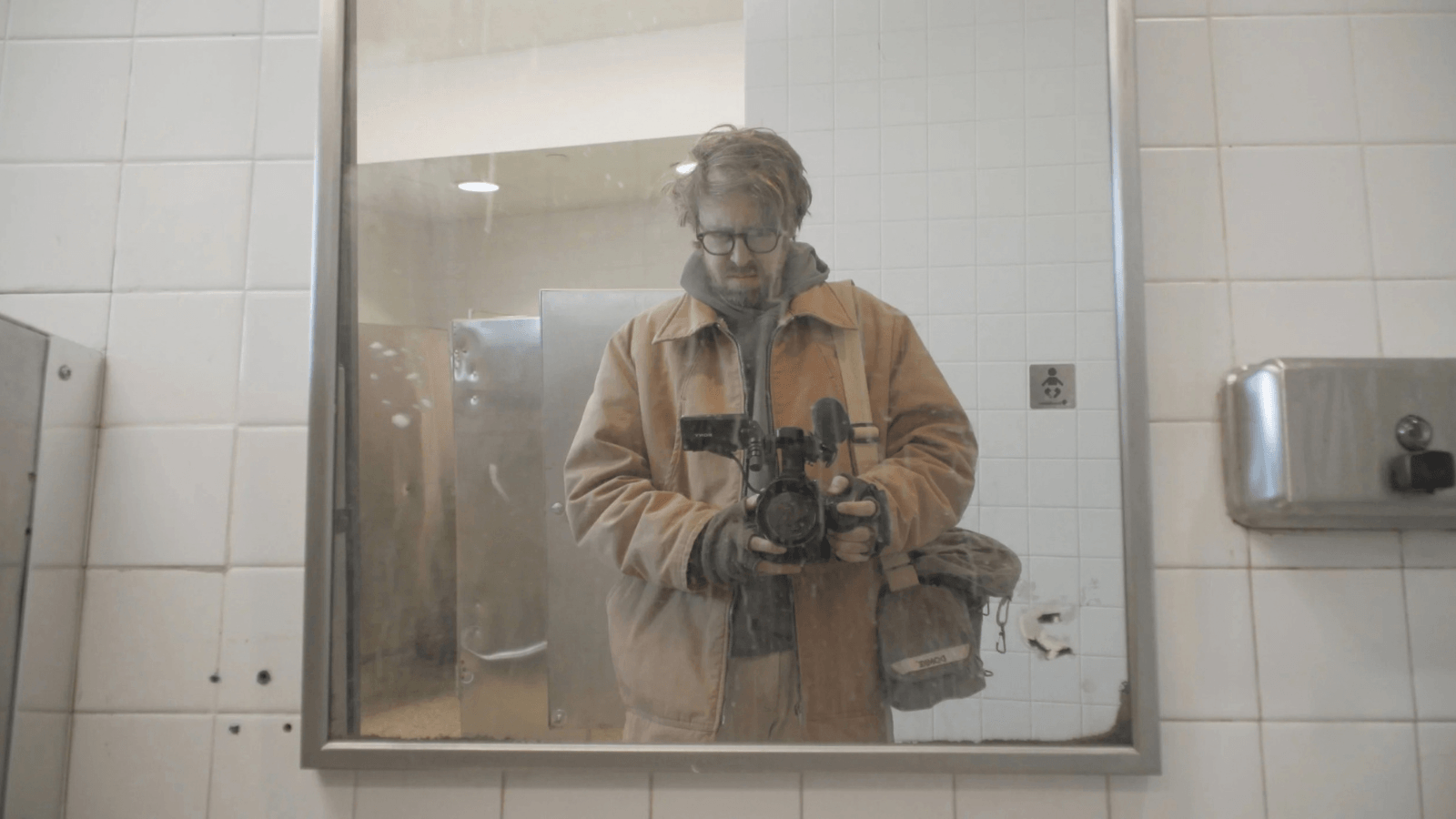
That episode may have been the impetus for his feature-length doc, which plays like a 101-minute episode of his show. He records with the same camera, narrates with the same dryly amusing tone, and assembles the footage into the same collage-like structure to find a curious connection between seemingly unconnected images. In what he calls “documenting without purpose,” Wilson goes out to record footage every day, usually with a handheld digital camera rather than a smartphone, which establishes a critical distance between the socially awkward documentarian and his subjects. When he starts a new episode or film, he begins with a title and goes from there, often chasing patterns and trusting his intuition about random details. Inspired by Robert Frank and other street photographers, Wilson looks for meaning in the banal and everyday. So when I say that The History of Concrete has an engaging “segment” on the chewing gum smashed into dark gray spots on the ground, I’m not being facetious.

The film opens with Wilson admitting that he’s been floundering after the end of his show, turning down commercial directing offers and searching for his next project. He explains that no one quite sees concrete history as attention-grabbing subject matter. Wilson told Jimmy Kimmel that he found a book online called The History of Concrete, and he worried that he might have to change his film’s title. But it contained nothing about concrete. The book was designed to look unappealing to thieves on the outside, while inside its pages are forms that store a user’s passwords. No one would really be interested in concrete’s history, the makers assume, so it’s the perfect disguise. However, Wilson makes the subject captivating and, in his unique way of stumbling upon meaning, staggering. He brings the viewer into the subject with a second-person autodiegetic voiceover; that means he talks about himself but uses the pronoun “you” instead of “I.” Here’s an example: “You have pitch meetings,” he says, “but you have trouble finding interested investors.” It subtly makes us feel like we’re in his shoes, where even passers-by question why he’s filming concrete. One New Yorker calls him an “amateur” for shooting at such a low angle.
The film has the same internet-rabbit-hole quality as Wilson’s show. He starts with a clear intention, gets randomly drawn into a sub-topic or two, and then remembers to return to his main topic. But Wilson’s talent is for making those sidequests feel like part of the bigger mission. As his royalty checks shrink, he searches for inspiration on how to make concrete appeal to viewers by attending a class on writing a Hallmark movie, then slyly adopts that formula for parts of his movie. Concrete is on his mind because he owns a rental property, and the basement apartment floods whenever it rains due to a cracked concrete foundation. The whole city is having the same problems, and worse. Some buildings and structures are literally falling apart, dropping large chunks onto the street below—hence the scaffolding everywhere. Yet, buildings from ancient Rome used concrete. Why are those still standing while New York, an infant city by comparison, is crumbling?
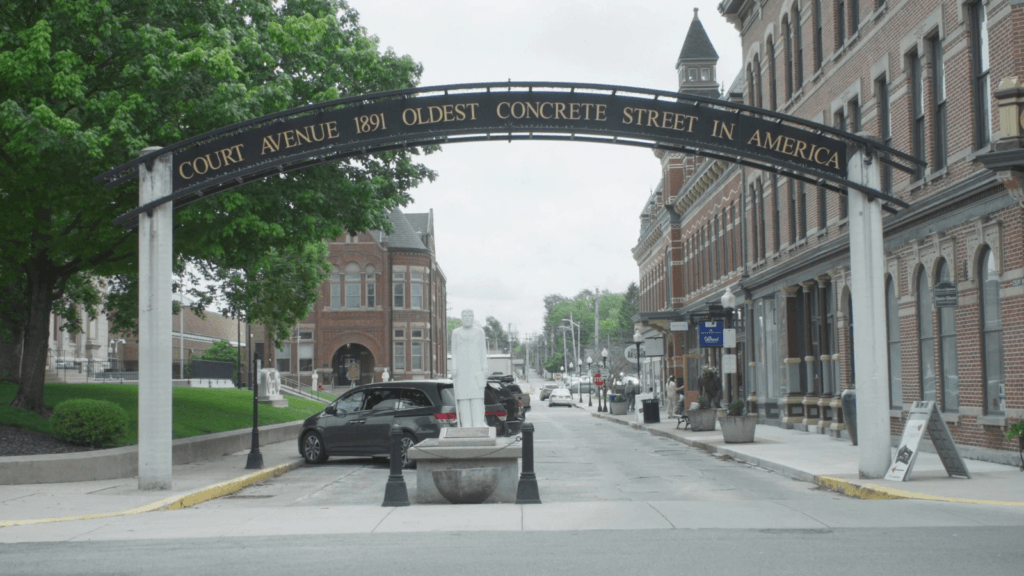
If nothing could feel more impersonal than concrete, Wilson’s approach makes the experience far more human. Sure, he includes some facts, noting that concrete differs from cement and contains a mix of cement, water, sand, and stone. A modern drive to make concrete cheaper by using subpar materials and corrosive steel rebars has reduced its service life to a few decades. It’s also the second-most-used material on the planet, with China as the world’s power-user given its rapid infrastructural development in the last quarter-century. Concrete is everywhere in New York, but after the city pours it, property owners must maintain it. This leads to lousy patch jobs and tree soil covered in concrete, preventing drainage. Exploring concrete’s origins in America, Wilson goes to Ohio to see the first US town to use concrete in 1891. There, he sees the state’s highest point (“I can’t believe it,” he says in his flat, riotously funny way). While in Ohio, he also discovers a company called Save My Ink Forever that removes and preserves the tattooed skin from loved ones who have passed. Somehow, Wilson leaves the viewer to notice that the company’s logo evokes Buffalo Bill from The Silence of the Lambs (1991).
Of course, many documentaries are about the making of the movie itself, especially when assembled by filmmakers who appear on camera, such as Werner Herzog or Louis Theroux. The History of Concrete finds Wilson disenchanted and losing confidence in his own project, mostly because no one but him thinks it’s a good idea, not even his friends. And he includes shots of pitch meetings where prospective producers want to develop and control his feature. But Wilson doesn’t want a creative committee; he wants funding. After a misunderstanding in which he describes his film with the punny genre description of “rockumentary,” he discovers his contract requires him to feature a notable musician. He finds two: one is a wannabe rocker who knows how to make lemonade from lemons; the other is a woman who lives near a concrete recycling plant that sends toxic levels of dust into the air. These characters come and go from his movie with tangential intent, always working their way back to the point. Wilson, who operates the camera himself and edits alongside Cori Wapnowska, often uses the Kuleshov effect—juxtaposing images to create meaning with ironic humor and visual gags.
The History of Concrete never feels like your average Netflix-brand exposé, filled with animated graphics and talking heads. Wilson’s approach is personal and even poetic, especially in the sillier moments. One of the film’s most unexpected asides involves the gum people spit onto sidewalks. “Gum is like the bird shit of people,” Wilson says. A company called Gum Busters (“That gum is busted!”) can remove the hardened flat dots left on the concrete. But the gum becomes a metaphor for the problem on Wilson’s mind: at drive-thru windows, drivers spit it out when they order, while passengers wait until the food-handover window. The point? People hold onto things until the last possible moment. This shows humanity’s lack of interest in the future, particularly regarding the disturbing consequences of so much building. Concrete’s carbon emissions are the third-highest contributor to global warming, and the widespread construction has led to alarming sand shortages. Big Sand and Big Concrete are billion-dollar industries, but their solutions aren’t sustainable, and they seem to willfully ignore that for the short-term success of their industry.
Dull as concrete may seem, there’s a certain beauty in its ephemerality that compels Wilson, and that’s fascinating to watch. He compares concrete to samsara, a concept found in many Eastern philosophies. Samsara holds that the only constant in the universe is impermanence. Even as his view of New York’s future borders on apocalyptic—with the city’s former traffic commissioner admitting he expects a concrete-related catastrophe in the next few years—Wilson yearns for people to embrace that nothing lasts forever. He suggests that, by waiting until it’s too late, we actively ignore the fleeting nature of what some call a “continuous surface.” Instead, humanity clings to a substance that creates the illusion of permanence and stability, ignoring the cyclical pattern of life, death, and rebirth. Alternating between droll and devastatingly grim, Wilson connects urban planning and historical construction to his career, how he went from running a show he stopped after three seasons to completing his first documentary feature. The film’s genius lies in how he arrives at the notion that things aren’t meant to last. This too shall pass, and “this” includes concrete. No matter what we think about the structural durability of concrete and other illusory constants in our lives, the world is ever-changing. Wilson’s thoughtful perspective is that the sooner we accept this, the happier and better equipped we will be for life’s uncertainties.
Thank You for Supporting Independent Film Criticism
If the work on DFR has added something meaningful to your love of movies, please consider supporting it.
Here are a few ways to show your support: make a one-time donation, join DFR’s Patreon for access to exclusive writing, or show your support in other ways.
Your contribution helps keep this site running independently. However you choose to support the site, please know that it’s appreciated.
Thank you for reading, and for making this work possible.
Brian Eggert | Critic, Founder
Deep Focus Review