In the Hand of Dante
By Brian Eggert |
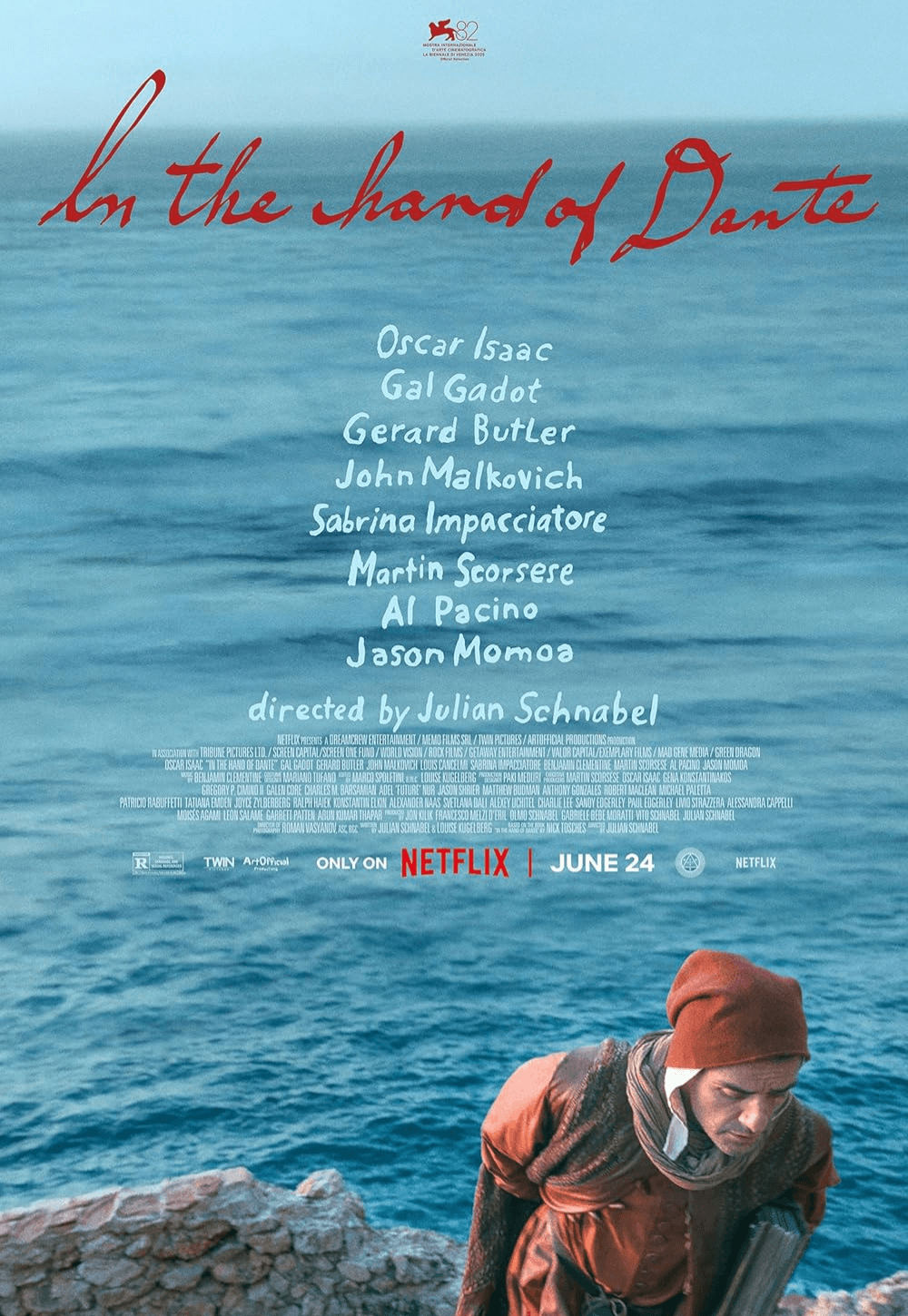
Ruminative and indulgent, Julian Schnabel’s In the Hand of Dante boasts inspired moments that become lost in its otherwise rambling structure. Loaded with flashbacks within flashbacks (within flashbacks) and expressive flourishes, the film is somehow more cohesive than the 2002 Nick Tosches novel that co-writers Schnabel and Louise Kugelberg adapted here. Tosches’ book includes random asides and essays about everything from the grim state of modern art to the dying publishing industry. Schnabel’s film at least maintains Tosches’ dual narrative, with a punchy crime story set in 2001 that follows a fictionalized version of Tosches, and another section, flighty and spiritual, set in the early 1300s, about the spiritual awakening that led Dante Alighieri to write the Divine Comedy. Although marvelously shot, the film’s narrative meanders, which is no artistic crime. But its ponderings and commentary on the evolution of art and commerce over human history, however resonant in the Age of AI, are insufficiently humanized by its lackluster love story. After premiering at the 82nd Venice International Film Festival last fall, it arrives on Netflix with almost no buzz whatsoever.
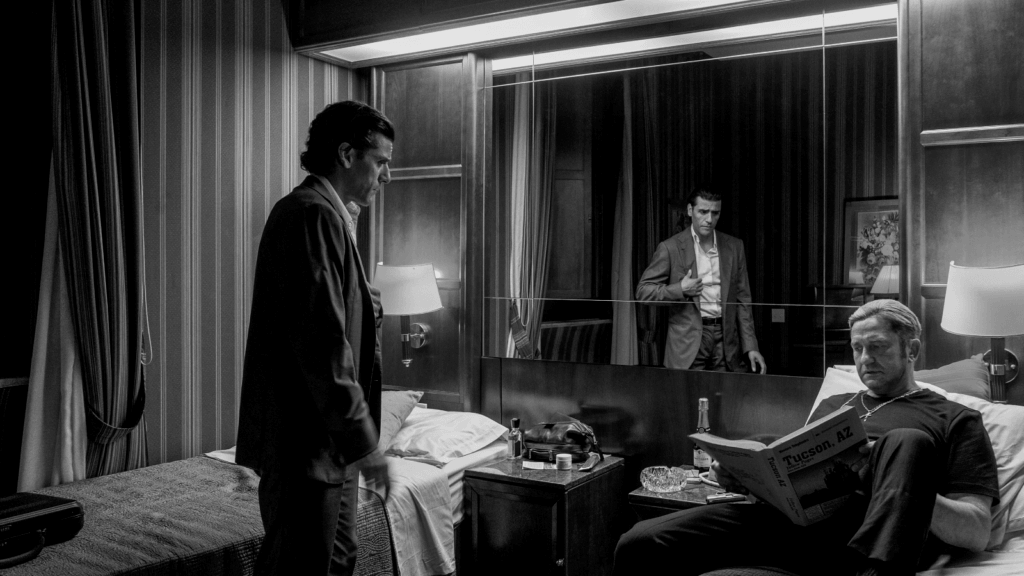
The first half-hour (with two more hours to go) zigzags through time in an array of episodic subplots designed to establish backstories and motivations. In 1969, the adolescent Nick takes advice from his Uncle Carmine, played by Al Pacino, who advises the boy not to take any malarkey from anyone in a shockingly subtle single-scene performance. When Nick admits to Carmine that he just killed another boy, his uncle tells him not to confess to a priest. Nick’s sins are between him and God. That sort of compartmentalization informs Nick later in life, in 2001, when Oscar Isaac plays him. A published writer soured by a recent tragedy that befell his estranged daughter, Nick is enlisted by New York gangster Joe Black (John Malkovich) to recover a priceless original copy of the Divine Comedy from a mafioso, Don Lecco (Franco Nero), in Italy. Joining him is Louie, played by Gerard Butler, who proves he’s a better character actor than a leading man. Louie is a swaggering, ridiculously coifed, yet amusingly ruthless enforcer. After acquiring the book, which has somehow been kept secret from historians for centuries, Nick insists that Black must have the pages authenticated—at the same lab that carbon-dated the Dead Sea Scrolls—so they can earn the biggest possible payday at auction.
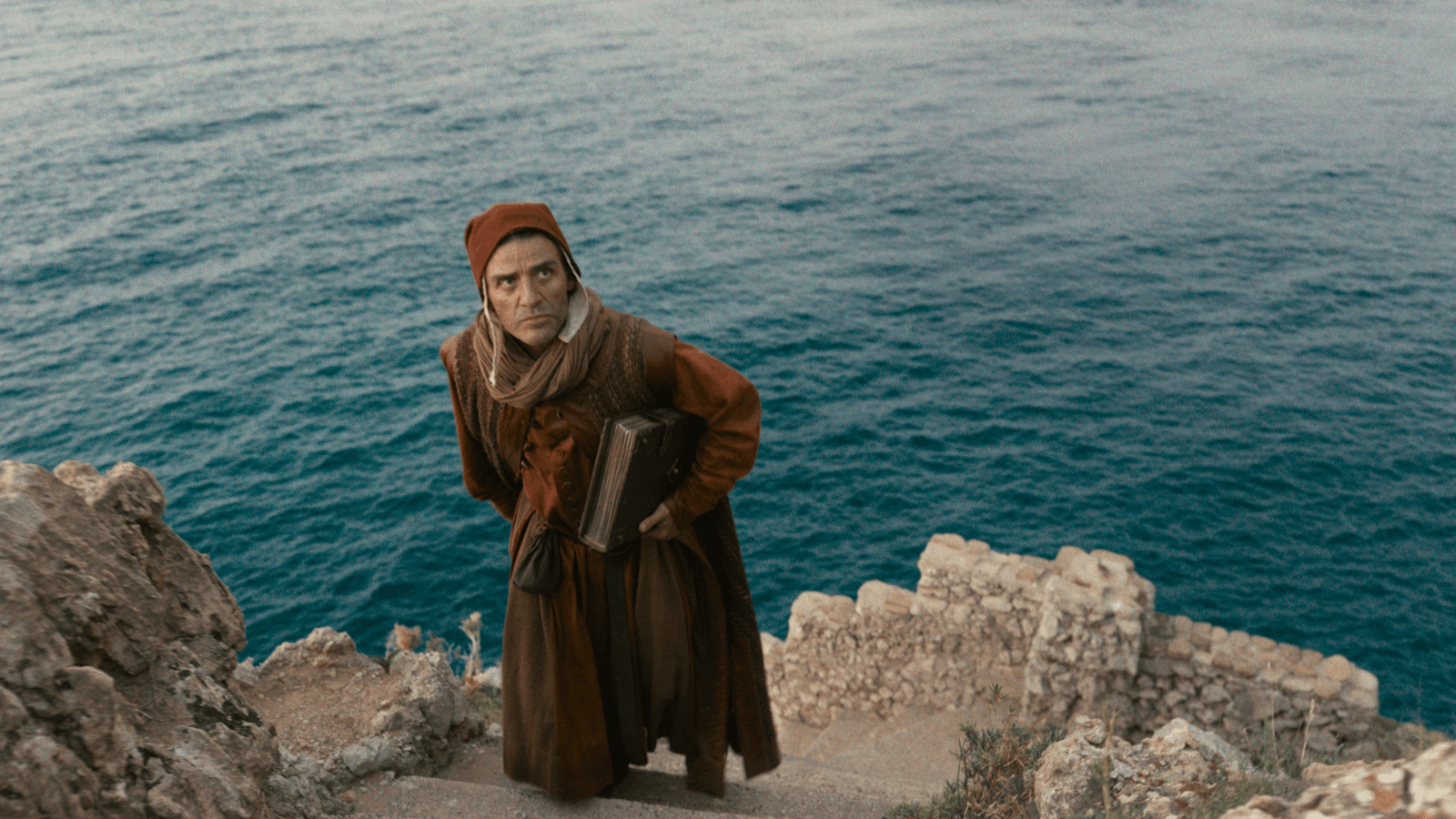
Periodically, Schnabel and his editors (Kugelberg and Marco Spoletini) transition to Florence in the 1300s, dwelling on nebulous scenes with Dante (Isaac again). Although In the Hand of Dante never quite justifies the temporal connection between Nick and Dante story-wise, there’s some compelling stuff to see: Martin Scorsese lends his presence to a thoughtful Isaiah, Dante’s spiritual advisor of sorts. Butler also has a second role as Pope Boniface VIII, though he can’t disguise his Scottish accent enough to pull off the Italian character. Isaac’s choice to play Dante with a vaguely British accent is also confusing. But it’s no less confounding than Netflix’s choice to force English subtitles during the fourteenth-century scenes, apparently to clarify the heavily accented but always intelligible dialogue. In any case, the Dante story comes across as directionless and less urgent than the twenty-first-century caper scenes. The earlier scenes feel listless because the vague, metaphysical connections between the two plots never congeal into an overarching narrative.
This is surprising from a director whose work I’ve enjoyed in the past. Schnabel began his career as a renowned painter before turning to film. His debut feature, Basquiat (1996), about the short-lived neo-expressionist from Brooklyn, was a powerful look at a complex artist (Jeffrey Wright, in his breakout role) who was chewed up and spit out by the art market. The same is true of his most recent effort, At Eternity’s Gate (2018), a more conventional biopic about Willem Dafoe’s Vincent van Gogh. In the Hand of Dante lacks cohesion and proves less conceptually realized than the director’s previous films; it’s also missing the emotional resonance of his best film, The Diving Bell and the Butterfly (2007). But Schnabel and cinematographer Roman Vasyanov create some beautiful imagery. The Nick Tosches scenes appear in crisp black-and-white widescreen, whereas the Dante scenes unfold in vivid color, albeit narrowed by the Academy ratio. Both feature wide angles and roaming, Malickian camera movements. Interspersed through these sections are poetic passages of luminous clouds and blooming flowers, as well as a microscopic look at a virus that nearly claims Dante, only for him to recover and begin writing.
Try as the film might to tell two linked stories, its biggest downfall is the half-baked, time-spanning love between Dante and his wife Gemma Donati, mirrored by the romance between Nick and his new assistant, Giulietta. Gal Gadot plays opposite Isaac as his soulmate, and her flat acting receives no help from her two underwritten roles. Gadot doesn’t have the range to make either part convincing. Gemma is mostly an afterthought, while Nick’s intense but inadequately developed passion for Giulietta drives him. To live with her happily ever after, Nick double-crosses his employers and tries to escape with the original manuscript. But while trying to sell Dante’s pages, Nick and Giulietta find themselves pursued by a vengeful gangster, Rosario, played by Jason Momoa. His Italian “a-lika-da” accent is comically bad. However, Schnabel includes scenes of Nick on a beach in Bora Bora in 2011, reading from his journal. Given that the audience knows he survives Rosario, these scenes neutralize much of the tension.
Also underemphasized is how In the Hand of Dante examines shifting perspectives on art. The scenes with Dante consider the personal side of artistic creation, inspired by perceived divine influence or personal passion. Nick’s world sharply contrasts Dante’s—he operates in a crass, ruthless market that ignores the soul and meaning of art, treating it as a commodity to be bought and sold for considerable profit and displayed as a marker of wealth. Over the course of human history, the commodification of art has escalated since the emergence of a feverish art market in the mid-twentieth century. Now, pieces sell for tens of millions (even Schnabel has sold seven-figure paintings). Take the scene in Black’s office, where the gangster displays an original Rembrandt self-portrait—not because he loves the painter, but because it’s a status symbol. Still, the film downplays that, centuries ago, the capitalist component of art was not an overarching drive, even though art has always been a commodity. The masters from Giotto to Michelangelo to Rembrandt needed patrons and commissions to survive, and their works often hung in the wealthiest homes and institutions—not museums.
Somewhere in this footage is a film that better underscores these ideas; however, I see no evidence of an adequate love story on either timeline. Maybe that footage lies on the cutting room floor. Maybe it was never shot. Despite a considerable list of deficiencies, Schnabel’s film has its moments and often looks stunning. Isaac is always compelling to watch. And Butler is engaging in the film’s showiest, most entertaining role. Every scene he’s not in (the entire second half) feels muted by comparison. The talented people in front of and behind the camera notwithstanding, the material is thoughtful and skillfully composed technically, yet emotionally inaccessible. When Nick resolves to leave behind “artful whoredom” to live a quiet life of solitude, it hardly feels like a victory in the way a philosophical act of rebellion against the art market should. Instead, the finale feels unearned and never as resonant as it might’ve been. Though admirable for its lofty thematic and aesthetic ambitions, In the Hand of Dante ultimately disappoints.
Thank You for Supporting Independent Film Criticism
If the work on DFR has added something meaningful to your love of movies, please consider supporting it.
Here are a few ways to show your support: make a one-time donation, join DFR’s Patreon for access to exclusive writing, or show your support in other ways.
Your contribution helps keep this site running independently. However you choose to support the site, please know that it’s appreciated.
Thank you for reading, and for making this work possible.
Brian Eggert | Critic, Founder
Deep Focus Review