Michael
By Brian Eggert |
Michael is the movie equivalent of a greatest hits album. A superficial look at the early career of Michael Jackson, this conventional biopic has less depth than his Wikipedia article, which at least includes a section on his scandals. But this movie avoids anything resembling an impartial portrait or challenging treatment of a celebrity who went from the most beloved pop star on the planet to a controversial and complex figure. Not even the considerable gloss and sparkle of Lionsgate’s $155-million puff piece can distract from its glaring biographical omissions and rose-colored perspective. The movie has been carefully manicured by Optimum Productions, the Jackson family’s company that oversees Michael’s estate and intellectual property, for maximum profitability and effortless viewership. Several of Michael’s siblings appear in the credits as executive producers (Janet never appears either onscreen or in the credits; she refused to be involved and has reportedly decried the resulting movie). Regardless, Michael will probably do quite well at the box office. People are ready to love Michael Jackson again. What they’re not prepared to do is think critically about him.
Though written by John Logan, who has tackled complicated subjects from Howard Hughes (The Aviator, 2004) to Thomas Wolfe (Genius, 2016), Michael makes a tedious musician biopic. Bohemian Rhapsody (2018)—a clear influence here, right down to Mike Myers playing a record executive and a triumphant concert finish—looks nuanced by comparison. Michael is shown standing up to his abusive and domineering father, the sour-faced Joseph (Colman Domingo, behind grotesque prosthetics), and becoming an artist on his own terms. Meanwhile, Michael’s homelife looks like a breeding ground for neuroses, though Logan does not explore them—or more accurately, Optimum Productions would not let their cash cow look like anything but an angelic figure. There’s no chance of biographical honesty or narrative conflict besides the one with Joseph, nor even questions about Michael’s affinity for childish things. Michael remains an innocent and uncommonly talented man-boy who plays with children’s toys, collects zoo-animal “friends,” and dreams of flying away to Neverland. “I have to shine my light,” he says, a halo practically shimmering overhead, “to spread love, to heal.”
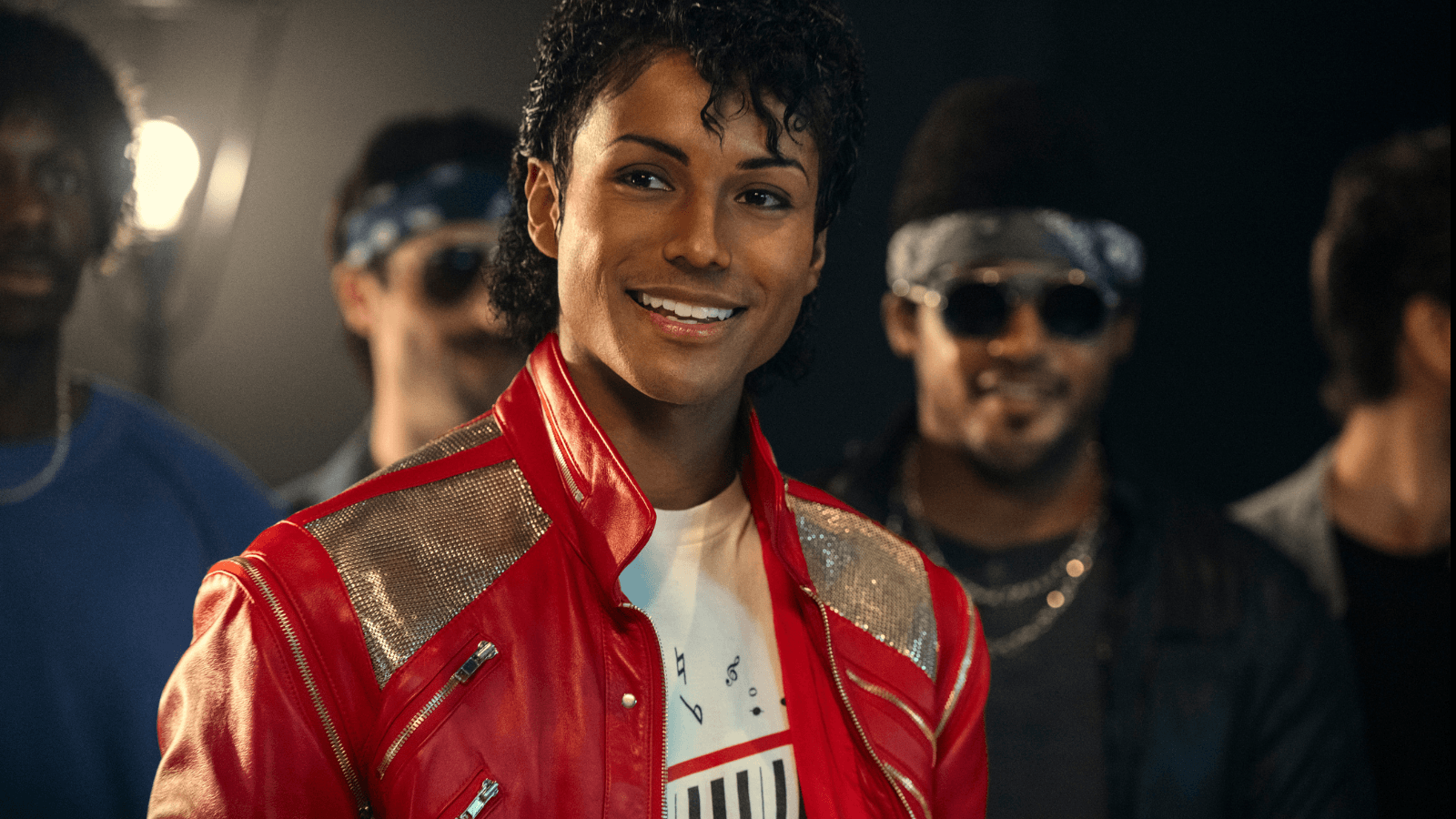
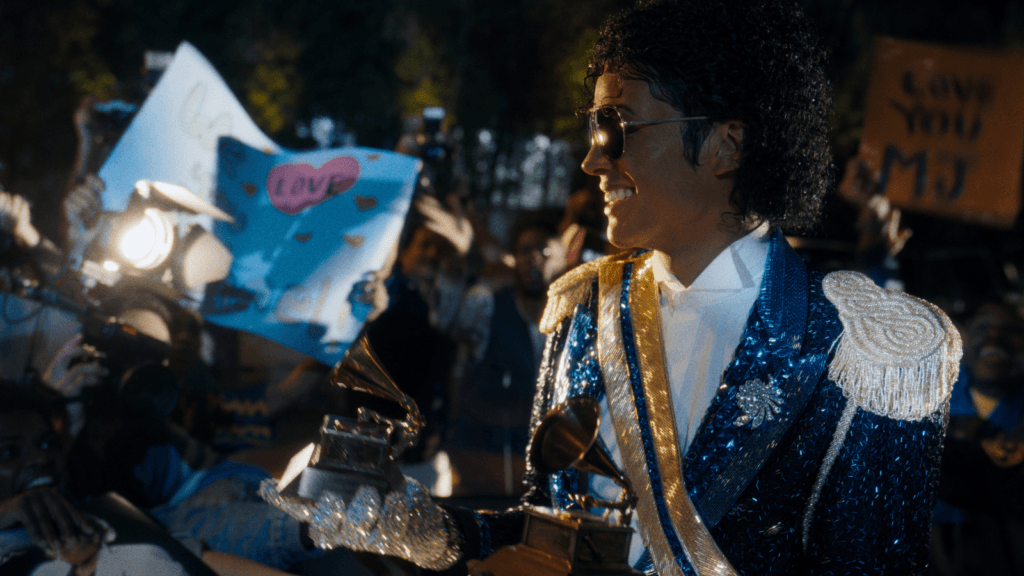
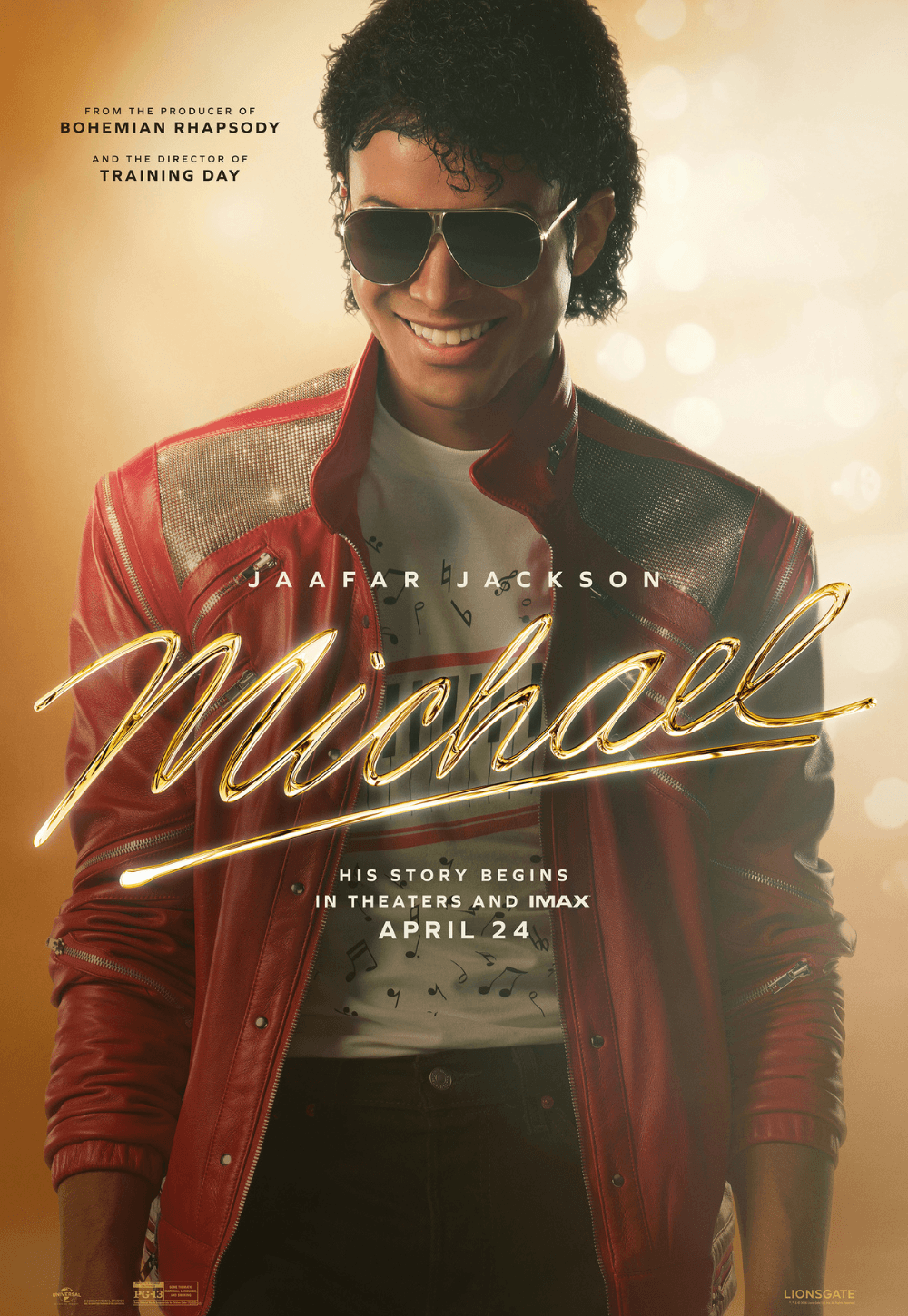
The story begins in Gary, Indiana, the Jackson family’s hometown. It’s 1960, and Joseph, a steelworker, develops his five sons into The Jackson 5, while his wife Katherine (Nia Long) watches, bearing silent witness to Joseph belting their most talented son. Juliano Krue Valdi is extraordinary as the young Michael, capturing the star’s voice and dance movements with uncanny accuracy. But Michael’s director, Antoine Fuqua, and his editors (John Ottman, Harry Yoon) race through the early years, touching on the band’s first tours, their deal with the Motown record label, and Michael’s first solo album in 1978 with Quincy Jones producing. Jaafar Jackson impersonates Michael as an adult behind a series of CGI-augmented noses, adding to the movie’s general surplus of strange-looking wigs, color contacts, and prosthetic features. He never quite disappears into the role. Technical distractions aside, the actor has captured Michael’s dancing and occasionally resembles the King of Pop in the faux concert footage, which recreates iconic moments from Michael’s life in a music-video style.
Fuqua’s film does not confront the musician’s evident arrested development or how his traumatic childhood literally reshaped him. It treats the adult Michael’s behavior—such as reading a children’s book version of Peter Pan well into adulthood, associating Joseph with Captain Hook, or befriending animals because they don’t want anything from him—as cute and normal, rather than painful and tragic. Likewise, rather than raise questions about his insecurities and body dysmorphia, it passively acknowledges that Michael’s interest in a narrow, upturned nose originated from his identification with Peter Pan—a sad reflection of his desire to escape his family life. The movie prefers to dwell on long concert sequences in stadiums filled with CGI crowds, to capitalize on the audience’s love of Michael’s early hits. It also features several scenes of Michael visiting sick children in the hospital to hand out toys and occasionally call a child a “doo-doo head.”
Alas, this isn’t what Logan’s script originally delivered. Variety reported that the screen story was supposed to begin in 1993, using Jackson’s child molestation charges as a framing device. In December of that year, a 13-year-old Jordan Chandler, who accompanied the pop star on his Dangerous tour and often shared his bed, accused Jackson of sexual abuse. The LAPD and the Santa Barbara County Sheriff’s Department photographed Jackson’s genitals, which Chandler described in some detail. A month later, Jackson paid $25 million to settle the case out of court. None of this, nor the 14-week trial that eventually acquitted Jackson of a separate child molestation charge in 2004, nor the many subsequent allegations after he died in 2009, are addressed by the film. The Jackson estate maintains the accusations are lies—and to be sure, nothing looks more innocent than paying $25 million and demanding an NDA to silence an accuser. All of this, including the new film, seems designed to protect Jackson’s reputation and ensure the continuing financial success of the Michael Jackson brand—an industry unto itself that, without Jackson’s unruly spending habits that offset revenue gains before his death in 2009, has since accumulated billions.
However unlikely, Jackson’s reputation seems poised for rehabilitation—even after Dan Reed’s chilling HBO documentary Leaving Neverland (2019) detailed the experiences of Wade Robson and James Safechuck, two men who accused Jackson of sexual abuse. In the post-#MeToo era, when victims’ voices have more power (but not as much as they should), it’s curious that the court of public opinion is now swaying in favor of Jackson. One suspects that fans have overlooked questions about his personal life to preserve their fandom, even as they ignore Jackson’s “special friendship” with children and the whole Neverland Ranch thing. The reasons that some entertainers continue to work (or profit from their earlier output) while others remain unemployable and “canceled” remain incidental and dependent on the public’s mood. Michael is proof of that. Suffice to say, it’s a confounding set of circumstances and further evidence that money buys power, and power buys silence. Case in point: The Jackson estate sued HBO over Leaving Neverland in 2024, claiming they had violated a non-disparagement clause they signed to air concert footage from the 1992 Dangerous tour. As a result, Leaving Neverland is not currently available to rent or stream in the US.
Michael’s narrative ends in 1984, after the release of Thriller and the Jacksons’ final “Victory Tour.” Then there’s a random coda in 1988, seemingly so the movie can cram in a performance of “Bad,” but it’s a strange postscript that omits how weird things had started to get in Michael’s career: see Captain EO (1986) and Moonwalker (1988). It ends before the accusations, before the most shocking changes in his appearance, before two chemistry-less marriages, and before he dangled his baby Blanket outside of a Berlin hotel balcony. Although Logan’s script originally included the molestation charges, Lionsgate and the producers resolved to pivot, scrapping that footage and spending upwards of $15 million on reshoots to rethink the film with a fluffier last third. The release date then shifted twice, from the original April 18, 2025, to more than a year later. This is despite producer Graham King’s remarks to Variety in 2024 that the film would “humanize but not sanitize and present the most compelling, unbiased story.” Whatever happened between then and now, Michael feels far removed from anything approaching a critical investigation into its subject.
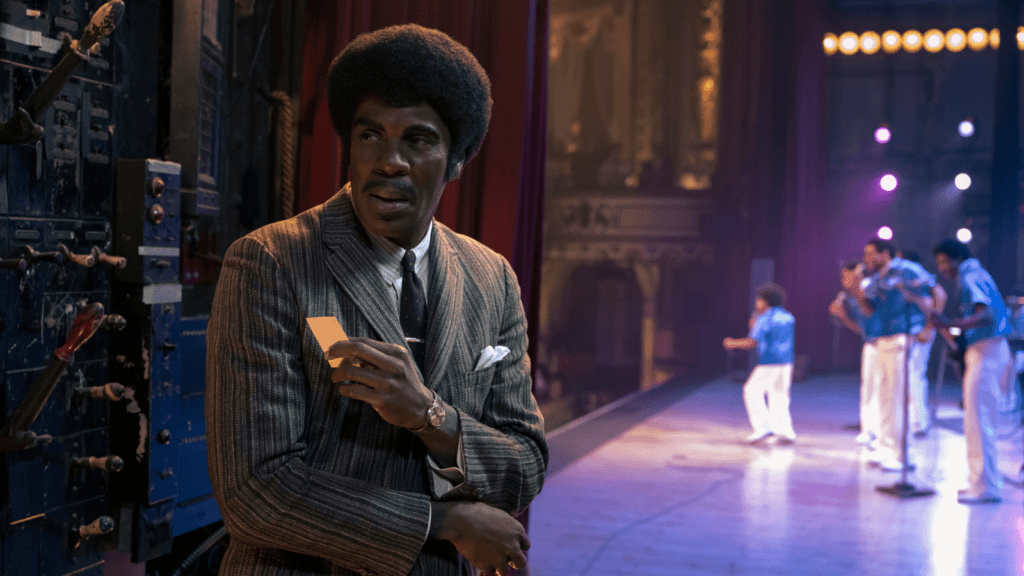
Several people involved in the production have remarked that they aimed to “let the audience decide” about how to judge the singer, but this is hardly balanced filmmaking. If they wanted to let us decide, they wouldn’t have stopped in 1984. But according to The Guardian, a lawyer for the Jackson Estate became involved in production decisions and took a hard line, refusing to allow anyone unsure of Michael’s innocence to be involved. By refusing to acknowledge potential ambiguities in the facts, Michael joins the increasingly common trend of musician biopics in which the performer’s estate has a voice in creative decisions. Biopics about Whitney Houston (I Wanna Dance with Somebody, 2022) and Amy Winehouse (Back to Black, 2024) sanitize the artists’ lives, overlooking personal downfalls that might prompt consumers to second-guess downloading a song or album. Michael also overlooks his relationships with his brothers and his tendency to seek out alternative father figures with producer Berry Gordy (Larenz Tate), manager John Branca (Miles Teller), and private security guard Bill Bray (KeiLyn Durrel Jones).
Fuqua, known as an action director of Training Day (2001) and the Equalizer series, does his best with a production that probably started as one movie and ended as something entirely different. There’s enough material about Jackson to produce an eight-hour miniseries, but Fuqua settles on montages to leap through Michael’s early life. Worse, Michael relies heavily on uneven VFX. The digital solution to thin out Jaafar Jackson’s nose looks better than Michael’s various pets, who all behave like carryovers from the abortive digital remake of The Lion King (2019). A llama endearingly closes its eyes when Michael hugs it, and the chimp, Bubbles, looks as though he might speak or lead an ape rebellion at any second. These vaguely anthropomorphized animals are today’s counterparts to the cartoon bluebird that lands on Snow White’s finger. The movie suggests this is how Michael sees the world, treating it as charmingly idiosyncratic rather than as evidence of deep-seated pain.
With Michael, it’s not a matter of separating the art from the artist. The movie outright ignores Michael Jackson’s complicated inner world and altogether omits any challenging questions about the allegations against him. The filmmakers have already separated the art from the artist by presenting moviegoers with a candy-coated version of him. It comes down to how the production frames his life. The only honest moment arrives when someone calls Michael a “one-man financial empire,” and this movie reflects that assessment. It’s more interested in showcasing the songs and the dance moves, which, admittedly, left my toes tapping and a sense of wonder over Jaafar Jackson’s moves. But as a movie that’s supposed to help us understand the King of Pop, it’s blindly worshipful and woefully inadequate and, by extension, underlines just how bizarre and fraught “the Michael Jackson story” remains.
Like DFR? Support us.
This site exists because readers like you care about film. If DFR has enriched your experience with movies, I’d be grateful for your support. You have a few options:
• Join DFR’s Patreon community
• Make a one-time donation on PayPal
• Buy me a coffee
Whatever option you choose, it helps keep my work independent. And it means a lot to me.
Thank you for reading, and for making this work possible.
Brian Eggert | Critic, Founder
Deep Focus Review