Reader's Choice
Sentimental Value
By Brian Eggert |
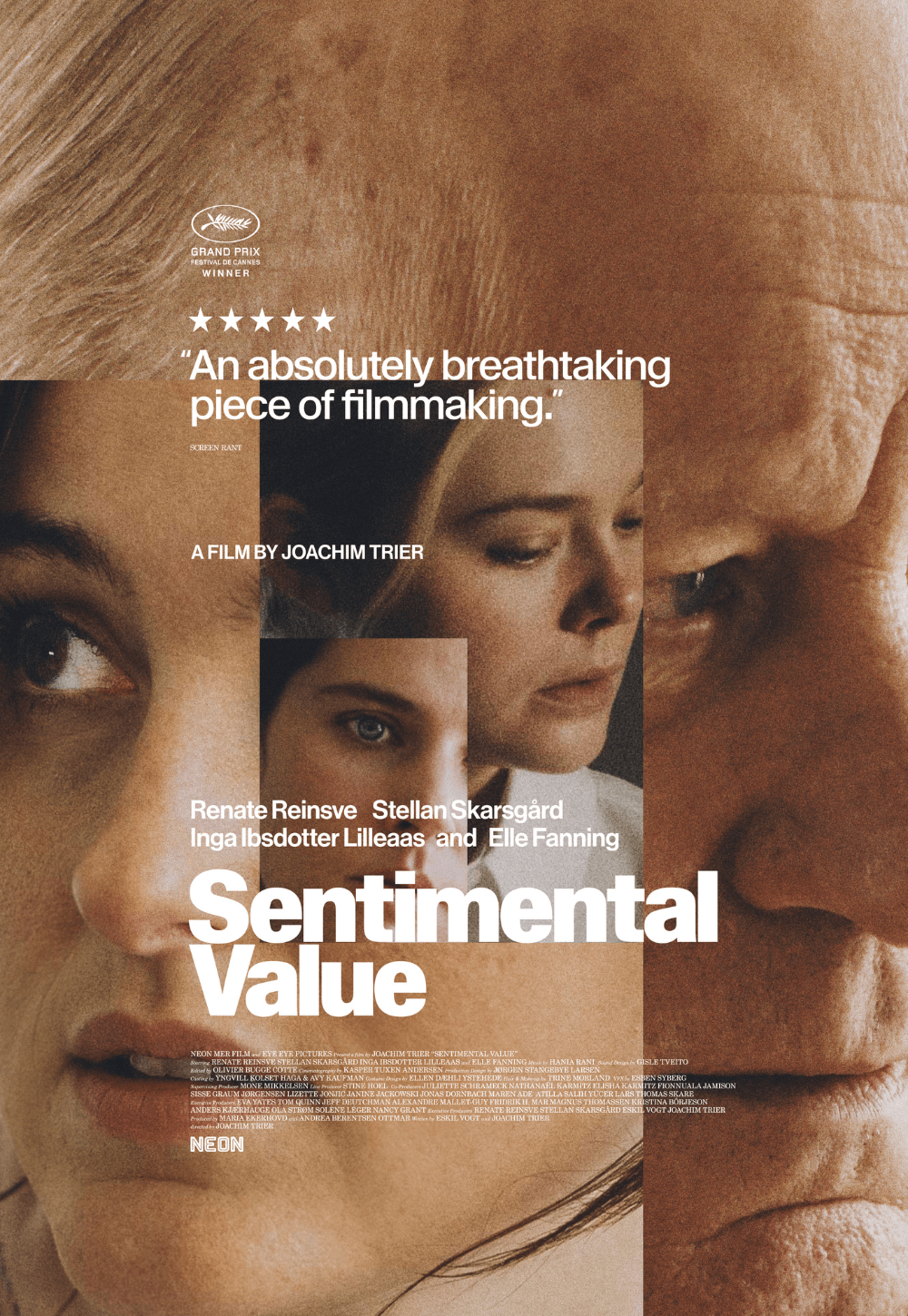
At the center of Joachim Trier’s Sentimental Value stands a house that has been in the Borg family for generations. As a child, Nora wrote about her home for a class essay, asking whether the house prefers to be empty or filled with her family. Do the cracks in its foundation cause the house pain, or are they like wrinkles on an aging face? Many generations of her family have been born and died there, often in the same rooms. The house brings to mind Ann Patchett’s The Dutch House, a 2019 finalist for the Pulitzer Prize for Fiction, which portrays a house as more than just a living space. It’s a metaphor for those who live inside, in the same way Trier’s film, and all great art, expresses emotion, evokes memories, witnesses trauma, and alludes to history beyond its form. With his latest, Trier—the Danish-Norwegian filmmaker whose previous film, The Worst Person in the World (2021), made a star of Renate Reinsve—crafts a film that encapsulates his brand of cinema and feels both organic and literary. He makes films so richly layered, terrifically acted, and thoughtfully shot that they prompt a frisson of viewing pleasure, along with long periods of post-viewing contemplation. This one is no exception.
Sentimental Value is about people who express themselves best through their art. They have trouble communicating honestly about their feelings, which they channel through other areas of their lives, both literal (the house) and figurative (their art). In this, Trier brings his tendency for novelistic portraiture to a family rather than, as in his other films, a single individual. Although the main character is Nora Borg, a stage actress wonderfully played by Reinsve, the film is about her family. Her estranged father, Gustav (Stellan Skarsgård), a renowned filmmaker who hasn’t made a feature film in fifteen years, and her married younger sister, Agnes (Inga Ibsdotter Lilleaas), also play central roles. Trier wrote the script with Eskil Vogt, the director’s collaborator since his earliest short films made a quarter-century ago. And like their Oslo trilogy—including Reprise (2006), Oslo, August 31st (2011), and The Worst Person in the World—the film’s interplay of theme, characters, and narrative offers an endless source of insight and emotion.
When the film opens, the mother of Nora and Agnes—Gustav’s ex-wife—has died. Nora has avoided her father for years, given his absence throughout her childhood. He always seemed to put his art before his family. But he returns, in part to take over the family house, where his children were raised and where his mother lived for most of her life. She was a World War II resistance fighter who was captured and survived torture by the Nazis, only to hang herself when Gustav was a seven-year-old boy. His ex-wife took the house in the divorce, but she never filed the paperwork to transfer it to her name, so legally, it belongs to him. Gustav hopes to shoot his next film there, and he wants Nora to star in the lead role. She refuses to read the screenplay, despising her father for his abandonment, even though, by all accounts, the script is a masterpiece—an autofictional account of his mother. But it also relates to Nora, who, similar to Gustav’s mother, attempted suicide recently.
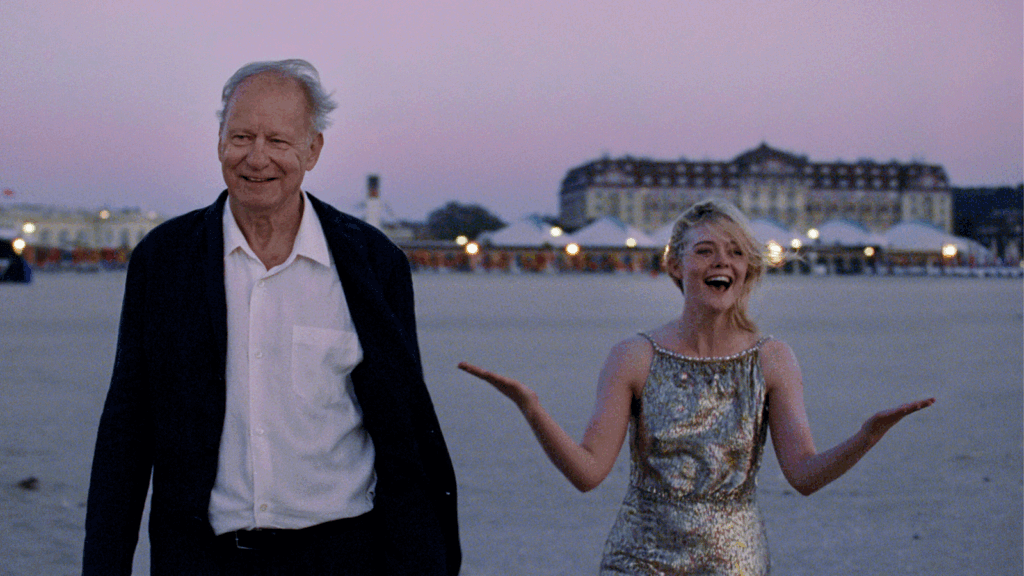
While casting Nora would certainly help secure Gustav’s financing for the picture, he does not pester his daughter to play the leading role. Instead, he attends the Deauville Film Festival, where a retrospective of his oeuvre coincides with a new documentary about his life and work. There, he meets Rachel Kemp (Elle Fanning), a Hollywood megastar who’s looking to escape banal IP-driven movies and work with a bona fide European auteur. (Let the comparisons to Olivier Assayas’ Clouds of Sils Maria begin.) While at the festival, a single scene glimpsed from Gustav’s filmography demonstrates that the praise of his former genius is not exaggerated. Films about directors often get this wrong, providing film-within-the-film examples that seem hollow, self-conscious, or manufactured. Not so, here. The scene, an impressive oner, follows two siblings, a boy and a girl, running from Nazis. The girl escapes onto a train and must watch, helpless, as the fascists detain her brother. It’s devastating. Agnes performed the role as a child, her only acting credit, and has since worked alongside Gustav as a historical researcher on his films.
Trier spends much of the 134-minute runtime fleshing out his characters and making them feel genuine. Gustav has a warm relationship with Erik (Øyvind Hesjedal Loven), the son of Agnes and her in-the-background husband Even (Andreas Stoltenberg Granerud). For the boy’s birthday, Gustav hilariously brings him two DVDs of the most inappropriate films a person can buy for a child. He also teaches his grandson basic video editing and perspective tricks on an iPhone. Absent fathers often show up for their grandchildren to compensate for their deficiencies as parents. Gustav also reserves some tenderness for Rachel, who, after seeing his work at the retrospective, meets him and builds a rapport. With her name attached to his new film, Netflix agrees to finance, even though she’s all wrong for the part he wrote for Nora. She doesn’t speak Norwegian, so he resolves to shoot in English. When he asks her to dye her hair a color similar to Nora’s, she begins to suspect that she’s not the best fit for the role.
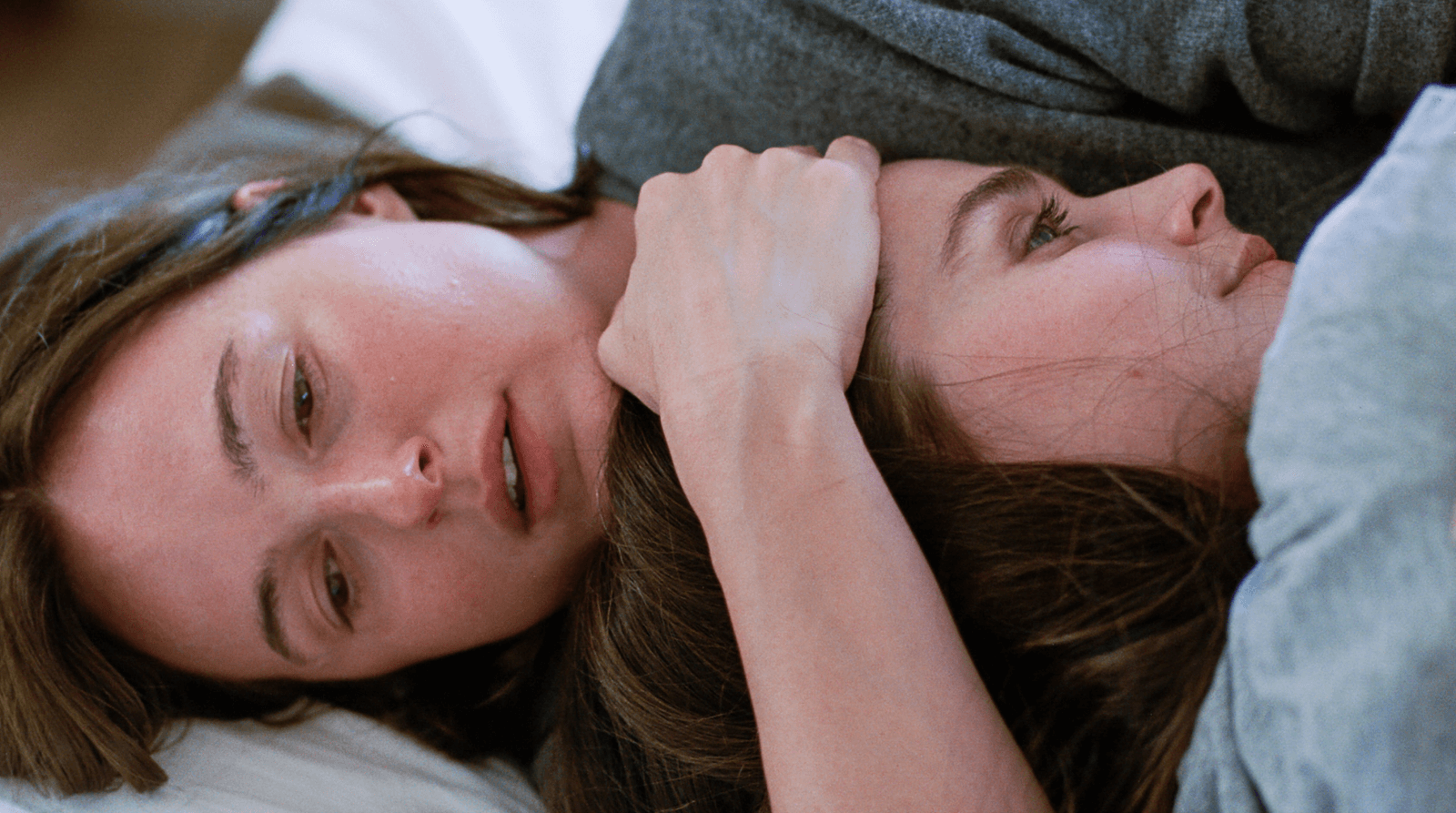
Filled with an undefined sadness, Nora attempts to focus on her creative output. In one blithe early scene, she’s so stricken by frantic pre-show jitters that she nearly tears off her costume before demanding that Jakob (Trier regular Anders Danielsen Lie)—the married colleague she’s sleeping with—either have sex with or slap her. He does the latter. Almost instinctually, Nora avoids emotion. Just as she delays performing on stage, she avoids real relationships to keep from any introspection, already knowing she is “eighty percent fucked up.” One of today’s most compelling performers (see last year’s A Different Man), Reinsve has the kind of face that seldom conveys a single emotion or state of being; there’s always something happening behind her eyes or in her body language that implies a secret or character detail she has buried beneath the surface. Here, she captures Nora’s resentment toward Gustav, along with the character’s jealousy over Rachel’s hiring and suppressed yearning to reconnect. Most affecting is her bond with Agnes, the kind of relationship where the two supported each other growing up when their parents argued, their father was away, or their mother, a psychiatrist, talked with patients in her office in the Borg house—and they listened through a vent.
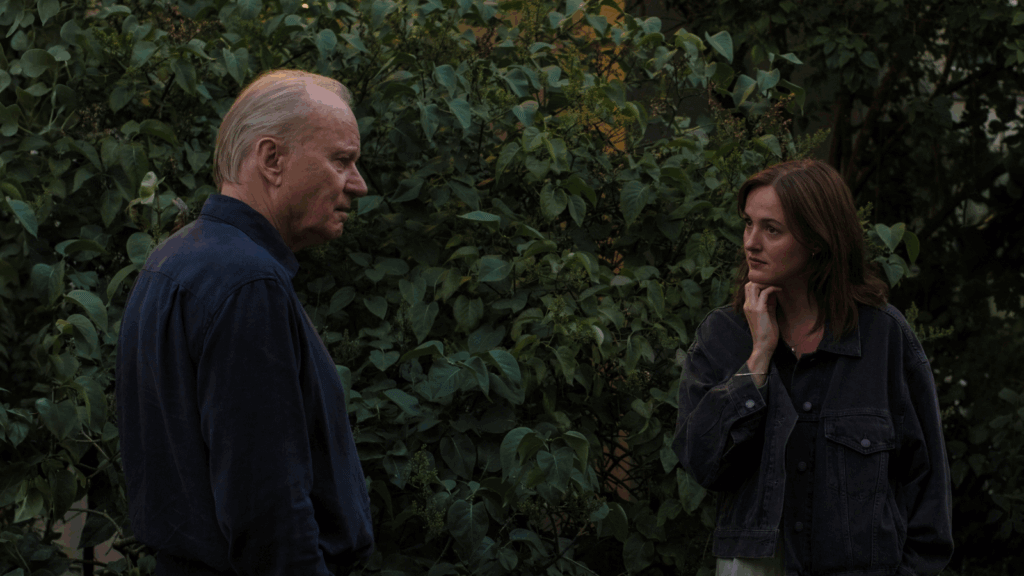
Trier alternates between Gustav, Nora, and Agnes, building a tapestry of family history, artistic expression, and emotional avoidance. They all have secrets, and rather than work them out—with a therapist, who might remind them too much of their late mother and ex-wife—they create their own therapy through acting and filmmaking. Even so, Gustav begins making compromises: he blames Netflix for not working with Peter (Lars Väringer), his retired cinematographer, who may be too old to shoot, while the streamer may actually not give his film a desired theatrical release. As for his family, Gustav can be inconsiderate and self-obsessed, but he’s never intentionally cruel or mean-spirited. He’s just someone driven by a singular imperative: his art. He’s also grappling with generational trauma from his mother to his eldest child, fueling drunk calls to Nora at night. Nora finds them annoying, but it says something that she’s the person Gustav thinks to call when his inhibitions drop. Eventually, they bond over their antisocial tendencies and affinity for expressing themselves through art. Their reconciliation, which is not total, comes after Nora reads a single page of his script and begins to cry. The page makes clear that even though Gustav wasn’t there for her in person, his artistic intuition led to a profound understanding of who she is.
Set against autumn, the season with the most complex symbolism, Sentimental Value at once explores the dramatic harvest of artistic creation while mourning the loss of family, both recent and from decades earlier. The film unfolds with an omniscient narrator, as many of Trier’s films do, but the device is less about conveying exposition than adding a literary texture to the film. Trier uses voiceover the way Woody Allen or Stanley Kubrick do, as another layer of the overall aesthetic rather than a device for conveying information. Note also the fades to black that serve as a break between chapters. In more cinematic terms, Trier presents a hypnotic interlude in which light rotates above the faces of Gustav, Nora, and Agnes, morphing them into one another. And a mid-film scene finds Gustav walking through the devastating final shot of his proposed film with Rachel, and in the final scenes of Trier’s film, it plays out just as he envisioned—this time shot with Nora, fluidly captured by cinematographer Kasper Tuxen. As much as Trier’s film shines because of its actors and the thoughtful script they perform, the less foregrounded aesthetics are no less stunning.
Although Sentimental Value is flush with symbolism, Trier never overemphasizes his themes or underlines his imagery, even as they remain readable. It’s a film that wraps itself up in the past and present, in history and art. How fitting that Agnes is a historian and Nora is a performer. Together, they embody what art means to Gustav: a commingling of personal experience and creative expression, particularly in his final film. And how fitting that his ex-wife was a therapist. Directors are like therapists, too. They must work through the psychology and meaning of every scene with their actors. When Rachel asks him why his character kills herself, he asks her, “What do you think?” Nora knows the answer without needing to articulate it, and acting it out will be the ultimate therapy. Trier’s psychological depth in Sentimental Value is both intuitive and resonant, evoking tears, laughter, and recognition. It’s the filmmaker’s best film to date, giving both Reinsve and the more seasoned Skarsgård two of their most intricate and moving roles. And perhaps best of all, it’s a heartfelt testament to the indefinable ways art reflects and enriches our lives.
(Note: This review was originally published on Patreon.)
Thank You for Supporting Independent Film Criticism
If the work on DFR has added something meaningful to your love of movies, please consider supporting it.
Here are a few ways to show your support: make a one-time donation, join DFR’s Patreon for access to exclusive writing, or show your support in other ways.
Your contribution helps keep this site running independently. However you choose to support the site, please know that it’s appreciated.
Thank you for reading, and for making this work possible.
Brian Eggert | Critic, Founder
Deep Focus Review