Reader's Choice
Another Round
By Brian Eggert |
Thomas Vinterberg’s Another Round dances on the ledge between tragedy and comedy, chaos and clarity. The Danish filmmaker fortifies his 2020 release, winner of the Oscar for Best International Feature and many other awards, not only with a superb ensemble cast headlined by Mads Mikkelsen’s outstanding performance, but also with a balance of puckish energy and philosophical depth. He opens the film with a quote from Kierkegaard: “What is youth? A dream. What is love? The content of the dream.” Vinterberg frames youth as a fleeting time of passion that becomes muted as one grows older. From there, he thoughtfully explores the midlife crises among men who run an impulsive experiment involving alcohol—a somewhat ill-advised attempt to recapture the dream of youth and renew their dispirited lives. Their reckless revival efforts put their careers and personal lives at risk for an experiment that awakens some and sends others further into a downward spiral. Just like the characters, the film, too, alternates between high and low, playful and sobering, pickled and profound.
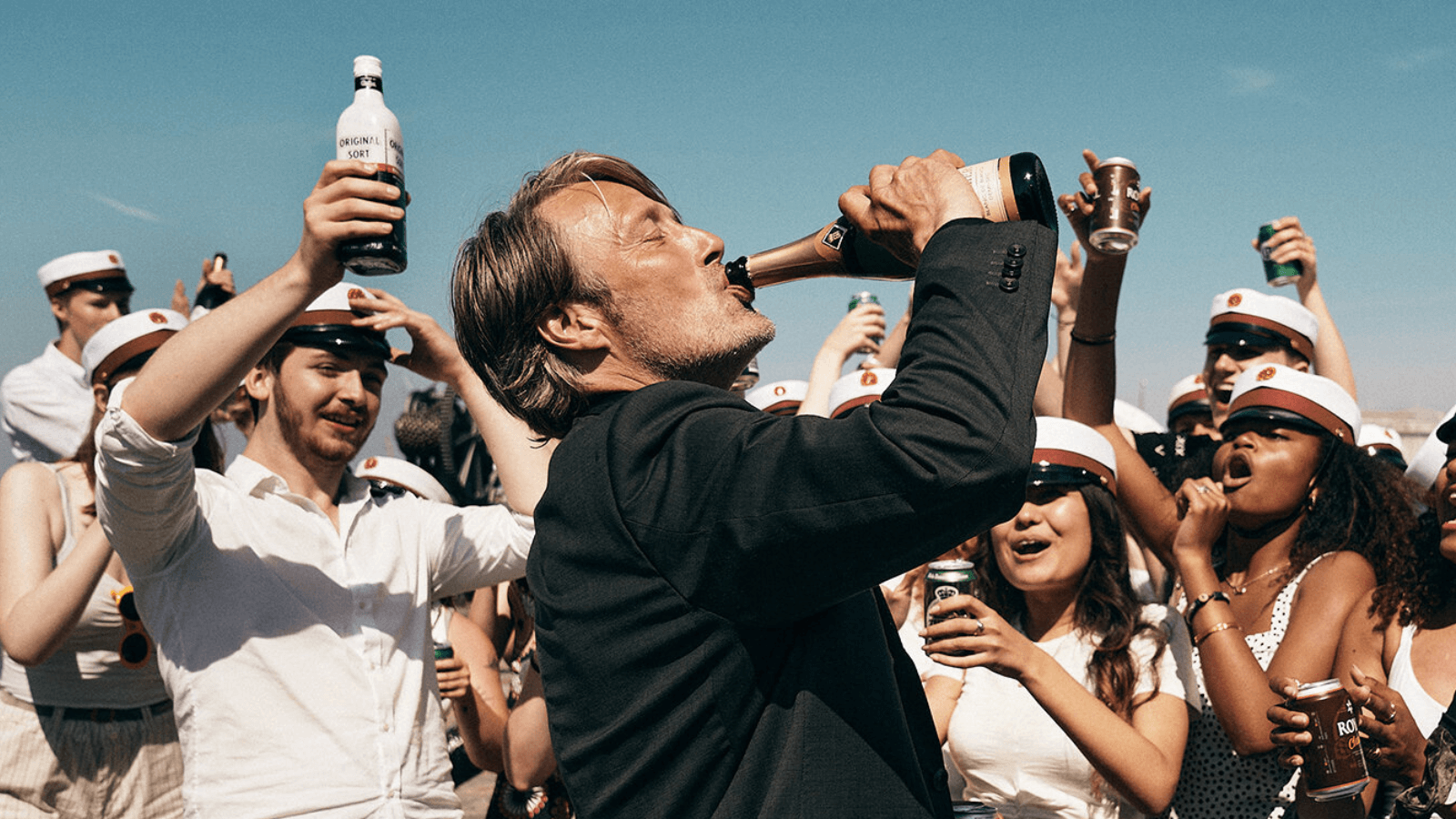
Another Round opens with a portrait of youth drinking rituals in Copenhagen, where the legal drinking age is 16, and an annual Lake Race finds students alternately jogging and chugging beers for glory. After a raucous celebration, the local high-school faculty considers banning alcohol. But among the staff, four close teachers wonder if alcohol might enrich their lives, drawing from an actual theory proposed by Norwegian psychiatrist Finn Skårderud: He claimed that human beings have a 0.05% blood alcohol content (BAC) deficiency. By replacing that percentage with controlled drinking, one will become “more relaxed and poised and musical and open,” inducing confidence and creativity—a method of accessing one’s true potential. They make a friendly pact to test Skårderud’s theory for, you know, science, but also to shake up their banal lives.
Mikkelsen stars as Martin, a history teacher whose detached lectures raise alarms among his students and their parents. They accuse Martin of indifference toward education, and his drifting classroom performance shows they’re right. But Martin reacts to their claim with his standard reply: a flat “okay,” with equal measures of doubt, offense, and concession behind Mikkelsen’s measured delivery. Martin has lost his drive to teach and live, more even than his co-conspirators: Peter (Lars Ranthe), a music instructor who never had the family he yearned for; Tommy (Thomas Bo Larsen), the school’s lonely gym teacher, who’s spared loneliness by his elderly canine companion, Laban; and Nikolaj (Magnus Millang), the psychology teacher who’s married and with small children. Upon turning 40, Nikolaj introduces them to Skårderud’s theory. And after a night of getting sloshed like teenagers for Nikolaj’s birthday, they agree to pursue the experiment and write a report, testing their BAC levels with a home breathalyzer.
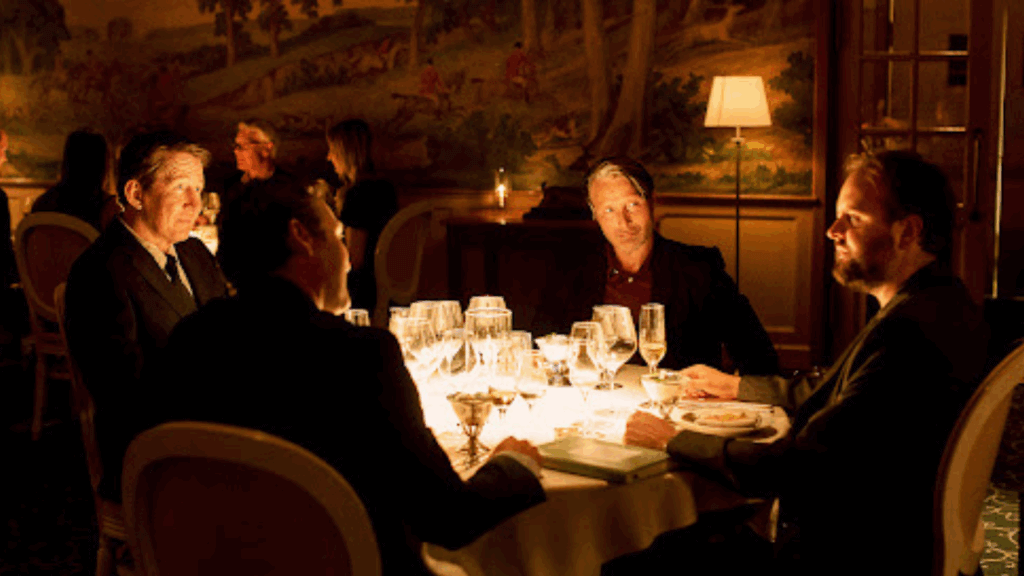
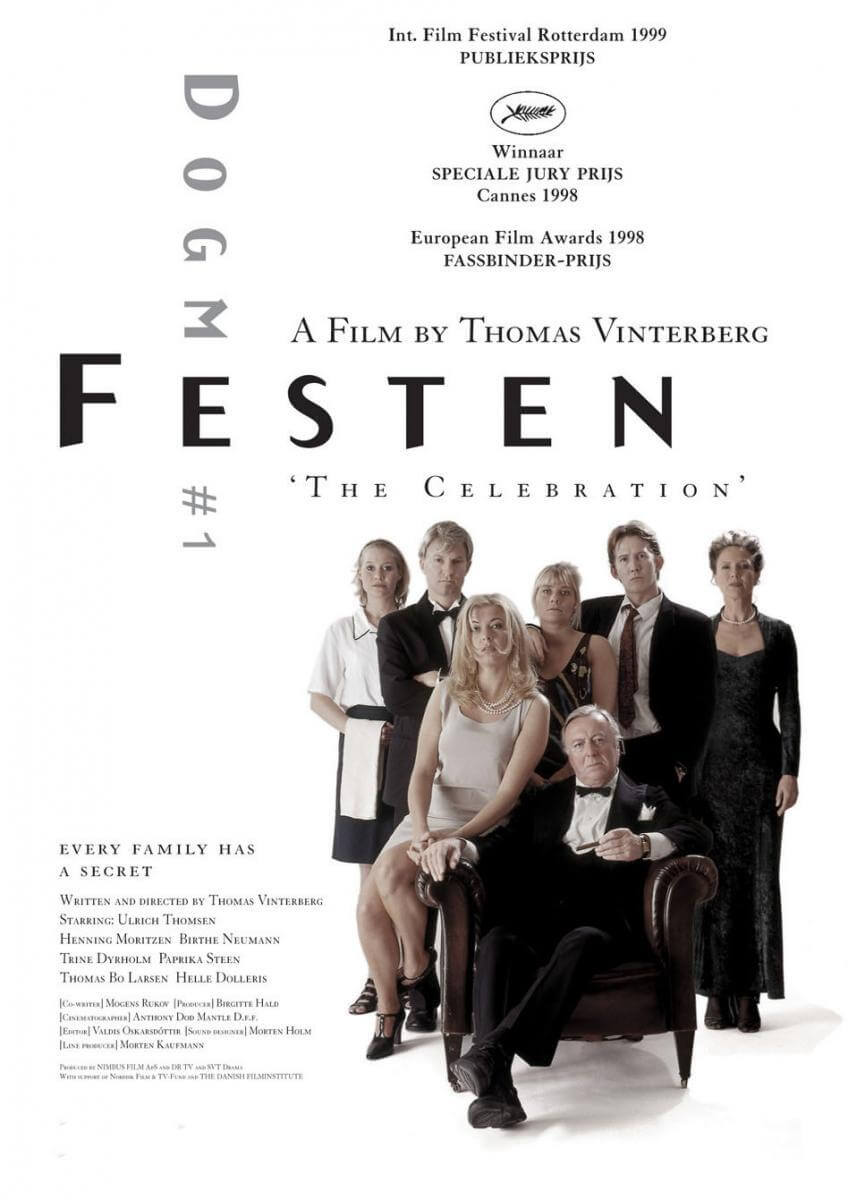
Their agreement recalls the Dogme 95 manifesto, which Vinterberg co-authored alongside Lars von Trier, imposing technical and narrative limitations on directors to access a truer cinema. Like the filmmaking doctrine that produced Vinterberg’s essential The Celebration (1998) and von Trier’s The Idiots (1998), the group never quite adheres to their own rules, such as drinking only on weekdays before 8 pm, and limiting the experiment to its impact on their teaching. They document their findings in brief notes, which Vinterberg presents with on-screen typing—somewhere between intertitles and a desktop movie. When they start, they meet the 0.05% standard outlined by Skårderud (“At the exact point of being neither drunk nor sober”) and find there’s something to the idea—their lectures come alive. Then it accelerates into finding their personal sweet spot, up from 0.06% to 1.2%, to the point where Martin’s euphoria finds him bobbing and weaving between colleagues in the teachers’ lounge before hilariously walking into a door frame.
Vinterberg spends much of the film navigating Martin’s life and how the experiment changes him. Married with two teenage kids, Martin, early on, asks his distant wife Anika (Maria Bonnevie), “Have I become boring?” She replies sincerely, “You’re not the same Martin I first met.” This will not be her last confession. And it might be this remark that prompts Martin, who does not drink, to participate. Nikolaj claims Martin lacks “self-confidence” and “joy,” and Martin later admits that he’s been in a funk for about eight years. But alcohol dulls whatever apprehensions he had about talking to Anika about the distance in their marriage; soon, they’re taking weekend vacations and making love again. Baffled by Martin’s newfound drinking and erratic behavior, she says, “I’ve missed you,” then “I’ve missed us.” They have been apart for too long. They still yearn for each other but have forgotten how to talk. Drinking gives way to honesty, even as it threatens to unravel their family. Mikkelsen’s performance is terrific in scenes with his wife, at once yearning and deflated, with an eagerness for life that Anika meets with confusion and caution.
Another Round originated as a play that Vinterberg wrote during his time at the Burgtheater in Vienna, which he described as “a celebration of alcohol based on the thesis that world history would have been different without alcohol.” The central example appears in one of Martin’s alcohol-infused lectures, noting that while Franklin D. Roosevelt and Winston Churchill may have been soused some of the time, they did great things; meanwhile, Adolf Hitler abstained. Vinterberg’s then-nineteen-year-old daughter, Ida, had encouraged him to turn the story into a feature film. She told him stories about Denmark’s youth drinking culture. The film even takes place at her high school, with some of her friends appearing as students. After adapting the play for the screen alongside co-writer Thomas Lindholm—Vinterberg’s collaborator on The Hunt (2012) and Commune (2016)—the production of Another Round was unexpectedly shaped by loss and grief. Four days into filming, Vinterberg received a call that Ida had died in a car accident in Belgium.

Devastated, Vinterberg had to decide whether he could continue making Another Round. In an interview with Nils Thorsen in Politiken, the director explained that, given the circumstances, the production company, Zentropa, offered to shut down production or hand the film over to another director. He resolved to continue shooting for Ida and dedicated the film to her. “That film is very much hers,” he reasoned later. “And she loved that project. So I can’t just not do it, I thought.” While Vinterberg steadied himself to return, Lindholm directed for a week. When the director finally came back to the set, Vinterberg’s pain was eased by the actors and crew with whom he had previously worked and considered friends. Ida’s death also turned Another Round from a comedic look at alcohol to a story about “being brought back to life.” Her death had awakened Vinterberg to his surroundings in a dramatic way. “I had the feeling that I had always lived in a bubble. And that it had now burst,” he said.
Vinterberg had made a short film about that very phenomenon early in his career, before his feature debut with The Celebration. His 1994 short The Boy Who Walked Backwards followed a boy who grapples with loss after his younger brother dies during a motorcycle accident with their father, who survives. In the same way that Vinterberg and Martin look back on their lives and regret not embracing its full potential, loss prompts the boy to reframe his way of looking at the world. Similarly, in Another Round, Martin’s colleagues gain a new perspective from alcohol, but their escalating experiment crosses moral lines. Peter takes a student struggling with the pressure of testing under his wing, suggesting the boy should try alcohol to overcome his nerves. It works out, but will the student now try to solve his mental health issues by drinking? Nikolaj drinks so much that he nearly loses his family. Tommy hides bottles in the gym storage room, almost exposing the group.
It’s not until the group’s final variation on Skårderud’s theory, to find their personal BAC limit, that Martin, who has resolved to back out, joins them in going too far. After a couple of Sazeracs—a New Orleans cocktail with absinthe—and a charmed dance to The Meters’ “Cissy Strut,” they descend into sloppy behavior during a destructive bender. They climb on bars, make a scene in a grocery store, and leap into a lake. On his way home, Martin passes out in front of a neighbor’s house, leaving a nasty wound above his eye. The result brings the experiment to a screeching halt, given the adverse social effects and risk of alcoholism. But it’s too late for Tommy, who arrives late and clearly plastered to a faculty meeting about teachers drinking on duty. Tommy’s eventual death, much like that of the brother in The Boy Who Walked Backwards, prompts reflection in the others. Sometimes tragedy shakes us out of apathy. “I think Tommy is rooting for you and me,” Martin texts Anika, who has left him. “Me too,” she replies.

Vinterberg’s aesthetic feels split between the film’s two extremes, with cinematographer Sturla Brandth Grøvlen alternating between a ragged handheld style for classroom and drinking scenes to a more textured, even classical look for sober discussions. After more conventional and commercial movies, such as his costume drama Far from the Madding Crowd (2015) or submarine thriller Kursk (2018), Another Round feels like Vinterberg’s return to artistic filmmaking. Note the montage of drunken world leaders (Boris Yeltsin, Bill Clinton, Leonid Brezhnev, etc.) that interrupts the straightforward action. Touches of irreverence and earnestness appear throughout Another Round, but there’s never a moral line drawn in the proceedings. Vinterberg allows his audience to feel at once elated and filled with dread over the characters’ behavior. And yet, his film ends with a graduation party, where Martin, reinforced by a few drinks, joins students who dance to “What a Life” by the Danish band Scarlet Pleasure. Martin studied jazz ballet in his more confident days, and the dance that follows is exhilarating cinema beyond words. The moment was inspired by Mikkelsen, who trained as an acrobat in his youth before transitioning into professional dance, studying with the famed Martha Graham Dance Company.
Another Round’s original title in Danish is Druk, which in this context means to binge drink. Whereas the former feels limited to the bar scene, the latter suggests something more dangerous and irresponsible. Vinterberg’s bookend scenes of youth drinking, from the Lake Race to graduation-day revelry, hint that reliance on alcohol is endemic in Danish culture. “This entire country drinks like maniacs,” Anika observes. Most either abstain or go absolutely bonkers, but there’s almost no middle ground between depression and ecstasy—not for Martin or anyone else in the picture. Another Round ends with the perfect illustration of this. After Martin’s impromptu dance, he runs and leaps toward the lake, prompting a freeze-frame worthy of Thelma & Louise (1991). Vinterberg leaves us to question whether Martin has leaped toward regressive self-destruction or a personal breakthrough—or perhaps, after seeing both sides, he will achieve a balance. Even amid such uncertainty, the director conveys the delirious but dangerous appeal, achieving an essential film that is intoxicating and richly layered.
(Note: This review was commissioned by Maaisha and posted on Patreon on July 12, 2025. Thanks for your suggestion and long-time support!)
Like DFR? Support us.
This site exists because readers like you care about film. If DFR has enriched your experience with movies, I’d be grateful for your support. You have a few options:
• Join DFR’s Patreon community
• Make a one-time donation on PayPal
• Buy me a coffee
Whatever option you choose, it helps keep my work independent. And it means a lot to me.
Thank you for reading, and for making this work possible.
Brian Eggert | Critic, Founder
Deep Focus Review