Reader's Choice
Christine
By Brian Eggert |
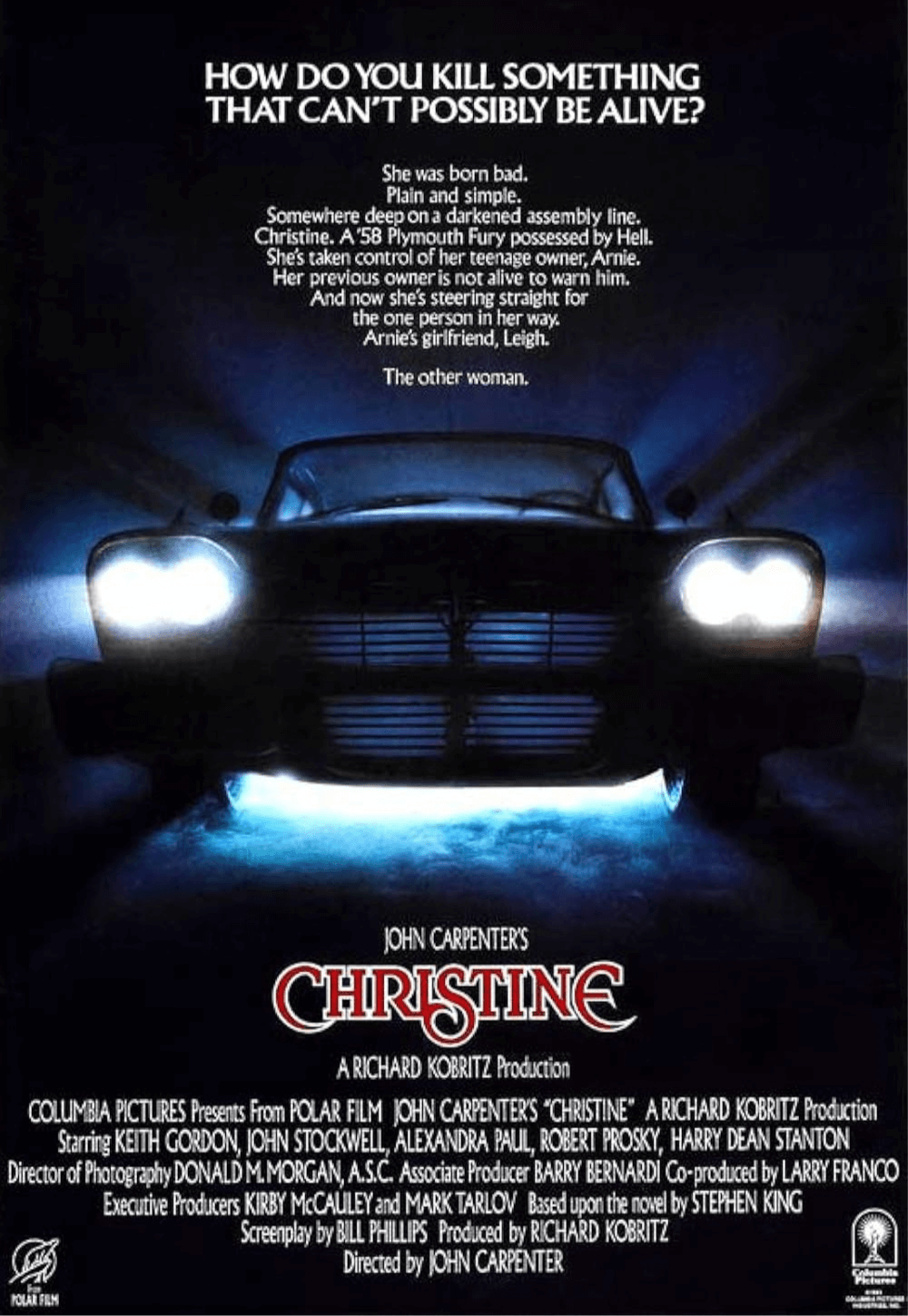
Few names deserve a place over the title of a Stephen King adaptation. John Carpenter’s is one of them. The director made Christine in 1983 from the source novel published earlier that year, and the resulting film balances the creative voices of both. The adaptation reflects some of King’s signature themes: horror rooted in high school trauma, possession (hotels, animals, and inanimate objects), and the entrenched psychology of his characters. But Carpenter’s production reimagines the book for the screen, transforming the titular killer car from a vessel for a maligned spirit into a faceless, unknowable threat—an abyss of evil that reflects and distorts its driver. When an engine revs over the opening credits, unaccompanied by music, it distills Carpenter’s ambiguous intent. The filmmaker embraces the terror of the unknown and the implication of evil, relying less on exposition than powerful images to tell his story. More than the particulars of the screenplay’s adaptation, Carpenter knows the classic car’s presence is powerful and can instill terror because it warps a familiar image from Americana into something unknowable and twisted. Blending Carpenter’s and King’s sensibilities, Christine idles at the crossroads where two horror masters converge.
Producer Richard Kobritz spearheaded Christine’s translation from page to screen after making Tobe Hooper’s excellent made-for-TV movie of ‘Salem’s Lot in 1979. As Kobritz explains in a featurette on Christine’s Blu-ray, he and King began discussing other possible adaptations, and the author gave him two as-yet-unpublished manuscripts to consider: Cujo and Christine. Uninterested in Cujo, Kobritz felt drawn to Christine for its portrait of American autophilia, acquired the screen rights, and reached out to Carpenter to direct. Carpenter had been developing King’s book Firestarter with screenwriter Bill Phillips at Universal Pictures, but the director’s commercial and critical disaster of The Thing (1982) prompted the studio to fire him from the project. Hoping to restore his reputation with a hit, Carpenter agreed to helm Christine. Over the years, the director has remarked in interviews that he didn’t find the story scary and maintains that he took the project as a director-for-hire gig. Nevertheless, Christine performed moderately well at the box office in a year with two other King adaptations on the big screen, Cujo and The Dead Zone, mainly due to the author’s rising popularity and brand recognition.
What’s more, screenwriter Phillips’ adaptation feels split between its author and auteur, like a hybrid of King’s original text and Carpenter’s breakthrough, Halloween (1978). In the book, the 1958 Plymouth Fury’s evil stems from possession by the original owner, Roland LeBay—a vile, crusty old pig whose love of his car consumes him. It also corrupts the vehicle’s next owner, nerdy high-schooler Arnie Cunningham, who buys the car in 1978. Phillips’ script simplifies the scenario, suggesting that Christine, the name LeBay chose and later Arnie uses, was evil when it rolled off the assembly line in 1957. The first sequence in Carpenter’s film takes place in a Detroit auto factory. Shot in dreamy, soft light and accented by the soundtrack’s chillingly on-the-nose selection of rock-and-roll hits, the scene embraces the ‘50s-era nostalgia that dominated pop culture in 1980s entertainment. Christine was born “Bad to the Bone,” as the anachronistic George Thorogood & The Destroyers song declares. One inspector nearly loses his hand when Christine chomps down with its hood, and another dies mysteriously in its front seat.
Whatever drives Christine in the film is there from the start and is tantamount to that of the faceless killer Michael Myers, described as The Shape in Carpenter and Debra Hill’s Halloween script. Sure enough, the film adopts a Carpenter-style slasher movie structure, with an unknowable killer, propelled by some unearthly force that Halloween’s crazed Dr. Loomis might best describe as “purely and simply evil.” Carpenter’s early work often stresses that the unknown remains more frightening than the known. And much like Halloween, Christine—set in a California suburb that looks almost identical to Halloween’s Haddonfield, Illinois—imbues its killer with otherworldliness and never explains its origins of evil. Any clarification, whether possession by LeBay or some demon, would eliminate the mystery and take the focus off Arnie, who recalls Laurie Strode, Jamie Lee Curtis’ character in Halloween. Scholar Robert C. Cumbow observes that Arnie, an intellectual outsider seeking a girlfriend, instead finds an evil companion in Christine. This parallels Laurie, who wants to find a boyfriend but gets stuck with the murderous Michael Myers. In both, the protagonist’s search for sex results in punishment, following the moralistic trend of early slashers that penalized sexuality with gruesome violence.
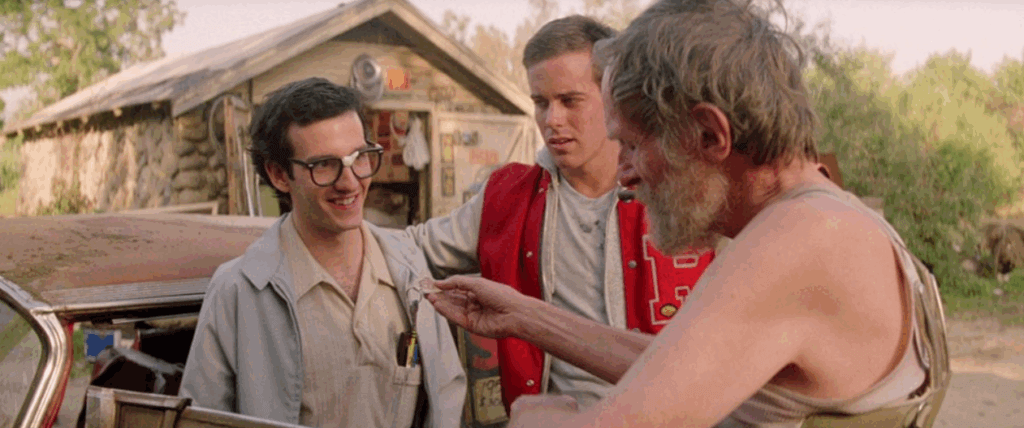
Keith Gordon lends humanity to the sympathetic yet corruptible Arnie, who signs up for shop class and impulsively pays $250 for the rundown Plymouth—acts of rebellion against his overbearing parents’ attempts to control his academic future. Forced to house the jalopy at a do-it-yourself garage run by the tobacco-chewing slob Darnell (Robert Prosky, making a meal of every line), Arnie directs his energy into restoring Christine. This goes against the advice of Arnie’s concerned best friend, Dennis (John Stockwell)—a high school football star who looks right past the eyelash-batting cheerleader (Kelly Preston) to the cute new girl, Leigh (Alexandra Paul). Initially, Arnie doesn’t have the confidence for romantic or sexual prospects, resigning himself to veritable celibacy because he’s “ugly.” But as Arnie pours his time and money into fixing up Christine, he changes—perhaps unbelievably so—morphing in a few weeks from a textbook dweeb to the look and attitude of a ’50s rebel (including a red jacket reminiscent of James Dean’s in 1955’s Rebel Without a Cause), which gives him the confidence to date Leigh.
However, Leigh only disrupts Arnie’s relationship with his car. From day one, Arnie talks about “me and Christine” like they’re a couple in love. And just as love can be freeing and life-giving, it can also be so intense that it distorts reality. When he’s alone with the car, he hugs the wheel as he would a lover; when he dies, he gently fingers the V-shaped emblem on the grille—an unsubtle but effective vaginal allusion to their coupling. Arnie’s zealous devotion to his car and Christine’s jealousy over anyone else in his life nearly kill Leigh, forcing her to seek comfort from Dennis. But Arnie doesn’t need them. He gets everything he needs from Christine, as declared in an unhinged speech to Dennis: “When someone believes in you, man, you can do anything, any fucking thing in the entire universe. And when you believe right back in that someone, then watch out world, because nobody can stop you then, nobody! […] I’m talkin’ about Christine, man! No shitter ever came between me and Christine!” Arnie and Christine believe in each other so much that the viewer almost roots for them—especially when Christine takes revenge on Arnie’s bullies.
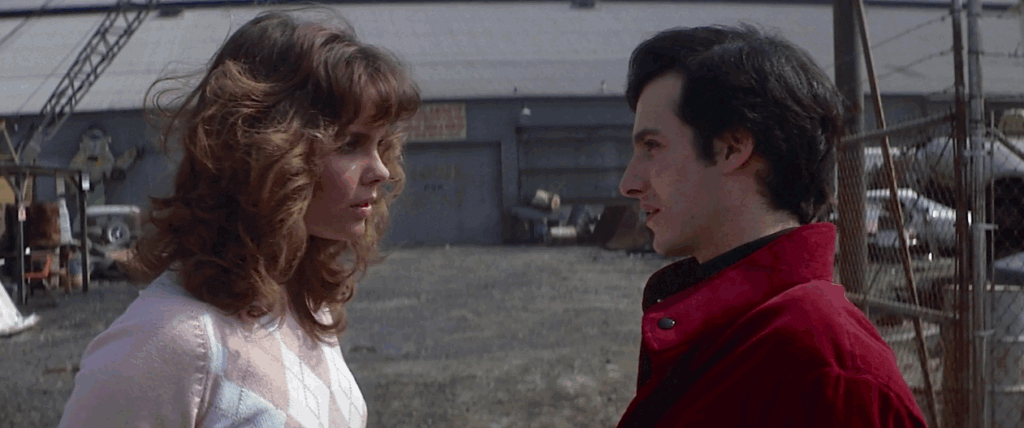
To be sure, the King story Christine most resembles is Carrie, another film about a bullied teen who lashes out against those who mock and humiliate her. In Christine, human scourge Buddy Repperton (William Ostrander) and his two goons, Moochie (Malcolm Danare) and Richie (Steven Tash), corner Arnie on the first day of school, splatter his lunch on the shop class floor, and pull a switchblade on him. Dennis attempts to help, but a teacher breaks up the fight and catches Buddy, who looks about 35. Buddy threatens Arnie: “I’ll fix you!” The character belongs to the incipient breed of despicable King bullies found throughout his fiction, evidenced when Buddy “fixes” Arnie by targeting Christine. Buddy’s crew tears the car to pieces, smashing the glass and exterior with sledgehammers, slicing the seats, and even defecating on Christine’s dashboard. It’s a turning point for Arnie, whose bond with Christine intensifies. Anyone who disapproves becomes a “shitter”—LeBay’s word, which, in the novel, Arnie adopts as LeBay’s ghost gradually possesses him. In the movie, without that plot point, it makes little sense for Arnie to start using the sneer.
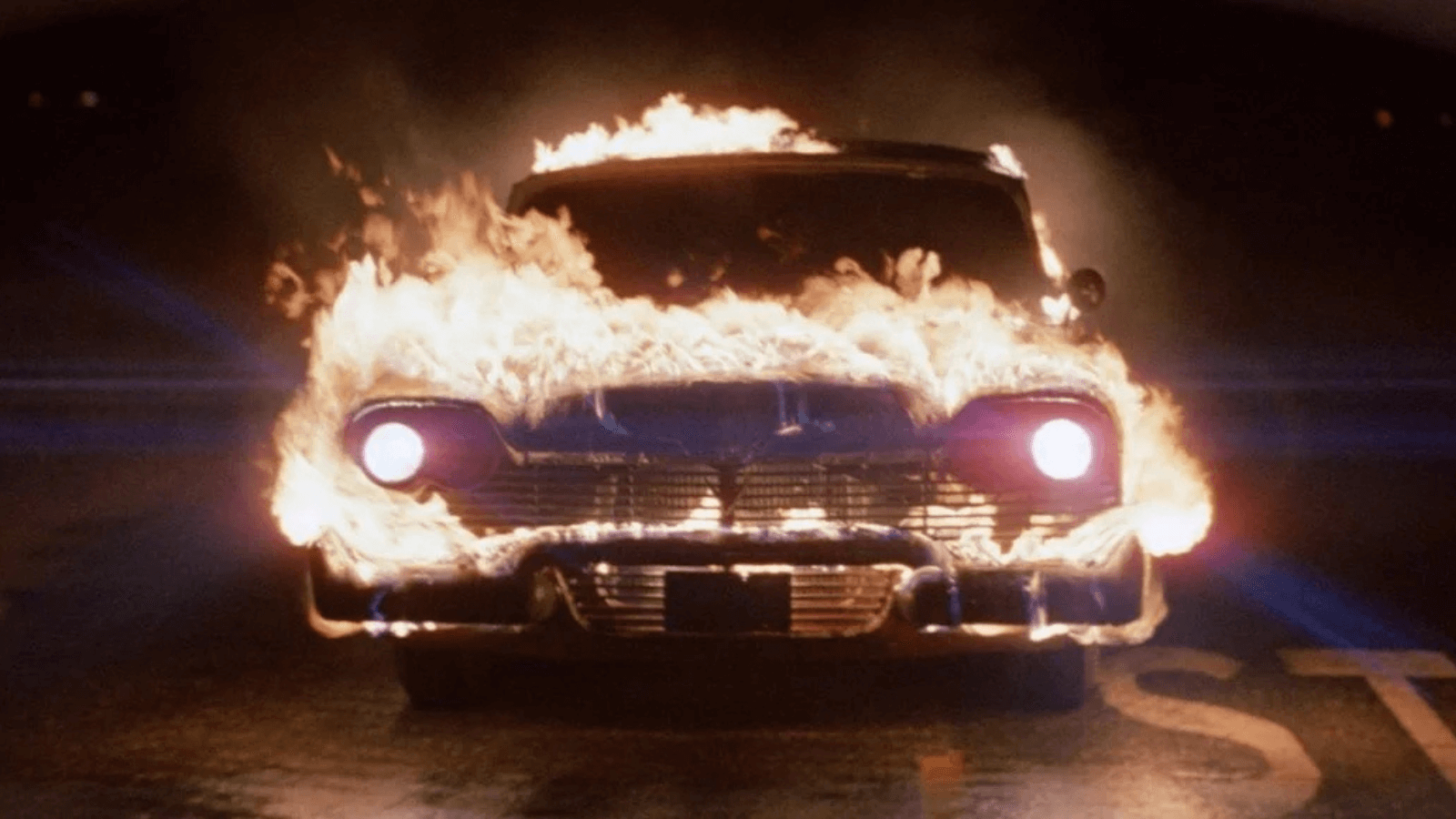
Many aspects of King’s book have been reworked, rearranged, or excised in Phillips’ script. The writer splices together and reassigns elements of LeBay’s and his brother’s roles; he gives minimal screen time to the resident detective (Harry Dean Stanton); and he omits the subplot about Darnell’s criminal enterprise, in which Arnie becomes entangled. Phillips alters the specifics of the killings and the finale to align more with Carpenter’s sensibilities than King’s. When Christine targets Arnie’s bullies, the car’s windows and windshield appear black, recalling what Quint had to say about the shark in Jaws (1975), that “he’s got lifeless eyes, black eyes, like a doll’s eyes.” (The Jaws connection becomes more pronounced when, in the climax, a collision smashes Christine’s grille into a vagina dentata that resembles jagged shark teeth.) Christine corners Moochie in a loading bay and forces itself into the narrow passage, crushing its body to cut Moochie in two. Next, the car chases Buddy and Richie into a gas station, prompting an explosion. Carpenter’s inspired imagery—sampled years later in Johannes Roberts’ underrated The Strangers: Prey at Night (2018)—shows a fiery Christine, accented by the director’s oft-used lens flares, eerily stalking Buddy as he runs down a highway. The blazing car leaves his body smoldering in the middle of the road.
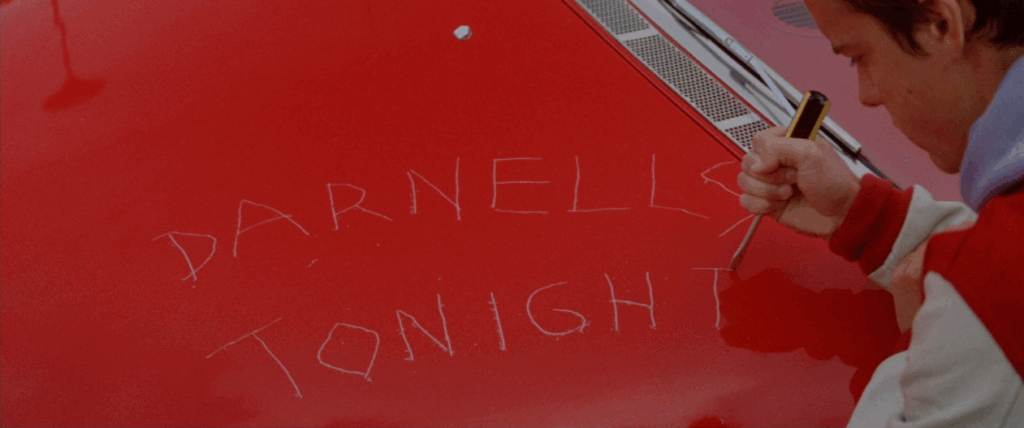
“Okay, show me,” Arnie says to Christine sometime later at Darnell’s, finally embracing his car’s supernaturalism. All at once, a synth sting from Carpenter and Alan Howarth’s brooding score prompts Christine to reveal to Arnie what the audience already knows: the car repairs itself. The sequence, achieved by special effects supervisor Roy Arbogast using a combination of rubber molds, hydraulics, and reverse footage, still looks incredibly plausible—especially when one considers that filmmakers would probably resort to unconvincing CGI today. The whole production of Christine boasts Carpenter’s clear, confident visual language, aided by cinematographer Donald M. Morgan, who also shot the director’s TV movie Elvis (1979) and box-office hit Starman (1984). Besides Carpenter’s distinct synth score, he considers the dark side of the rock ‘n’ roll attitude with a series of punctuating malt shop hits (from Buddy Holly to Little Richard) that, similar to Bumblebee’s choice of radio selections in the Transformers movie series, serve as Christine’s voice. The ’50s theme throughout critiques the decade’s fragile male egos that bolster their masculinity with automobiles and attempt to validate themselves by emasculating others (Buddy calls Arnie “Cuntingham,” for example). Some things never change.
Christine also belongs to the small but distinct killer-car subgenre, alongside Steven Spielberg’s Duel (1971) and Elliot Silverstein’s The Car (1977), which are about an unseen, disgruntled driver and a vehicle from hell, respectively. However, similar to the screen adaptation of Cujo, directed by Lewis Teague and also released in 1983, Carpenter’s Christine compresses and simplifies King’s overly complex explanation of the story’s evil and concentrates on the human characters. The car, meanwhile, broods—like the extended tones in Carpenter’s synth score—as the camera lingers, imbuing Christine with a menacing presence. Carpenter allows our imaginations to do the work, and that’s perhaps where Carpenter and King differ in their respective mediums. Carpenter knows that the viewer can give cinema its meaning, whereas King’s approach requires that he explore meaning on the page. Yet, in Christine, King’s concept and Carpenter’s direction find an unlikely but effective harmony.
(Note: This review was originally published on Patreon on June 21, 2025.)
Bibliography:
Boulenger, Gilles. John Carpenter: The Prince of Darkness. Spakenburg: H.O.M. Vision, 2002.
Cumbow, Robert C. Order in the Universe: The Films of John Carpenter. Lanham: Scarecrow Press, Inc.; Second Edition, 2000.
Muir, John Kenneth. The Films of John Carpenter. Jefferson: McFarland, 2000.
Thank You for Supporting Independent Film Criticism
If the work on DFR has added something meaningful to your love of movies, please consider supporting it.
Here are a few ways to show your support: make a one-time donation, join DFR’s Patreon for access to exclusive writing, or show your support in other ways.
Your contribution helps keep this site running independently. However you choose to support the site, please know that it’s appreciated.
Thank you for reading, and for making this work possible.
Brian Eggert | Critic, Founder
Deep Focus Review