The Sun Never Sets
By Brian Eggert |
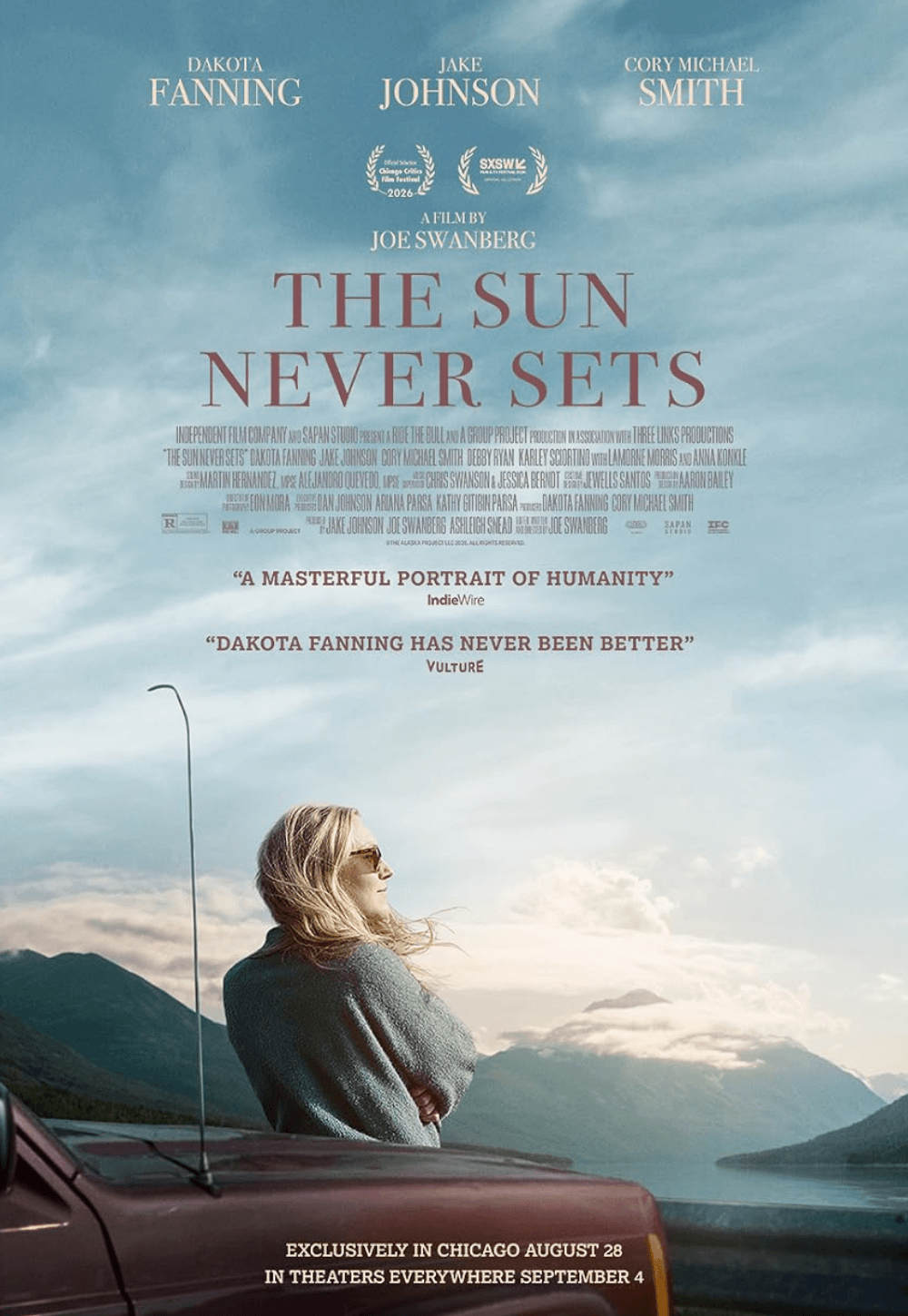
The Sun Never Sets is about people who cannot be alone. They end one relationship only to hastily enter another, when what they really need is a few months to get centered. It follows an on-again, off-again coupling between Wendy (Dakota Fanning), a woman in her early thirties, and Jack (Jake Johnson), a divorcé in his mid-forties with two kids and an ex-wife. When they separate so she can find herself, her former lover enters the mix, and Jack starts seeing someone else. Predictably, there’s jealousy and resentment. Writer-director Joe Swanberg reminds us that, despite being one of the originators of the mumblecore subgenre of talky, shoestring independents in the early twenty-first century, his brand of cinema transcends that description. And that tracks. None of the filmmakers who worked in the low-fi realm of mumblecore (Andrew Bujalski, Mark and Jay Duplass, Greta Gerwig, Aaron Katz, Lynn Shelton, et al.) particularly like that term. It’s a bit reductive, and not just because the characters don’t really mumble at all.
Consider instead that the “mumble” is more symbolic than literal. The characters speak at normal volumes, but the dramatic pitch is more a murmur than a shout. These aren’t films with melodramatic highs and lows. They’re intimate stories about modern relationships. And while this is certainly true of The Sun Never Sets as well, Swanberg’s production values and shooting location distinguish his picture from the usual low-budget look and feel of his earliest work, such as Hannah Takes the Stairs (2007) and Nights and Weekends (2008). Shot on 35mm by cinematographer Eon Mora, the footage was captured on location in Alaska, lending the production natural beauty—whereas his fuzzy, pixelated early films were often shot on consumer-grade digital camcorders to keep the budget down.
Swanberg also wrangles a superb if small cast for his new film. Fanning hasn’t done much of note in the last few years, but after The Sun Never Sets, it’s clear this former child actor has been overlooked and undervalued by the industry as an adult. Or perhaps she’s keeping her distance from Hollywood? Either way, her recent string of independent productions, sequels, and low-budget horror movies hasn’t given her much chance to show her range. Swanberg evidently recognized Fanning’s potential as a raw performer here and pairs her with Johnson—a regular presence in the director’s output, including Drinking Buddies (2013), Digging for Fire (2015), and Win It All (2017). Johnson feels on the verge of popping into stardom, appearing in small roles in blockbuster movies and headlining indies. He’s an affable leading man, making Jack’s more absurd behavior seem somehow rational in the moment.

As Wendy and Jack, the actors play characters at an impasse in their two-year relationship. She wants kids and to get married, especially when her best friend Lindsay (Debby Ryan) has just announced she’s pregnant, and others have moved into the next phase of their thirties. Having been there, done that, Jack has no desire to do either, much less hold her back. Neither of them seems willing to compromise. So Jack, in a display of staggering overconfidence, does what he thinks is logical. “Zero part of me wants to do what I’m doing right now,” he tells Wendy. Then he adds, “If you love us, you will do this.” He wants her to take the summer to explore her options, just in case. He vows not to date anyone else, but he wants her to become a whole person. They both declare their love for one another. But after tears and discussion, Wendy agrees. Things just move a little faster than either of them expected.
While on a colossally bad first date, Wendy bumps into Chuck (Cory Michael Smith) at a bar. Chuck is Wendy’s ex-boyfriend from her twenties—the one who got away. Chuck explains he was a “scared little bitch” who fled from love to work in Mexico. Now he’s back for the foreseeable future and ready to settle down, he says. They immediately hook up. And because Wendy and Jack have such an open dialogue, she tells him what happened. Jack, of course, regrets pushing her to find herself. His jealousy flares. He wants her to stop taking space and marry him. But now she’s confused, caught between a historically unreliable partner who’s perhaps more age-appropriate, and someone she loves dearly but maybe cannot manage starting another family.
Swanberg receives screenplay credit on The Sun Never Sets, but that’s somewhat misleading. There’s not a screenplay, per se. Rather, Swanberg relies on improvisation with his actors, preferring to craft a general outline and let them explore under his direction. The result is effortlessly natural interactions, with spontaneous quips, laughs, and mood shifts that feel genuine. The plot turns, with Wendy volleying between Jack and Chuck, can feel somewhat repetitive and uncertain. But that’s what the film is about—Wendy feeling pulled in various directions, none of them exactly what she wants, and her two suitors acting out to sway her. Jack becomes apologetic and generous to draw her back, while Chuck seems more like he needs her to stabilize his life.
The first scene in The Sun Never Sets finds Wendy scoping out a boat for sale. It’s more than she can afford, and it needs work, but she would be happy living that boat life and maybe having a kid. It’s what she really wants. Yet, neither Jack nor Chuck wants to do those things—unless it’s to preserve their relationship with her. Swanberg has made a ruminative film about the compromises people sometimes make, settling for a good partner for now when a great one might still be out there, if only they could deal with the solitude and the grind of searching. Like so many of Swanberg’s films, it’s shrewdly observed and rings true, with its skilled performers confronting the realities of modern relationships with emotional intelligence. Terrifically acted and realized, it’s the kind of modest indie that was once commonplace but now feels like a rarity.
Thank You for Supporting Independent Film Criticism
If the work on DFR has added something meaningful to your love of movies, please consider supporting it.
Here are a few ways to show your support: make a one-time donation, join DFR’s Patreon for access to exclusive writing, or show your support in other ways.
Your contribution helps keep this site running independently. However you choose to support the site, please know that it’s appreciated.
Thank you for reading, and for making this work possible.
Brian Eggert | Critic, Founder
Deep Focus Review