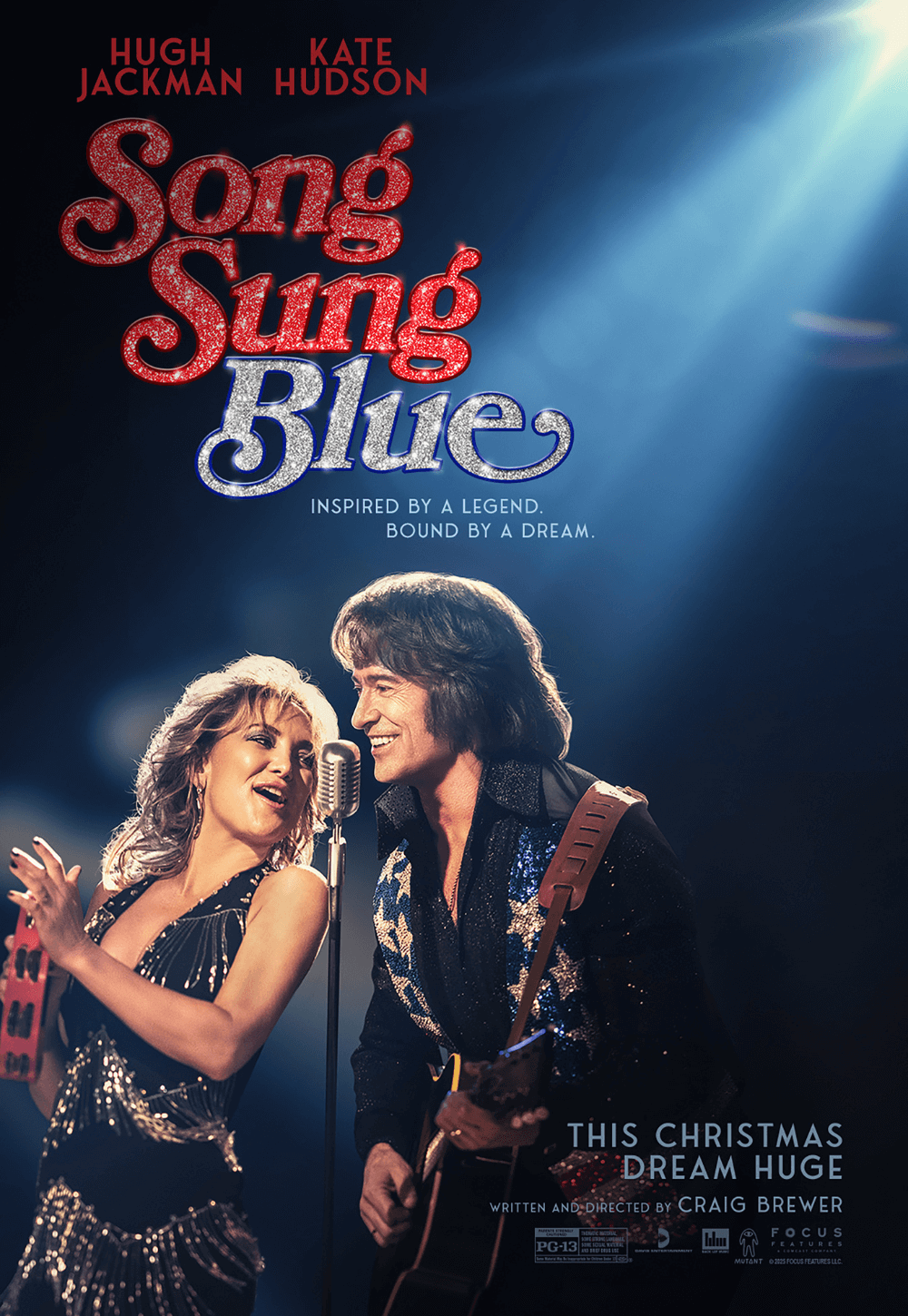
Song Sung Blue
By Brian Eggert |
Song Sung Blue is the latest in a series of award-hungry features that turn an earlier documentary into a showy drama. A few months ago, Benny Safdie did something similar with The Smashing Machine, a sports movie based on a 2002 doc. I suspect this trend makes it easier to attract talent and investors to a project. The producers can just show the documentary as a proof-of-concept. In this case, producer-writer-director Craig Brewer based his screenplay on Greg Kohs’ unreleased 2008 doc of the same name, which I have not seen and so cannot attest to how closely it follows its source material. Nevertheless, this stranger-than-fiction true story about Vietnam vet Mike Sardina and his hairdresser wife, Claire Sardina—known together as Lightning and Thunder—who headline a Neil Diamond tribute band in Milwaukee, is sure to generate similar interest to Walk the Line (2005) and Bohemian Rhapsody (2018).
Oddly enough, the story takes the same trajectory as those biopics, following the characters on the road to success, only to take a detour into drugs and tragedy before a bittersweet finale. Played by Hugh Jackman and Kate Hudson under some garish wigs and overdone Wisconsin accents, Mike and Claire have modest lives and big dreams. They meet at the Wisconsin State Fair, playing a gig alongside other small-time impersonators of Elvis, James Brown, and Barbra Streisand, overseen by the resident Buddy Holly, show promoter Mark (Michael Imperioli). Mike remains a devoted Diamond performer, repped by his dentist (Fisher Stevens), while Claire performs as Patsy Cline. After meeting and falling for one another, they conceive the “Neil Diamond Experience”—a full band dedicated to Mike’s “interpretation” of Diamond. After all, as Claire points out, “Nostalgia pays.”
That may well have been Brewer’s pitch to Focus Features to get Song Sung Blue made. The movie targets older generations who maintain an affinity for Diamond’s music and, much like musician biopics, has an inbuilt audience. The movie openly acknowledges that fans just want to hear “Sweet Caroline,” but Mike has a vision for something more transportive with him at the center. He insists on beginning his show with the lesser-known “Soolaimon” to convey a welcome and the start of a musical journey. What’s unique about the movie is how the musicians never become superstars. Rather, much of their story wallows in a shocking procession of bad-luck disasters. Mike, a 20-year-sober alcoholic, remains shaken by his time in Vietnam as a tunnel rat who disarms booby traps, leaving him under constant worry about his lingering heart problems. Claire is just one accident away from an opioid addiction.
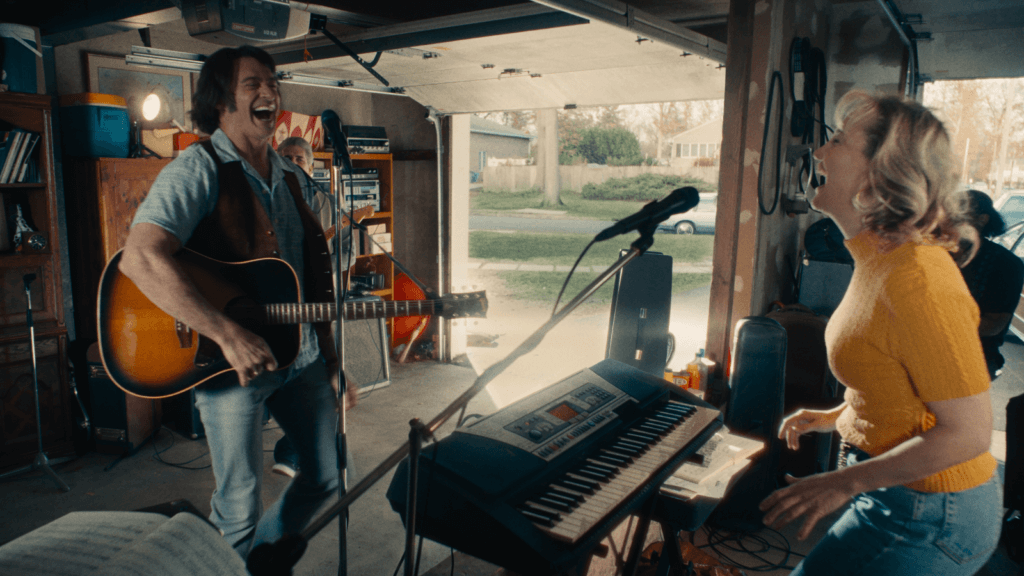
Although there are highs in the story—such as Eddie Vedder, unconvincingly played by John Beckwith, asking the group to open for Pearl Jam (“What’s a pearl jam?” asks Mike)—much of the second act entails one unthinkable downturn after another. Living on a street that reminded me of Sharp Corner (2025), Mike and Claire undergo a change after a horrifying accident, which leads to an even worse set of personal downfalls. It’s the kind of story that inspires cursory fact-checking, because it couldn’t possibly have happened this way, right? But generally, Brewer hews close to the real story, and the wildest parts actually happened, whereas others have been compressed or invented for dramatic effect. Still, in true biopic form, our main characters achieve a kind of legendary status through a final performance at an uplifting climactic concert, performed the same night as a sold-out Diamond show in town.
It’s worth speculating whether Brewer intended Song Sung Blue to look plastic, with generic, overlit cinematography by Amy Vincent, as if it belongs on Netflix. The material constantly looks unreal, perhaps to underscore how Mike and Claire aren’t the real deal. Then again, Brewer’s movie shows too much affection for the couple to demean them with a formal allusion like this. It might just be bland filmmaking. Brewer has long been interested in entertainer underdogs, having directed Hustle & Flow (2005) and Dolemite is My Name (2019). His next project is about Snoop Dogg. And there’s a decidedly phony quality to Mike and Claire, with their cheap wigs (both diegetic and non-diegetic) and accents that would embarrass the cast of Fargo (1996). Indeed, only Jim Belushi’s regional accent, playing a local casino booking agent, is more cartoonish than Hudson’s.
At least Jackman and Hudson shine in their singing, though they’re obvious celebrity counterparts to the real Mike and Claire, appearing as movie stars incapable of downgrading their good looks even with bad wigs and shabby surroundings. There’s a certain cinematic irony in celebrities playing everyday people who are playing celebrities. Regardless, Jackman does a convincing Diamond, and Hudson’s singing leads to some wonderful harmonies. Most of the dramatic performances tend to be overwrought, though the children in the Sardinas’ blended family (Ella Anderson, King Princess, Hudson Hensley) do solid work to ground the story about their high-maintenance “artistic” parents. After all the ups and downs, ranging from sold-out venues to drug addiction, the music helps maintain the 132-minute feature’s tempo. But throughout Song Sung Blue, I never bought into Brewer’s production, which, similar to his efforts on Coming 2 America (2021), feels like it belongs on the small screen.
Thank You for Supporting Independent Film Criticism
If the work on DFR has added something meaningful to your love of movies, please consider supporting it.
Here are a few ways to show your support: make a one-time donation, join DFR’s Patreon for access to exclusive writing, or show your support in other ways.
Your contribution helps keep this site running independently. However you choose to support the site, please know that it’s appreciated.
Thank you for reading, and for making this work possible.
Brian Eggert | Critic, Founder
Deep Focus Review