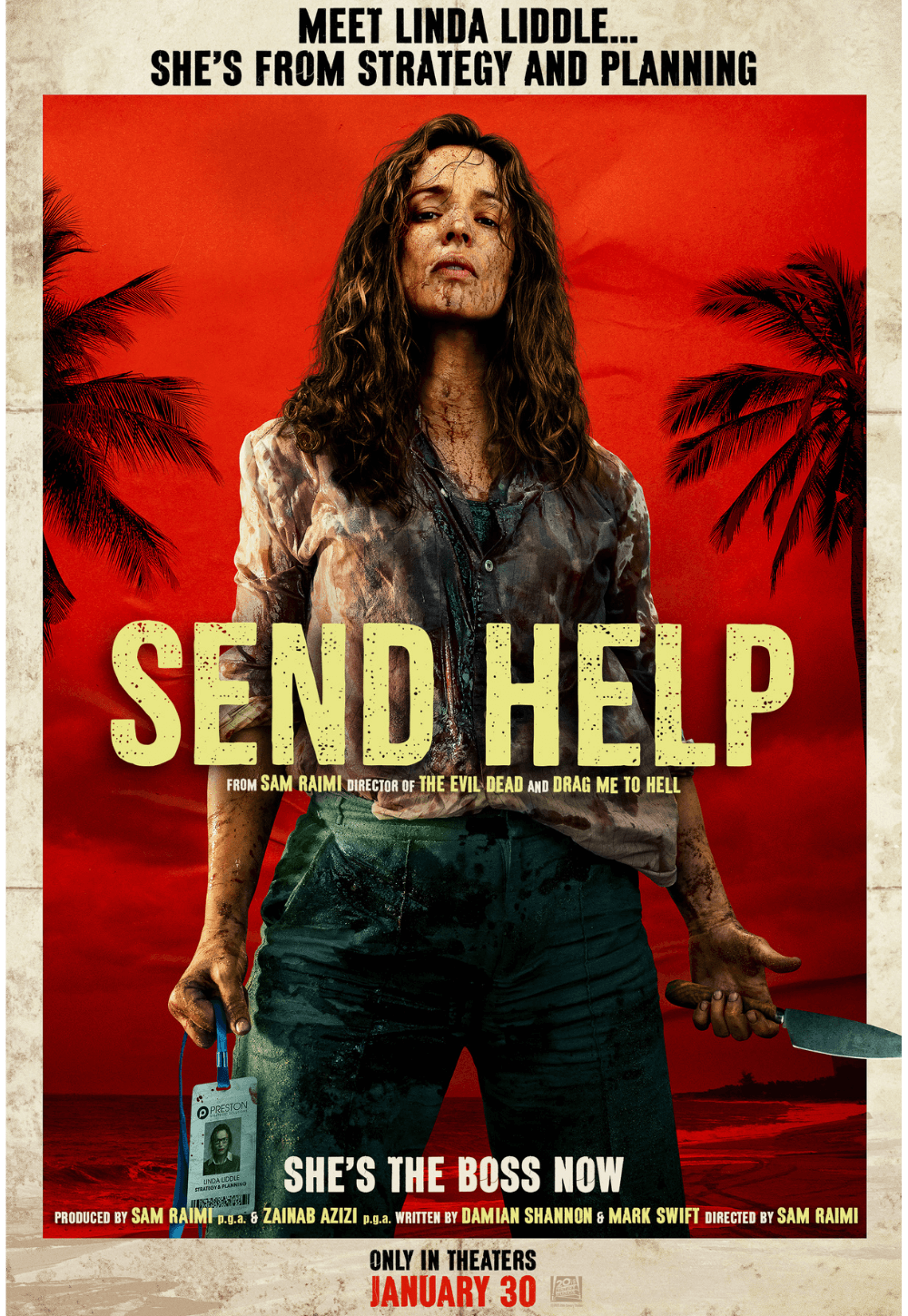
Send Help
By Brian Eggert |
Sam Raimi’s Send Help is a deliriously entertaining throwback. Signaled by the opening’s vintage-looking 20th Century Studios logo and a retro-style score by Danny Elfman, the movie is part sensory assault and part larkish carnival ride, both befitting a William Castle production. Following two coworkers whose plane crashes, leaving the mismatched pair stranded on a deserted island, the familiar setup benefits from Raimi’s signature sensationalism—a personal aesthetic that combines Three Stooges slapstick, zippy camera flourishes, goopy effects, and a tendency to put his cast through the wringer. Screenwriters Mark Swift and Damian Shannon conceived this survival thriller, which Raimi imbues with the prankish gross-out mindset of a demented teen, but also the feminist wit of a gender equity officer who snapped after dealing with too many boys’-club executive teams. Anchored by committed performances from Rachel McAdams and Dylan O’Brien, along with a blend of social commentary and spookhouse jolts courtesy of Raimi, Send Help is the most fun moviegoing experience I’ve had in recent memory.
When he was promoting Drag Me to Hell, Raimi described his 2009 feature as a “spook-a-blast” movie. The term conjures images of a haunted house ride, where scary animatronics pop out of the darkness, prompting a scream, then relieved laughter. It’s the same approach Raimi applied to his increasingly comic Evil Dead series, where the director’s longtime friend and star Bruce Campbell served as a human punching bag for Deadites. Hints of this style have even appeared in Raimi’s major studio features, such as his original superhero caper Darkman (1990), his Spider-Man trilogy from the 2000s, and his MCU entry, Doctor Strange and the Multiverse of Madness (2022). Raimi draws from the gimmicky productions of mid-century showman William Castle—for instance, House on Haunted Hill (1959) and 13 Ghosts (1960)—and combines that influence with his own penchant for physical humor. Yet, he doesn’t prioritize shock value over good storytelling.
Despite the director relying on a bag of exploitative tricks, he patiently builds genuine characters who give his otherwise lurid, tongue-in-cheek sensibilities a human foundation. This priority also enriched Drag Me to Hell, a movie with similar narrative DNA. Both involve a woman who yearns for a promotion but remains undervalued at the office, thanks mainly to her douchebag boss and the brown-nosing competition. When extraordinary circumstances provide her with an opportunity to get ahead, she leaps at the chance. Both women begin as mousy, undervalued workers who have more intelligence and potential than their male counterparts can see or maliciously ignore. And while Alison Lohman’s character in the earlier movie must endure no end of supernatural torment before she fights back, the same cannot be said for McAdams’ Linda Liddle, a number cruncher from her company’s Strategy and Planning department.

You’ve probably worked with someone like Linda Liddle (McAdams), so it’s fitting that Raimi should introduce her with “Rip Her to Shreds,” by her favorite band, Blondie, with its refrain “You know her.” She has blotchy skin and greasy hair; she wears frumpy, inexpensive clothes; and she lives alone with a bird named Sweetie. She’s the person who eats a tuna-salad sandwich at her desk at work, much to the olfactory offense of her coworkers. Despite these superficial downfalls, she’s also brilliant with numbers and contracts, almost ensuring someone like her smarmy and duplicitous coworker Donovan (Xavier Samuel) will take credit for them. When the new CEO of her company, Bradley Preston (O’Brien)—whose recently departed father (Bruce Campbell, in a blink-and-you’ll-miss-it cameo) started the place—promotes the useless Donovan, not her, she’s outraged. She works up the gumption to approach Bradley, who reeks of unearned authority. Yet the encounter leads him to invite her on a business trip to Tokyo to seal a deal and prove herself. But they never get to Tokyo. The plane crashes somewhere in the Gulf of Thailand, leaving Linda and Bradley stranded on a small tropical island.
A lesser movie would have rushed to reach the island, or even given the viewer a bloody pre-credits glimpse of what’s to come in a flash-forward prologue. However, Raimi’s patient sensibilities build the story and characters so that when Linda finds herself beached, she blooms. Linda has read countless books on survival in the wild and hopes to become a contestant on her favorite show, Survivor. She knows how to start a fire without a match, build a shelter, identify which berries to avoid, and make sunblock from local flora. These skills help save Bradley, who injured his leg, and also lucked out when fate paired him with Linda. Not only does she thrive in this environment, but the situation has also given her an island beauty he didn’t think she possessed. Even so, this otherwise useless nepo-baby tries to control the situation by ordering her to stop being “Suzy Homemaker” and reminding her that she works for him. But when he tries to play hardball with her, she reminds him how helpless he is without her.
The power struggle that unfolds cuts into office, gender, and class politics, of course, which will earn comparisons to Ruben Östlund’s Triangle of Sadness (2022). However, Send Help becomes more twisted than that. Raimi reminds us who is directing this seemingly straightforward survival yarn when Linda hunts down a wild boar, leaving her covered in blood and boar snot—and thrilled about it—in a gross-out sequence worthy of ’80s horror schlock. To be sure, the movie takes some morbid turns. Linda never wants to leave the island; she has found her happy place. But as Bradley gets better, their relationship devolves into a Misery (1990) situation, except that Annie Wilkes is the hero. Even so, Bradley is such a spineless, disingenuous, and self-important elitist that, as soon as he learns some basic survival skills from Linda, he tries to assert his newfound power. It doesn’t work out well.

Raimi gradually ratchets up the tension, then delivers a series of stomach-churning roller-coaster drops. To describe further how bonkers Send Help gets would do you a disservice. Suffice it to say, Raimi fans will be delighted by his mischievous method of turning every shock into laughter. How many directors will take a thrilling sequence like a plane crash and make it into a gory physical gag? How many would turn Linda’s conscience-ridden nightmares into a source of spookhouse fun, complete with rotting CGI specters and wormy imagery? Raimi is the sort of filmmaker who will occasionally resort to an ageless mood-setter, such as an ominous-looking moon, but then also get a laugh out of an extended puke-in-the-face sequence. At 66, Raimi hasn’t lost his childish sense of humor, and he turns Send Help into a wild ride, albeit armed with worthy lessons: 1) Don’t fuck with Linda Liddle, and 2) No one is coming to help you, so you’d better help yourself. Maybe it’s because I’m a Minnesotan in the America of 2026, but that last lesson struck a chord.
Send Help is the kind of movie I will return to again and again. No, it’s not perfect. Linda gives maybe one too many winking looks at the camera in the last few minutes. The VFX that render the boar and the ghouls who appear in Linda’s dreams look underwhelming. But then, so did the digital effects in Drag Me to Hell, and that hasn’t prevented it from becoming a contemporary classic I revisit regularly. Cheap VFX hardly matter after Raimi invests us in his characters with the help of his longtime collaborators: cinematographer Bill Pope, who knows just when to contort the camera, and editor Bob Murawski, whose cutting understands that the timing in comic and horror scenes is practically the same. What I loved about this film, besides Raimi’s sensibilities, is that McAdams and O’Brien show they’re game for whatever he has in store. These two superb performances ground their characters while keeping up with their director’s shenanigans. Yes, Send Help is a B-movie. But it boasts A-list talent, and it’s incredible fun.
Thank You for Supporting Independent Film Criticism
If the work on DFR has added something meaningful to your love of movies, please consider supporting it.
Here are a few ways to show your support: make a one-time donation, join DFR’s Patreon for access to exclusive writing, or show your support in other ways.
Your contribution helps keep this site running independently. However you choose to support the site, please know that it’s appreciated.
Thank you for reading, and for making this work possible.
Brian Eggert | Critic, Founder
Deep Focus Review