Reader's Choice

All We Imagine as Light
By Brian Eggert |
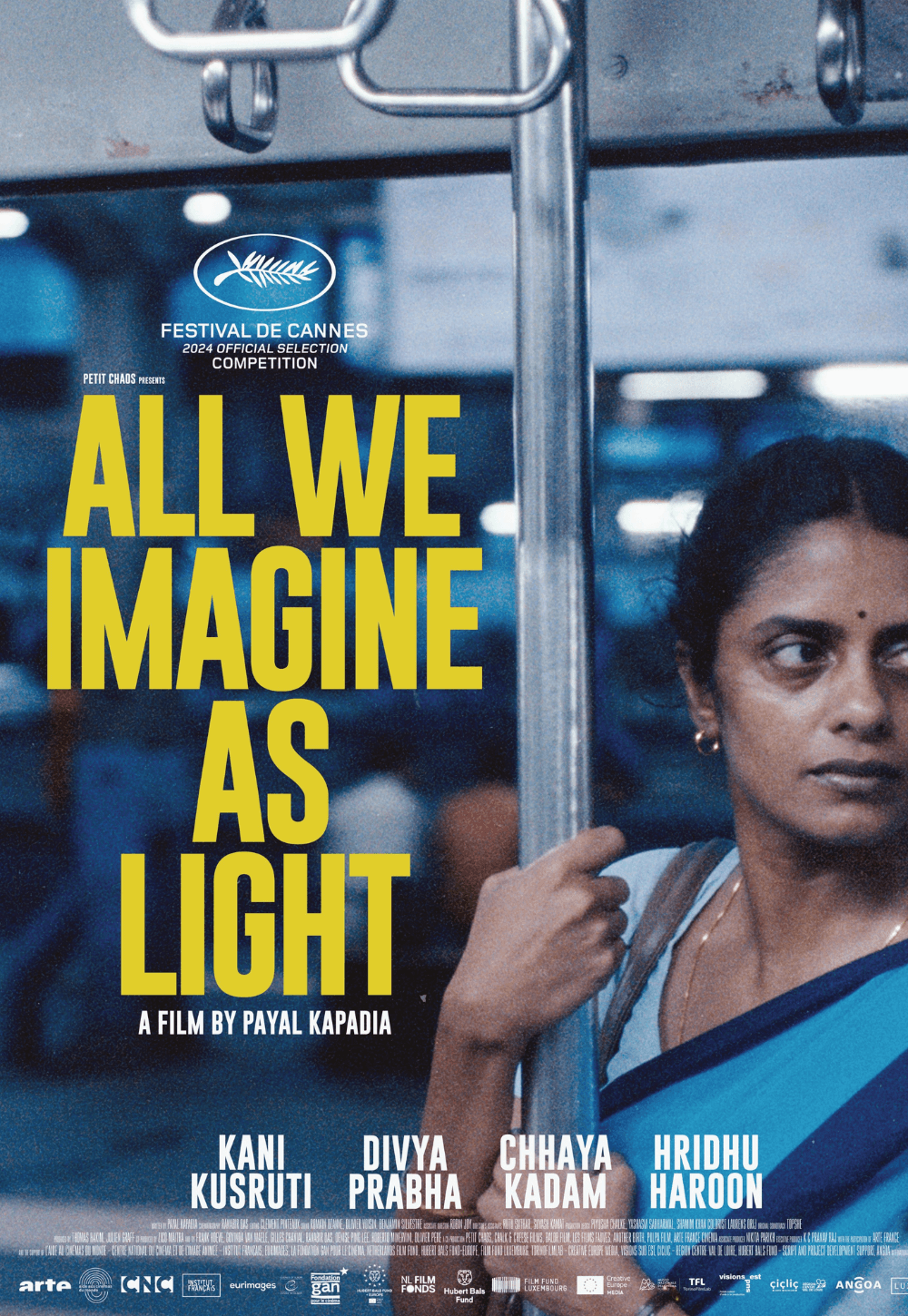
All We Imagine as Light follows three women navigating life and love in contemporary Mumbai. Prabha (Kani Kusruti) is a veteran nurse at the hospital where they all work, and though married, her estranged husband emigrated to Germany. They haven’t spoken in many years. Prabha’s younger workmate, Anu (Divya Prabha), is also her roommate. Anu has been consumed by the thrill of her secret romance with a Muslim man, Shiaz (Hridhu Haroon). And there’s also Parvaty (Chhaya Kadam), an older cook in the hospital kitchen. Parvaty faces homelessness due to a legal loophole that means she has no claim on the apartment she has called home for over twenty years. A thoughtful, tender story of women bonding over shared hardships, this award-winning feature by Indian filmmaker Payal Kapadia, her first dramatic effort, also explores themes of migrant work, gentrification, female subjectivity, and the conflict between Hindi and Muslim communities. If that description sounds heavy or thematically loaded, it contains an unlikely blend of artistic temperaments, ranging from docu-style flourishes to ethereal drama.
This is the second film by Kapadia, whose initial project, A Night of Knowing Nothing (2021), earned the Cannes Film Festival’s Golden Eye prize for Best Documentary. But that film operated less like a documentary than an experimental blend of reality and fiction—a collage of sometimes surreal and impressionistic imagery. Kapadia accumulated the film’s footage from those involved in the widespread student protests against religious discrimination and the insidious caste system in India. At times, the protesters, hailing from the Film and TV Institute of India, dance in defiance; elsewhere, they take to the streets with signs and give interviews with reporters to articulate their concerns about nationalist, xenophobic politics. Just as A Night of Knowing Nothing belongs more to avant-garde cinema, All We Imagine as Light defies an easy description. That’s precisely what makes it special.
The first scenes in Kapadia’s latest film blur the lines between traditional narrative drama and documentary. Observational camerawork captures busy city streets lined with pedestrians, vehicles, and produce destined for the market. The voiceover by women from varied backgrounds—speaking in Hindi, Malayalam, Marathi, and Gujarati—provides remarks about life in modern-day Mumbai. “The city takes a lot from you,” one voice rationalizes. “That’s life.” These voices belong to migrant workers who come to Mumbai from various parts of India. A hub assembled by the country’s former colonial rulers, Mumbai was brought together from seven islands, which imperialists turned into a site for trade, manufacturing, and other capitalistic concerns. There is no one voice or language of Mumbai because so many travel from other areas to make a living in one of the world’s most populous cities. But it’s a place where, as one character observes, “You could vanish into thin air.” And regardless of the cliché, it’s also a main character in Kapadia’s film, captured in grainy, cool-colored light and rain by cinematographer Ranabir Das.
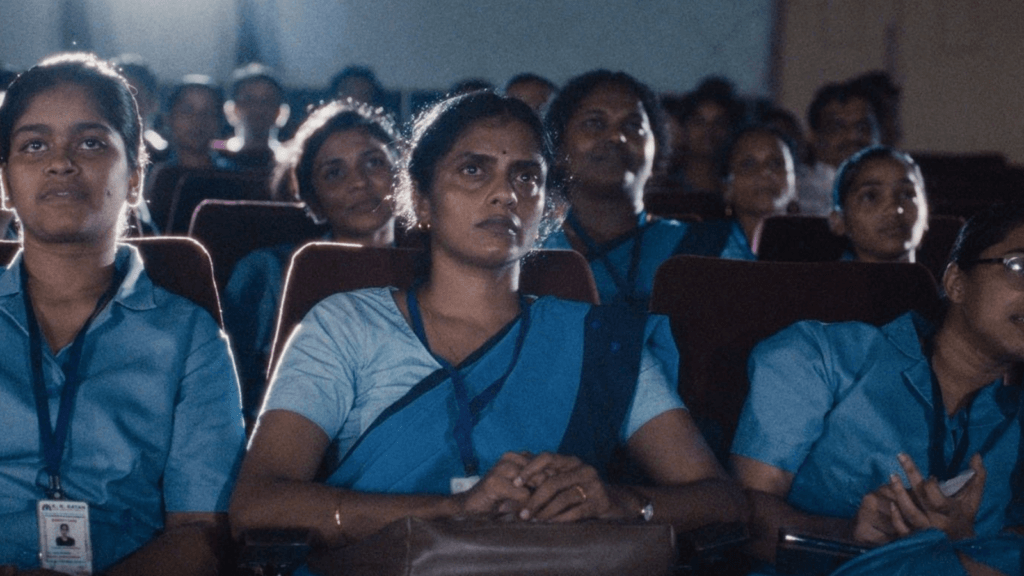
Each of the three women in the film yearns for something more from her life in Mumbai. Anu and Shiaz know their romance is doomed, that their parents won’t allow the coupling between a Hindi woman and a Muslim man. Her parents hope to arrange a marriage, sending her photos of men from a website with suitable candidates. Even so, the secret couple is passionate and searches for a private place to make love. Most of the story revolves around Prabha, who receives a new rice cooker in the mail, presumably from her husband in Germany. If circumstances were different, she might explore a romance with a doctor (Azees Nedumangad) at her hospital. He brings Prabha treats, and they take long walks together. He hopes for a relationship, but she resolves to remain faithful to her husband, unable to release herself from the strict social obligation. She’s practical and responsible, not given to flights of fancy, as her roommate is. Underneath these scenes plays jazzy music by Emahoy Tsegué-Maryam Guèbrou, an Ethiopian nun whose notes, along with additional music by songwriter Topshe, capture the city’s momentum and possibility.
India produces more films each year than any other film industry in the world. Yet, it’s rare for anything but Bollywood musicals or action movies to cross over into other territories. Kapadia’s independent production provides an antidote to the usual commercial imports, in the same way that Satyajit Ray’s lyrical dramas—particularly The Big City (1963)—took inspiration from Italian Neorealists. Similar to Ray, Kapadia’s work is at once rooted in realism but with a distinct visual poetry, which goes so far as to dabble in dreamlike sequences. Consider a scene near the end of All We Imagine as Light, when Prabha and Anu accompany Parvaty, who was forced to leave Mumbai because of her hopeless housing situation, to the seaside village of Ratnagiri, where she grew up. One day, a man washes up on the beach, and the nurses help revive him. Is this Prabha’s husband? He speaks of working in a factory for so long that he cannot remember light or joy. If it is her husband, it’s an awfully big coincidence. Instead, consider the sequence to be as far removed from reality as the initial, docu-style scenes in Mumbai were from such fantastical moments. It’s a fantasy that allows Prabha to end that chapter of her life.
All We Imagine as Light won Kapadia the Grand Prix at Cannes, and it’s easy to see why. Kapadia’s screenplay establishes several impossible situations for these women, mainly due to sociopolitical constraints. In this, she creates a bold work of feminist drama akin to Chantal Akerman’s Jeanne Dielman (1975), where society leaves women with few options. Without ever shouting from a soapbox as her subjects in A Night of Knowing Nothing do, Kapadia portrays the limitations her characters face. But she also allows them to find some measure of contentment, even happiness, in this otherwise oppressive world. Perhaps her solutions are imagined, as one of the overlaid voices in the film notes: “You have to believe the illusion or you’ll go mad.” The illusion is in Mumbai, where, from a Western perspective, the promise of economic prosperity seems as contrived as the American Dream. Still, she’s hopeful for her characters, who find solace outside the city and become even more aware of its binds after escaping them. If there’s a happy ending to be had, it’s not unearned, not without sacrifice.
(Note: This review was originally posted to DFR’s Patreon on January 22, 2025.)
Thank You for Supporting Independent Film Criticism
If the work on DFR has added something meaningful to your love of movies, please consider supporting it.
Here are a few ways to show your support: make a one-time donation, join DFR’s Patreon for access to exclusive writing, or show your support in other ways.
Your contribution helps keep this site running independently. However you choose to support the site, please know that it’s appreciated.
Thank you for reading, and for making this work possible.
Brian Eggert | Critic, Founder
Deep Focus Review