The Saviors
By Brian Eggert |
(Editor’s Note: This review alludes to major plot points in The Saviors. If you plan to see it, and you should, read this review after you see the movie to go in unspoiled.)
A former coworker once told me a story about a situation he experienced on an airplane. For the sake of this story, let’s call him Dennis. When Dennis first sat down, he saw a man who appeared to be of Middle Eastern descent, looking at a smartphone with an angry expression. The man made a quick call and spoke in an intense tone to the person on the other end. After liftoff, the man continued to behave with pointed anger, texting furiously about whatever was happening in his life. Dennis told me he was very concerned. What if this man were a terrorist? Dennis said he chose not to raise the issue with a flight attendant, but he kept a close eye on his fellow passenger during the flight. Dennis remained frightened of what might happen for the flight’s duration. Of course, the plane landed without incident. The point of the story, as Dennis saw it, was that this situation represented a “close call.” From my perspective, the lesson was far different.
The Saviors is about a similar scenario of racial profiling, albeit with characters who act on their assumptions and prejudices. Directed by Kevin Hamedani, who co-wrote the movie with Travis Betz, the uncomfortable comedy debuted at this year’s SXSW Film Festival and, as of this writing, has yet to secure a distributor. This is despite its relevance in the modern-day United States, where an entire law enforcement agency grabs people from their homes, their jobs, and off the streets, often based solely on their language, accents, and the color of their skin. The Saviors cannot help but be political. And as much as some moviegoers may not want politics to invade their escapism, there’s no avoiding it entirely. Hamedani’s film belongs on a shortlist of recent entertainment—alongside Ike Barinholtz’s The Oath (2018), Mickey 17 (2025), and Daredevil: Born Again (2025-Present)—that comments on contemporary political concerns within fantastical premises.
That statement might be saying too much. Before watching the film, I saw several publications describe The Saviors as a “dark comedic thriller” and a “sci-fi movie” with comparisons to The Twilight Zone. Even those vague genre labels set certain expectations about what’s to come, while the allusion to Rod Serling’s classic show implants the expectation of a last-minute twist. Because of this, I went into The Saviors with more information than I would recommend for others. And as the story unfolded, I guessed the twist, which others who go in blind may not. (Of course, I recognize that this review does the viewer the same disservice. But you’re the one who decided to ignore the spoiler warning above and continue reading.)
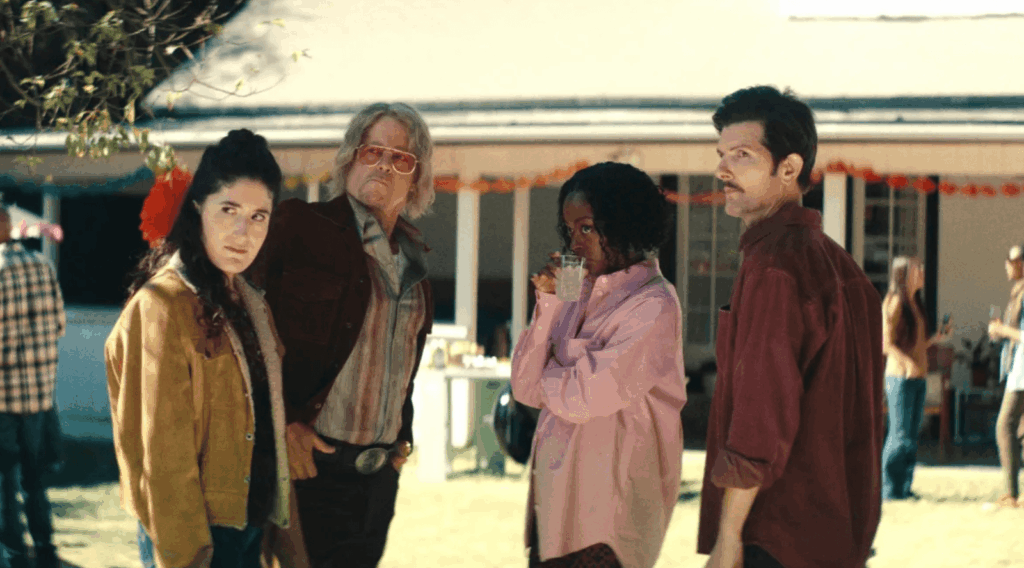
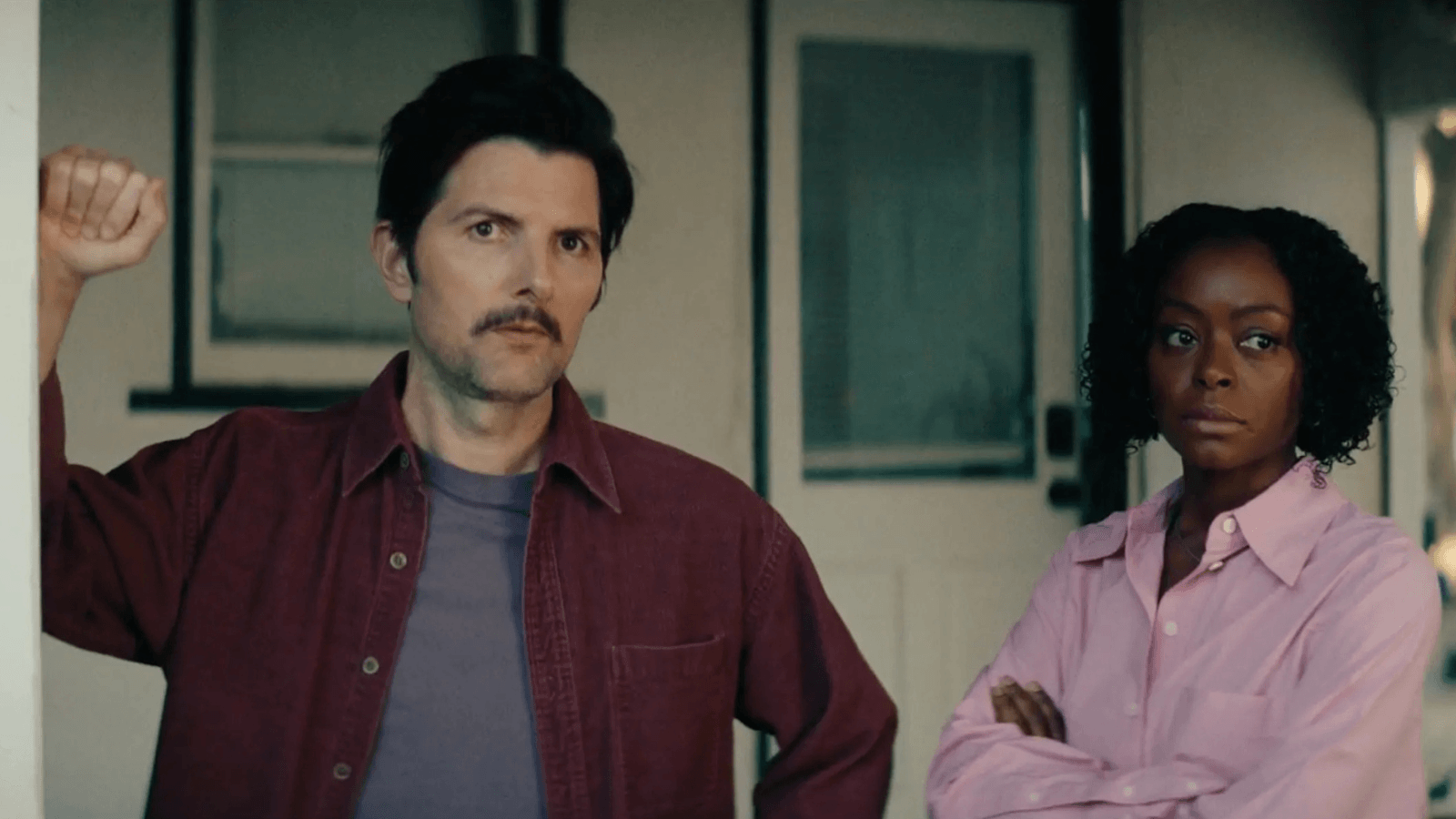
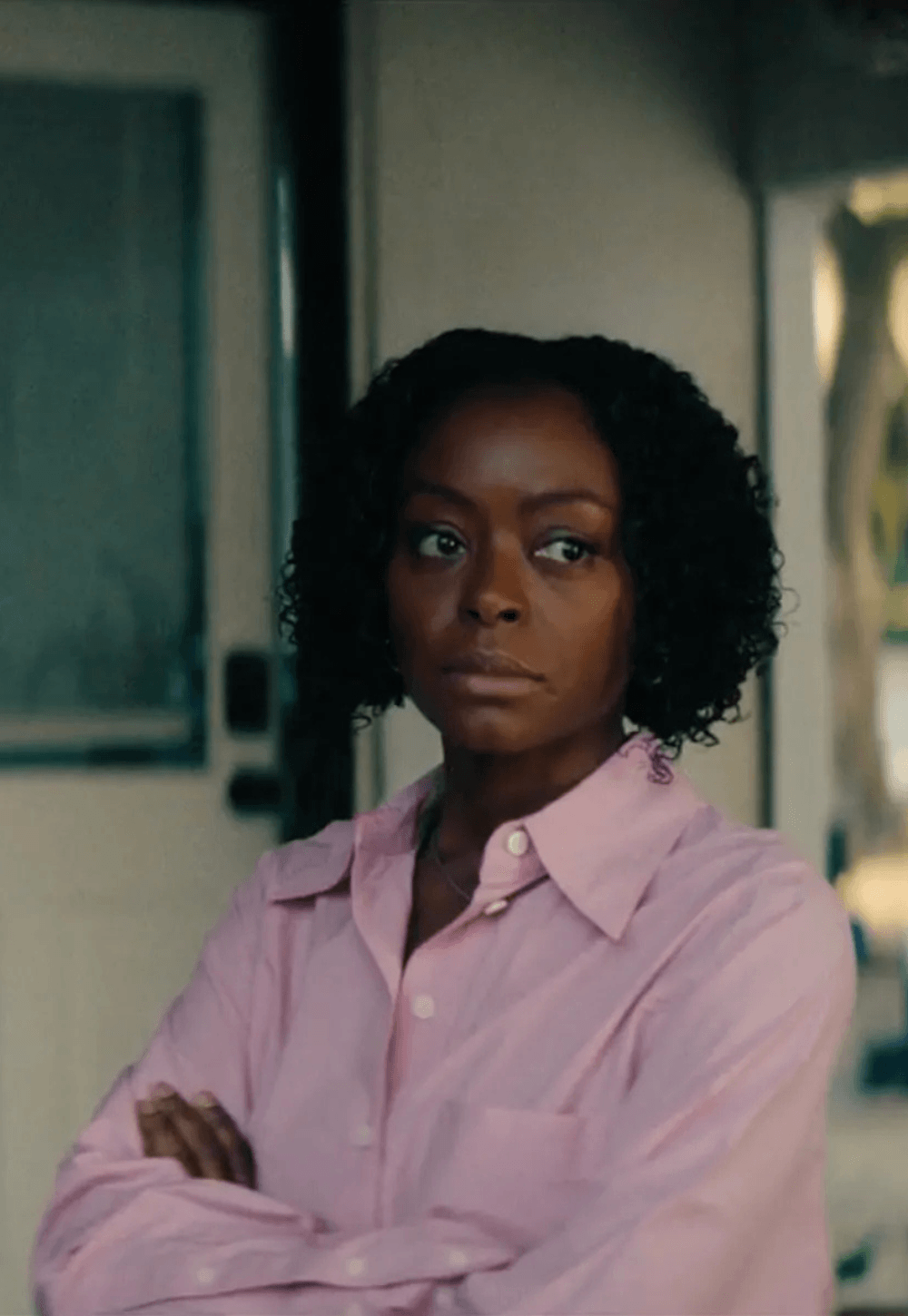
The story opens with a recurring nightmare: Sean (Adam Scott) dreams of a pulsating light from outside, brief flashes of clocks, and a nasty leg wound. When he wakes, Sean isn’t in his bed; he’s in his man-cave garage, where he’s been sleeping since agreeing to split with his partner, Kim (Danielle Deadwyler). For extra income, Sean and Kim have rented out their guest house on Airbnb to the kindly and thoughtful siblings Amir (Theo Rossi) and Jahan (Nazanin Boniadi). Amir is an architect; Jahan is a physicist. Because Jahan is deaf, she signs their gratitude: “It’s a great step forward for humanity when we let strangers sleep among us.” But over their guests’ eight-day stay, the hosts begin to suspect them of something after Sean’s sister Cleo (Kate Berlant, excellent) implants the idea that they’re a “sleeper cell.”
Why, for instance, do their guests receive a package containing blueprints of the local mausoleum, the very spot where the President will be visiting in a few days? Are they planning a terrorist attack? The suspicions mount, and with nothing better to do than obsess, the out-of-work Sean jumps to conclusions. Perhaps he’s unconsciously influenced by his right-wing parents (Ron Perlman, Colleen Camp), who harbor a low view of Muslims and pretty much anyone who isn’t white. At first, Kim is skeptical, believing that Sean’s current inactivity has led him to surveil his neighbors. But as holes emerge in Amir and Jahan’s story and other dubious details accumulate, Kim begins to suspect them as well. Curiously, their relationship begins to heal from their shared paranoia. Both Scott and Deadwyler do wonders with their complex roles, alternating between riotously funny and messy people.
Channeling aspects of Joe Dante’s The ‘Burbs (1989), Hamedani and Betz cleverly turn Sean and Kim’s Islamophobia—widespread in America, particularly since 9/11—into a symptom of something deeper in their marriage. This is further illustrated by the garage’s water-damaged, moldy ceiling, which initially serves as a metaphor for Sean’s laziness and souring identity. Then, it becomes a symbol of their decaying marriage and xenophobia. However serious that may sound, The Saviors never becomes too heavy, even amid somber scenes of Kim’s disenchantment and Sean’s increasingly zealous behavior. Alas, the movie veers into farcical territory when Cleo hires a private investigator, Jim Clemente (Greg Kinnear), who looks like a parody of a 1970s sitcom character. Kinnear’s goofball presence and bad wig are the most outlandish aspects of the story and seem to belong in another movie altogether.
With its winking title and darkly comic scenario, The Saviors smartly plays with the audience’s inadvertent prejudices before confronting them with reality. The impact of the final revelation has, however, been softened by an overly explanatory coda. (Indeed, there’s a moment when the movie should have ended, but it goes on to explain instead of trusting the viewer to fill in the blanks.) Hamedani’s treatment is formally unexceptional but competent, whereas his talented and affable cast pulls off an unlikely feat by making some truly frustrating people somehow palatable. Scott and Deadwyler provide a convincing, likable couple on the surface, and Hamedani skillfully manipulates us into thinking they’re the good guys. It’s a well-acted and timely movie that holds up a mirror to racism in American culture, using its predictable yet no less effective ending as a moral gut punch.
Thank You for Supporting Independent Film Criticism
If the work on DFR has added something meaningful to your love of movies, please consider supporting it.
Here are a few ways to show your support: make a one-time donation, join DFR’s Patreon for access to exclusive writing, or show your support in other ways.
Your contribution helps keep this site running independently. However you choose to support the site, please know that it’s appreciated.
Thank you for reading, and for making this work possible.
Brian Eggert | Critic, Founder
Deep Focus Review