Mother Mary
By Brian Eggert |
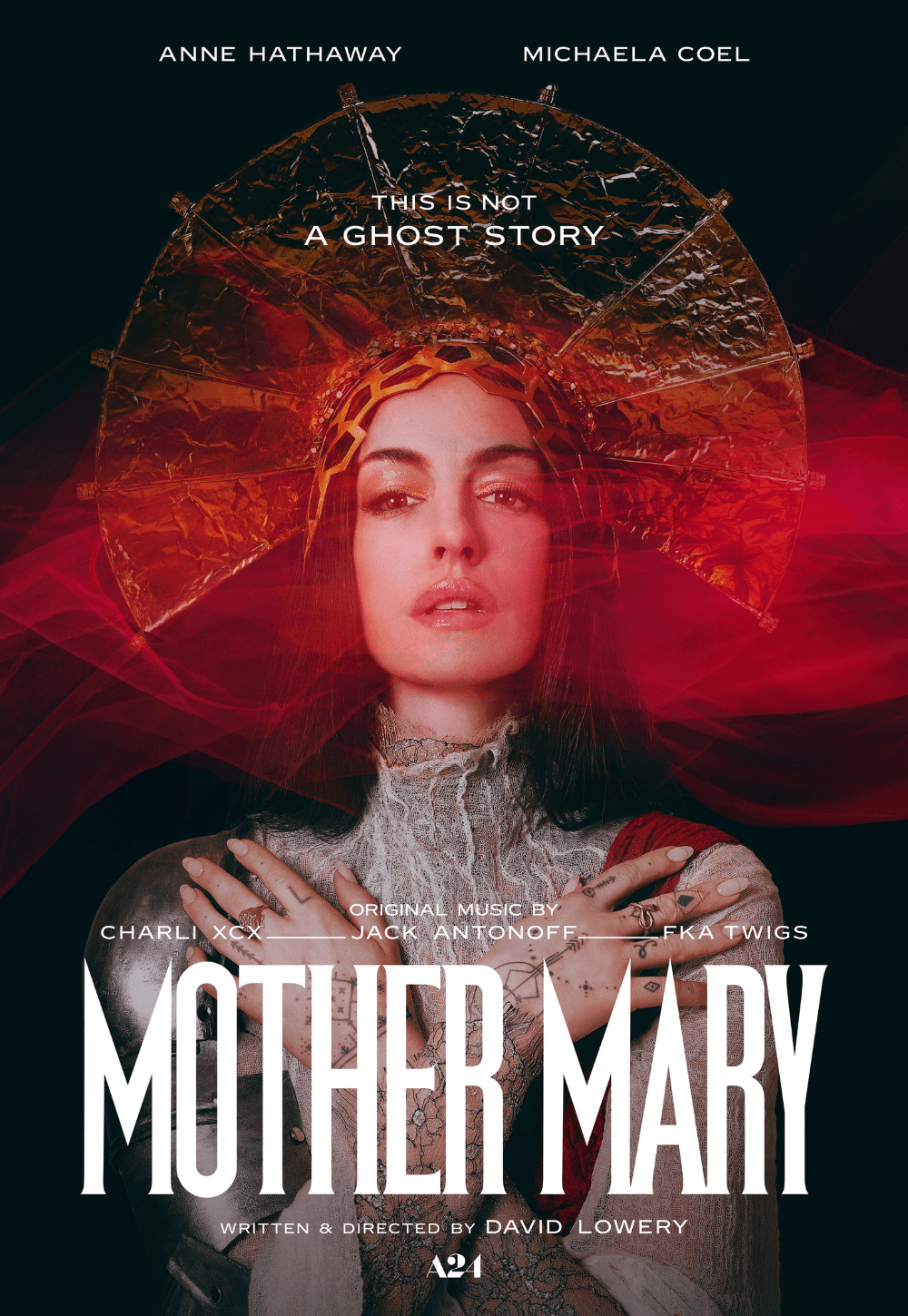
With Mother Mary, writer-director David Lowery seems pretty confident that he’s made a profound work of art that will blow moviegoers’ collective mind. Largely a two-hander between a pop star and her long-estranged friend, a famous fashion designer, the film promises to show us the most beautiful dress ever made, worn by the titular star as she performs “the best song ever written in the history of songs.” Anne Hathaway plays Mother Mary, an amalgam of Lady Gaga and Madonna, complete with a name that appropriates religious iconography for superficial purposes. At least Hathaway and her co-star, Michaela Coel (recently seen in The Christophers), deliver extraordinary performances out of Lowery’s mannerist script. Otherwise, we’re stuck with a sluggish, self-important drama that at times plays like bad avant-garde theater. Mother Mary should be seen for their performances alone. Everything else proves overwrought, with heavy-handed symbolism and dialogue so entrenched in metaphors that, at a certain point, the viewer stops caring what it all means.
Lowery’s hit-or-miss directorial career has seen him alternate between indie productions for A24, such as A Ghost Story (2017) and The Green Knight (2021), and occasional live-action reimaginings of Disney classics, including Pete’s Dragon (2016) and Peter Pan & Wendy (2023). Lowery also dabbled in a strain of earthy dramas that register as stylistic throwbacks to 1970s character pieces. See Ain’t Them Bodies Saints (2013) and The Old Man & the Gun (2018). His latest doesn’t have obvious antecedents, yet it boasts the limited location and fabric-centric ghost of A Ghost Story, along with the majestic compositions of The Green Knight. It’s admirably unique in its genre mashup, combining elements of a chamber piece, a pop music concert, and a possession movie. The result at once transcends those genre descriptors and falls short by doing none of them particularly well. And as a critic who often complains about too few original films in theaters, the irony is not lost on me: here is a fairly original film, except it didn’t work for me.
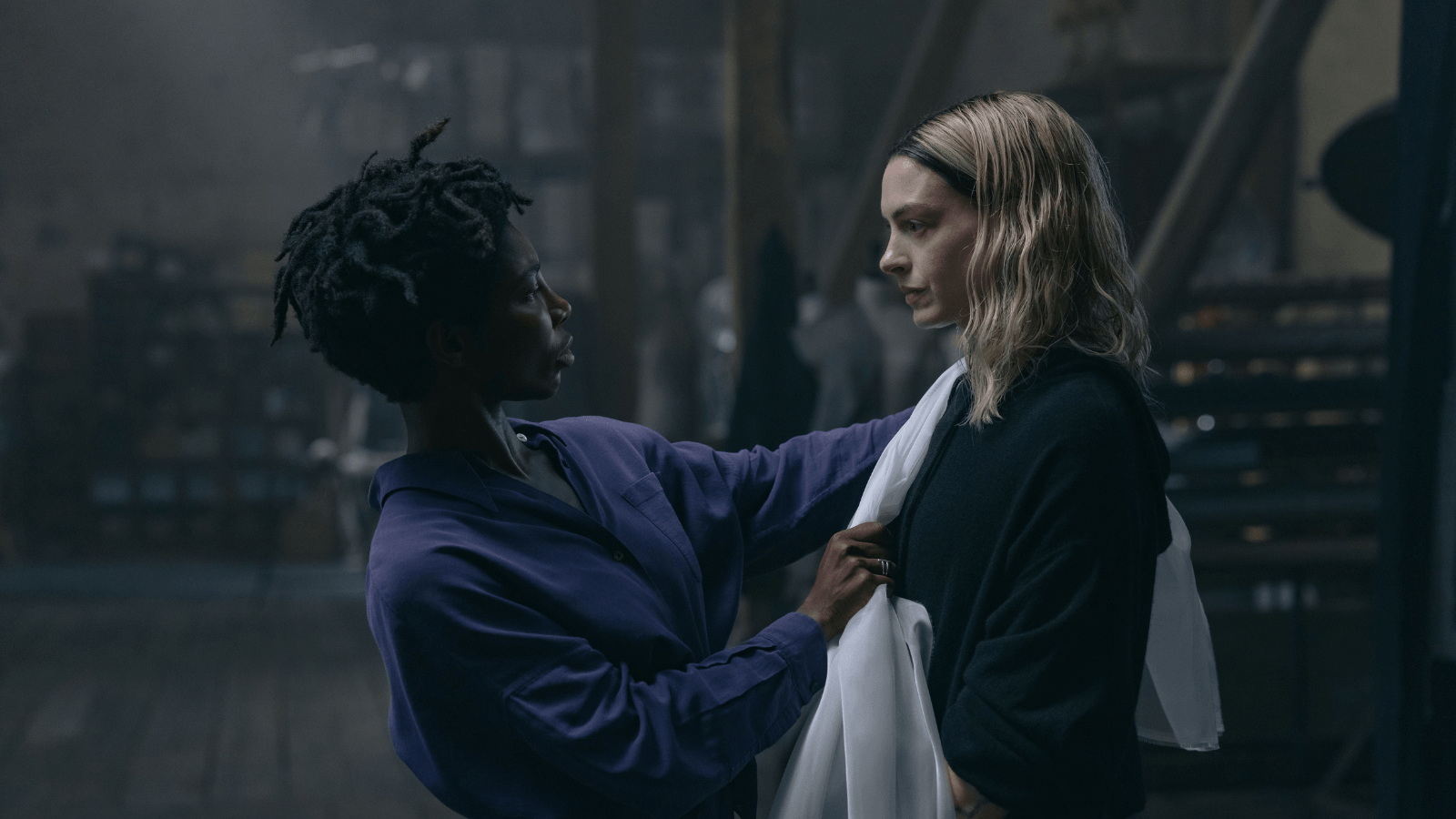
Months after some mysterious on-stage accident (?), which Lowery reveals later, the superstar with the absurd stage name (let’s call her Mary), whose signature look entails an ornamental halo, arrives at the studio estate of fashion designer Sam Anselm (Coel). Sam was Mary’s personal designer before the singer claimed she “needed a change.” Mary now returns to ask for a last-minute dress for her comeback concert and, in the process, to repair their friendship. In Sam’s winding monologues, she claims to feel nothing but indifference toward Mary, before going on to call her a human cancer. There are evidently some feelings there. Nevertheless, after some resistance, Sam resolves to help. But first, she must understand Mary’s headspace. Sam’s process, after all, is about the “transubstantiation of feeling” into her designs. Sam insists that Mary agree to wear whatever she designs. Mary has only one rule: no red.
The first act, in which the two characters engage in a verbal sparring match over their history and whether Sam will make Mary a dress, establishes a loaded dynamic, propelled by Sam’s persistent animosity and Mary’s teary fragility. For instance, Sam won’t listen to Mary’s new song, “Spooky Attraction.” (That’s right. The “best song ever” in this film’s universe is called “Spooky Attraction.”) Sam demands that Mary dance without her music, so she can see what her dress will be expected to endure. The show-stopping performance begins like a ballet and ends like a possession, and Hathaway’s raw physicality impresses. Elsewhere, these two former friends communicate in bold language. Their passion is deep and primal—just the sort of habitat that invites ghosts. Sure enough, Mother Mary soon introduces a malignant presence haunting both Sam and Mary, while also representing a metaphor for the fissure in their friendship that they must exorcise.
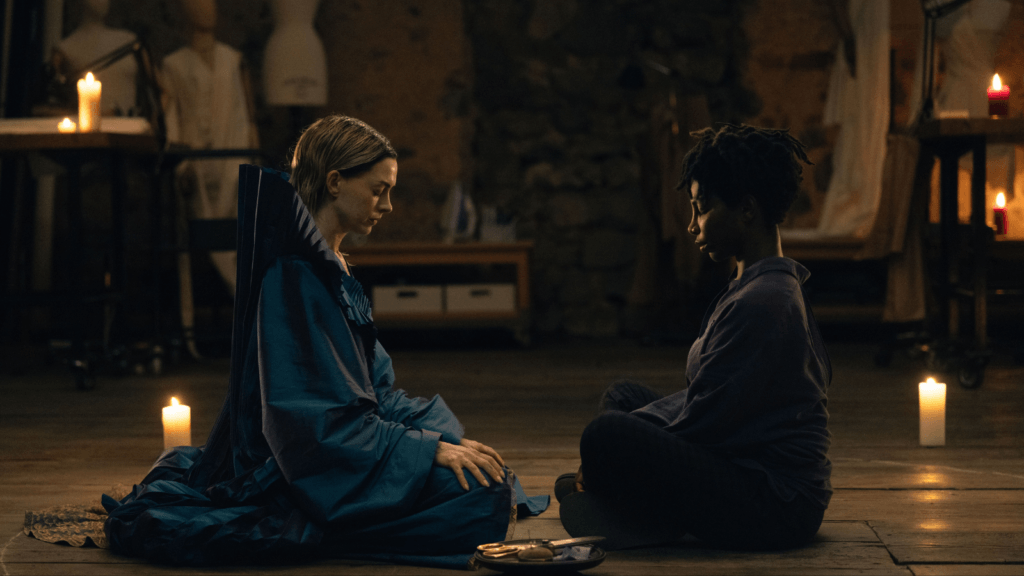
Lowery’s script is full of metaphors; so many, in fact, that the characters even admit to being confused by the sheer number of metaphors in their discussion. The director’s stark imagery also has a similar symbolic flair, with flowing crimson fabric representing both the ghost and the specter in their friendship. Of course, most pop stars aren’t interested in subtlety, so neither is Lowery. Several flashbacks to Mother Mary’s past concerts show elaborate designs and dance routines for thousands in attendance. Unfortunately, Lowery’s efforts suffer from a common malady among films about successful musicians: the music isn’t very good. Written by FKA twigs—who also plays Imogen, a medium who conducts a séance in a flashback—the songs don’t offer a single earworm, whereas the music in Vox Lux (2018) and even Smile 2 (2024) managed the whole fictional pop-star thing better.
Mother Mary is also quite a dark film—thematically, obviously, but also visually. It’s the sort of picture that will expose how much your theater of choice has dimmed its bulbs, leaving many scenes submerged in a thick gray soup. No doubt this was a factor in my inability to fully engage with Lowery’s characters. Cinematographers Andrew Droz Palermo and Rina Yang shoot the primary location, Sam’s interior studio space (which appears to be a barn converted by production designer Francesca Di Mottola), with a limited sense of space and color. The underlit set looks bleak aside from the bold strokes of red, both in the ghost’s appearance and the bloody scenes that precede its arrival. Much like The Green Knight, the grandiose imagery throughout seldom has the same emotional impact on the viewer.
However, the technical presentation is less of a problem than Lowery’s writing. His characters never behave like real people, speaking in a circular, poeticized manner that might work better on a theatrical stage. Little about these characters can break through their affected, stagelike way of speaking to each other. Maybe that’s what Lowery intended: a filmed play illuminated by cinematic asides. Whatever the intention, the film holds only intermittent interest. Hathaway and Coel breathe life into their scenes, enough so that watching their choices as actors is more compelling than the material they perform. But because the narrative never comes together in the penetrating way Lowery intends, the result tends to feel too lofty and satisfied with its artistry to be genuinely moving.
Thank You for Supporting Independent Film Criticism
If the work on DFR has added something meaningful to your love of movies, please consider supporting it.
Here are a few ways to show your support: make a one-time donation, join DFR’s Patreon for access to exclusive writing, or show your support in other ways.
Your contribution helps keep this site running independently. However you choose to support the site, please know that it’s appreciated.
Thank you for reading, and for making this work possible.
Brian Eggert | Critic, Founder
Deep Focus Review