Short Takes
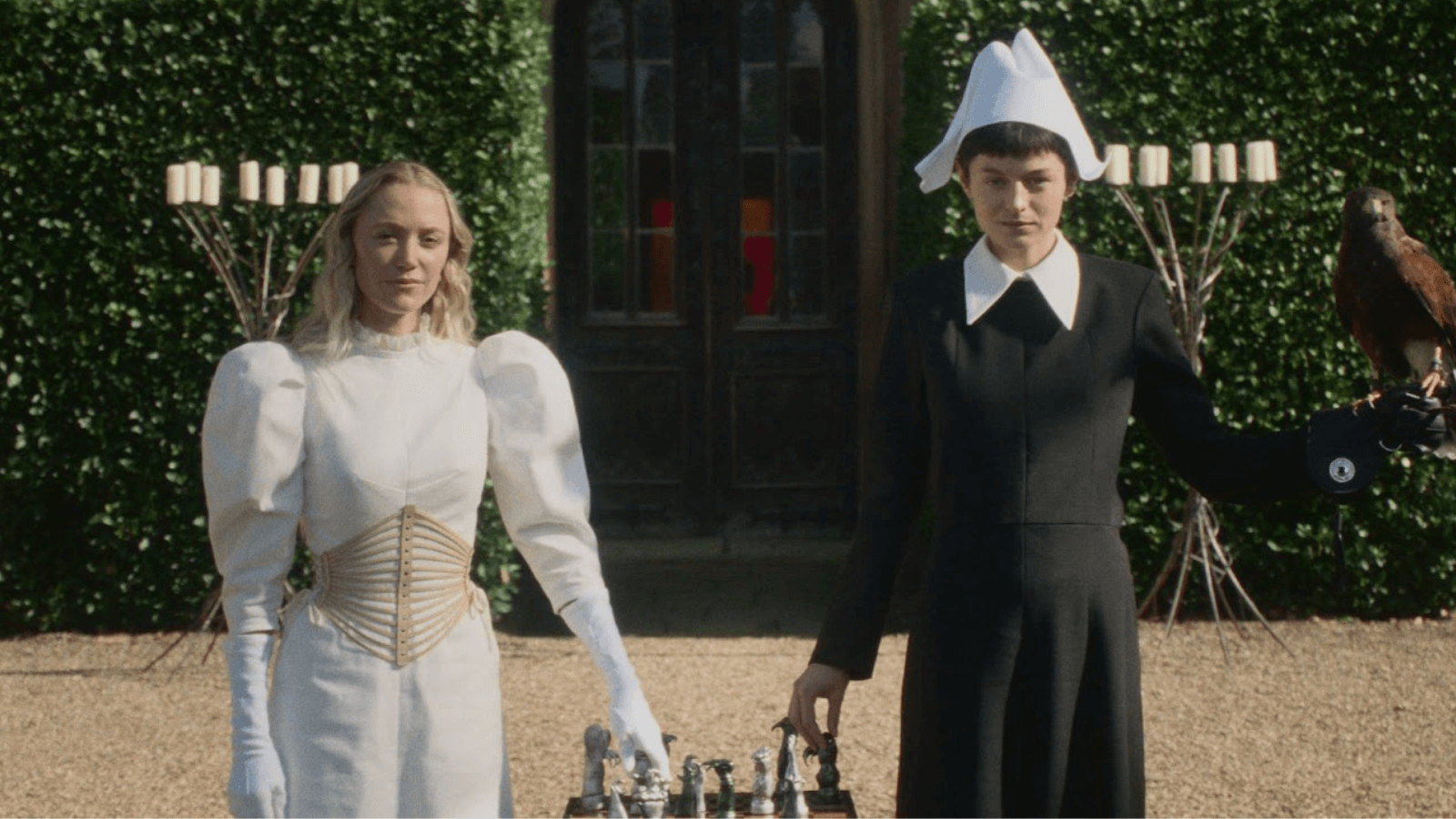
100 Nights of Hero
By Brian Eggert |
At once fey and twee, 100 Nights of Hero is a feminist fantasy written and directed by Julia Jackman. While the subject matter has obvious potential, and the production boasts an excellent cast, the execution adopts a tiresome postmodern affectation that feels like the convergence of Ever After (1998) filtered through the aesthetics of Autumn de Wilde and the voice of Emerald Fennell. Based on the graphic novel One Hundred Nights of Hero by Isabel Greenberg—a spin on One Thousand and One Nights, the famous collection of Middle Eastern folktales—the film relies too much on surfaces never becomes genuinely moving. Ultimately, it’s an undercooked romance whose politics couldn’t be more transparent or more obviously embedded into the dialogue.
Maika Monroe plays Cherry, a woman whose husband Jerome (Amir El-Masry) is tasked with impregnating his wife in 100 days—so says the cabal of patriarchal goons pulling the strings. While Jerome goes away on business, he allows his scheming friend Manfred (Nicholas Galitzine) to stay in the house. They even wager that Manfred can do what Jerome could not. Jerome, it seems, has no interest in the inexperienced Cherry. While Manfred attempts to woo the lonely wife, Cherry’s maid Hero (Emma Corrin) spins a series of tales to keep her occupied. Charli XCX plays the subject of Hero’s tales, a beleaguered bride. Inevitably, Cherry realizes it’s neither Jerome nor Manfred she desires. It’s Hero. All the while, Jackman writes with the subtlety of a bulldozer, with domineering men who say things like “Knowledge wasn’t made for you.”
Apart from some compelling visuals, 100 Nights of Hero never goes beyond a surface-level treatment of its characters or narrative. Cherry’s story isn’t compelling, nor are the fictions recounted by Hero. But its veneer is gorgeous, with elaborately decorative costumes by Susie Coulthard and ornate sets by production designer Sofia Sacomani. Cinematographer Xenia Patricia shoots like she just finished watching Wes Anderson’s entire oeuvre, employing a familiar blend of symmetrical and tableau-like compositions, albeit with a softness to the images that lends the look of a period piece shot in the 1960s. Even as I describe this, I recognize that 100 Nights of Hero has all the elements to make a delightfully nonconformist indie catered to a Gen Z audience. It’s an amusingly ironic and lushly aestheticized deconstruction of folklore, except that few of the emotional beats stick in any meaningful way.
Thank You for Supporting Independent Film Criticism
If the work on DFR has added something meaningful to your love of movies, please consider supporting it.
Here are a few ways to show your support: make a one-time donation, join DFR’s Patreon for access to exclusive writing, or show your support in other ways.
Your contribution helps keep this site running independently. However you choose to support the site, please know that it’s appreciated.
Thank you for reading, and for making this work possible.
Brian Eggert | Critic, Founder
Deep Focus Review