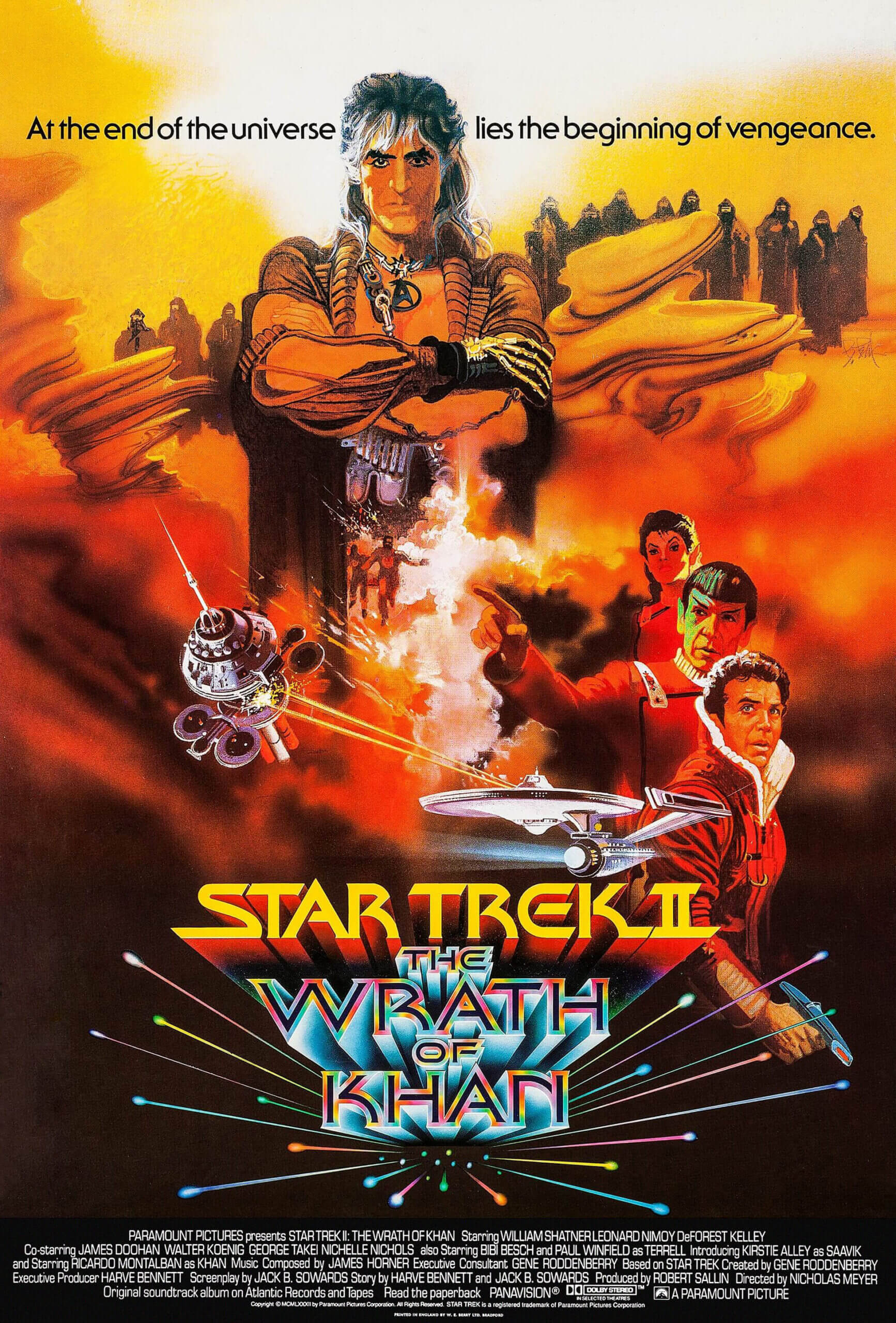
Star Trek II: The Wrath of Khan
By Brian Eggert |
“’It was the best of times, it was the worst of times,’” reads William Shatner’s Admiral Kirk from A Tale of Two Cities, the book Leonard Nimoy’s Captain Spock gives him as a birthday gift. How appropriate that DeForest Kelley’s Dr. McCoy gives Kirk antique reading glasses. Both gifts send Kirk into a ruminative state, forcing him to consider his life, his age, impending death, and how he wants to continue living. Fortunately, Star Trek II: The Wrath of Khan, widely regarded as the best in the franchise, allows him to work through his existential crisis. This thoughtful and exciting picture from 1982 happily revitalizes the Star Trek spirit established by Gene Roddenberry’s pivotal television series, emphasizing the undertonal space-buccaneer themes to create a full-fledged swashbuckler in the stars. Incorporating adventure and humor, and stressing the character dynamics that would accompany future films, for loyalists of the Enterprise’s original crew, this sequel is the bible against which all other Trek films would be judged.
After the lukewarm reception of Star Trek: The Motion Picture, Paramount Pictures had less confidence in the prospect of a sequel. Granted, it made $139 million on a $46 million budget, but the film still wasn’t considered a sensation. The slow-moving visual splendor of the first failed to evoke the intended comparisons to the grand spectacle of 2001: A Space Odyssey (1968), and it proved too measured in its pacing to be likened to Star Wars (1977). For the second go-round, Paramount removed the show’s creator, Gene Roddenberry, from a position of creative influence and ignored his script for the sequel—a time-travel yarn involving Klingons and the JFK assassination. And so, Roddenberry was reduced to the ambiguous position of an executive consultant, while the producers sought an entirely different approach for the follow-up. They reduced the original’s sizeable budget to little more than a B-movie price tag, leaving the filmmakers preoccupied with how to stretch their meager $11 million—$35 million less than its predecessor. But then, sometimes, a skilled filmmaker is forced into creative decisions they might not otherwise make, all because a small budget requires them to innovate. Such is the case with The Wrath of Khan.
In Roddenberry’s place, Nicholas Meyer and Harve Bennett signed on as director and producer. Bennet resolved to write the script and, believing the sequel needed a strong villain, chose an episode from the original series, “Space Seed,” as the basis for the screen story. Rather than a standard Klingon or Romulan villain, the episode featured a memorable bad guy: the genetically engineered superhuman Khan Noonien Singh (Ricardo Montalbán). In the episode, the Enterprise encounters the Botany Bay. Its passengers were cryogenically frozen on Earth in the 1990s, then sent into space, where they drifted for the next three hundred years until the Enterprise found and thawed them. As it turns out, they’re supermen from Earth’s “Eugenics Wars” who took over most of the planet (Khan’s name was meant to reference the Mongolian ruler) before being defeated, frozen, and banished to space. The episode ends when Kirk thwarts Khan’s attempt to take over the Enterprise, then leaves Khan and the crew marooned on an uninhabited planet to make a new life for themselves.
Jack B. Sowards wrote the initial script based on Bennett’s idea, but Meyer wasn’t satisfied with the result and authored the final draft of the screenplay in an uncredited rewrite, using bits and pieces of the various scripts that had surfaced since production began. Having a little more history with Star Trek than sitting down with a few episodes prior to writing, Meyer picked up on the naval strains of Roddenberry’s ship-in-the-stars setup and went from there. Much of the rewrite process, which took Meyer a mere 12 days to complete, involved imbuing the film with an overarching theme that ruminates on life, death, and rebirth—a theme foreshadowed in Kirk’s reading from A Tale of Two Cities in the early scenes. The theme also underscores that The Wrath of Khan was intended as a new beginning for Star Trek on film, leaving The Motion Picture a distant memory.

All throughout the writing and pre-production processes, Industrial Light and Magic scraped together what sets and models they could from the previous film to make special FX for this sequel. Montalbán, arguably at the height of his popularity thanks to his show Fantasy Island, found it strange to return to the one-episode character after so many years, yet he finally signed on. The rest of the original cast also returned, although Nimoy resisted and later admitted he only did so because Meyer promised to give Spock a worthy death scene. And when rumors leaked of Spock’s death in the film, fans wrote angry letters to Paramount, and Nimoy received threats. Fortunately, Nimoy enjoyed Meyer’s directorial style and the entire experience of filming The Wrath of Khan so much that he asked the studio to find a way to bring him back. This led to the addition of Spock’s mind-meld with McCoy and the final scenes in which Spock’s body ends up on the Genesis Planet.
But let’s not get ahead of ourselves. The film’s plot involves scientists—among them Kirk’s old flame Carol (Bibi Besch) and their son David (Merritt Butrick)—testing a desert planet for the possible use of the terraforming Genesis Device, a still-being-tested project that brings abundant new life to any dead planet. Trouble is, the proposed test area is where the Botany Bay was marooned by Kirk so many years ago. After taking hostages and commandeering the Federation starship Reliant, Khan begins a vengeful hunt for Kirk. Meanwhile, back at Starfleet, Kirk regrets becoming an admiral and begins to yearn for the captain’s chair once more. While teaching cadets, such as the newly introduced Lt. Saavik (Kirstie Alley, in her first film role), to accept that the “Kobayashi Maru” exam has no acceptable solution, Kirk realizes he needs to feel young again—with a touch of adventure. He gets his chance when he learns of Carol’s predicament and races out to save her.
What ensues is an angry battle compiling impressive, if low-budget, special effects, the original crew’s best acting, clever dialogue, and a fast-paced scenario. Khan lays traps for Kirk, and Kirk must engage in a no-win scenario much like the “Kobayashi Maru”. And since Kirk is the sole Starfleet cadet to pass that test (by cheating), he’s the sole man who can stop Khan. Underneath it all, themes of death and rebirth give the entire procession an air of high drama, complete with Spock’s sacrificial death in the finale and his promised rebirth when his body lands on the Genesis Planet—the planet injected with a fast-moving, life-bringing process. What remains fascinating about The Wrath of Khan is how taut and efficient the storytelling is, both in its rapid-fire pacing and the effectiveness of its resounding themes.

Even though Roddenberry protested Meyer’s inclusion of naval and maritime vocabulary into the story, it transforms this sci-fi story into something relatable to more than just die-hard fans. Meyer used the adventures of Horatio Hornblower as inspiration, which also inspired Roddenberry for the television show. The director also employed a sort of reverse-Moby-Dick scenario in which Kirk serves as Khan’s white whale. To further amplify the stakes, Meyer didn’t shy away from gritty details and death. When Khan brainwashes his victims with an eel that enters through the ear, the bloody result is squirm-inducing, which the filmmakers called “a Fangoria scene”. Or note how, after Kirk successfully attacks the Reliant, leaving the genetically engineered villains dead and only Khan alive, Khan appears horribly burned and bloody. To be sure, Meyer benefited from the MPAA’s less stringent rules to earn the film’s eyebrow-raising PG rating.
While fans clamor over Khan as the villain and still regard him as an all-time favorite, this Trekker finds the decision quite arbitrary when revisiting “Space Seed”. The episode never establishes a pivotal connection or conflict between Kirk and Khan; there’s never a major confrontation or ideological opposition, aside from Khan trying to take over Kirk’s ship and Kirk, naturally, protecting it. Khan appeared in just one episode of Star Trek, so the heightened conflict seems even less likely. There seems to be a deeper implied history between Kirk and Khan, though they never once appear face-to-face during The Wrath of Khan, besides on the viewscreen. Earlier drafts of the screenplay included an extended face-to-face between the two, which may have solidified that conflict for audiences—not that the majority of fans have any trouble seeing Khan as the ultimate Star Trek villain, curiously enough.
Although the central conflict in The Wrath of Khan feels somewhat synthesized, what the film cultivates naturally are the relationships among the main crew, namely between Kirk, Spock, and McCoy. This character-trifecta dynamic was hinted at within the show, all but nonexistent in The Motion Picture, and was rarely given the chance to flourish as it does here. Kirk finally becomes the intelligent-yet-brash decision-maker, with Spock as his center of ever-empowering Logic, and McCoy presents his moralist slant—traits that combine to reflect the essence of humanity. When Spock dies saving the Enterprise crew in the finale, the blow is marked with tragedy as well as reflection. Spock reminds Kirk, “We’ve been through life and death together.” It’s a genuinely heartrending scene, even if the script too often repeats Spock’s line, “I have been, and will always be, your friend.”

Later re-released on television and home video in a “Director’s Cut” edition, the expanded version included scenes that answered some questions while leaving others frustratingly unresolved. In the theatrical version, Scotty is extremely broken up by the death of an engineering crew member. The “Director’s Cut” reveals this is Scotty’s nephew, which brought a new emotional wallop to Scotty’s otherwise supplementary presence. Still, the newer version doesn’t correct some of the film’s inconsistencies, such as why Lt. Saavik cries at Spock’s funeral, since Vulcans don’t cry or experience illogical emotion. The film also doesn’t explain how Chekov knows Khan when they first encounter each other; after all, Chekov was not among the show’s crew members when “Space Seed” first aired, and therefore wouldn’t know Khan, nor would Khan know Chekov. Nor does the film elaborate on the aforementioned lack of opposition between Kirk and Khan, which is blown up by the film’s silliest scene, in which Kirk shouts “Khaaaaan!” in outrage. But the film’s thematic tightness makes up for what it lacks in story continuity.
That the film is considered the best of the Star Trek films is something that will always earn vigorous debate, at least from this critic’s perspective. The Voyage Home has a more significant social message, and First Contact, with the beloved crew from The Next Generation, employs a Moby-Dick conflict inspired by The Wrath of Khan, but it does so with a long-established villain: the Borg. (First Contact also contains directorial bravado and polish like the franchise has never known.) Nevertheless, The Wrath of Khan broods over old age and lost time, suggesting that perhaps Shatner, Nimoy, Kelley, and the rest are past their prime and should end while they’re ahead—otherwise, some bigger fish (like Star Wars) will come along and swallow them up. But as the final frame on the Genesis Planet suggests, this adventure gave the franchise a regenerative quality, earning it a then-record-breaking opening weekend of $14 million and establishing it on film. Though it would go on to earn less than The Motion Picture, with just $97 million, it was ultimately more profitable and left Paramount keen to explore future sequels.
As it is, The Wrath of Khan stands as one of the most thematically realized and articulated Star Trek films, next to The Voyage Home and First Contact. It boasts a character-driven plot, an imposing villain blindly bent on vengeance, and the hero at an existential crossroads between his past and future—all engaging concepts, dramatically. Moreover, The Wrath of Khan does something that movies based on television shows have tried to do but often failed to accomplish: it elevates the material from TV to film with appropriate gravitas. Meyer embraces the show’s mildly campy quality at times, but he also elevates the material for later films to build upon. Whereas The Motion Picture tried much too hard to raise Star Trek into realms too heady given the quality of the TV show, The Wrath of Khan takes a natural progression forward, easing the viewer into the cinematic medium by embracing the sheer entertainment value of Roddenberry’s original creation. Doubtless, this is why so many Trekkies ignore the existence of The Motion Picture altogether, and why many of the subsequent entries in the series naturally became films worthy of cinematic merit.
Thank You for Supporting Independent Film Criticism
If the work on DFR has added something meaningful to your love of movies, please consider supporting it.
Here are a few ways to show your support: make a one-time donation, join DFR’s Patreon for access to exclusive writing, or show your support in other ways.
Your contribution helps keep this site running independently. However you choose to support the site, please know that it’s appreciated.
Thank you for reading, and for making this work possible.
Brian Eggert | Critic, Founder
Deep Focus Review