Pillion
By Brian Eggert |
A meditation on desire and selfhood, Pillion considers the sexual subculture of BDSM relationships in a way that never feels sensational or exploitative. Instead, it’s a raw, quietly devastating story about experimenting with intimacy to learn your needs, desires, and limits in a relationship, both emotionally and physically. It’s also quite funny, delving into how comically awkward new sexual experiences can sometimes be, not to mention what happens when you introduce your new partner to your parents. Anchored by two superb performances from Harry Melling and Alexander Skarsgård, this adaptation of Box Hill, the 2020 novel by Adam Mars-Jones, marks the debut feature by Harry Lighton. The British filmmaker, whose adaptation earned him the Best Screenplay award at last year’s Cannes Film Festival, avoids any comparison to, say, the adult-themed fantasies E. L. James manufactured in her Fifty Shades book series and movies. Rather than a lurid, salacious work of pulp, Lighton prefers to explore an intimate character study about Dom/sub partners from within.
The title refers to the back seat of a motorcycle, an unmissable metaphor for how the protagonist, Colin (Melling), feels like a passenger in his own life, but also how he finds that submissive position fulfilling in complex ways. The first shots show a biker speeding on a crotch rocket through suburban streets to a Spanish-language cover of Little Peggy March’s “I Will Follow Him” (wink!). Colin sees the bike pass him on the road, and he perceptively deflates at the sight. Perhaps he’s jealous that the biker, clad in a white leather getup, appears so independent and certain of his direction, whereas Colin flounders. Or maybe Colin—a twentysomething man who lives with his kindly, supportive parents, Peggy (Lesley Sharp), who has only months left in her battle with cancer, and Pete (Douglas Hodge)—just wants someone to follow. Colin works as a parking enforcement officer and is a member of a barbershop quartet that performs at the local pub. Along with his timidity, he has such trouble meeting men and dating that it’s worth wondering whether he’s ever had a serious relationship.
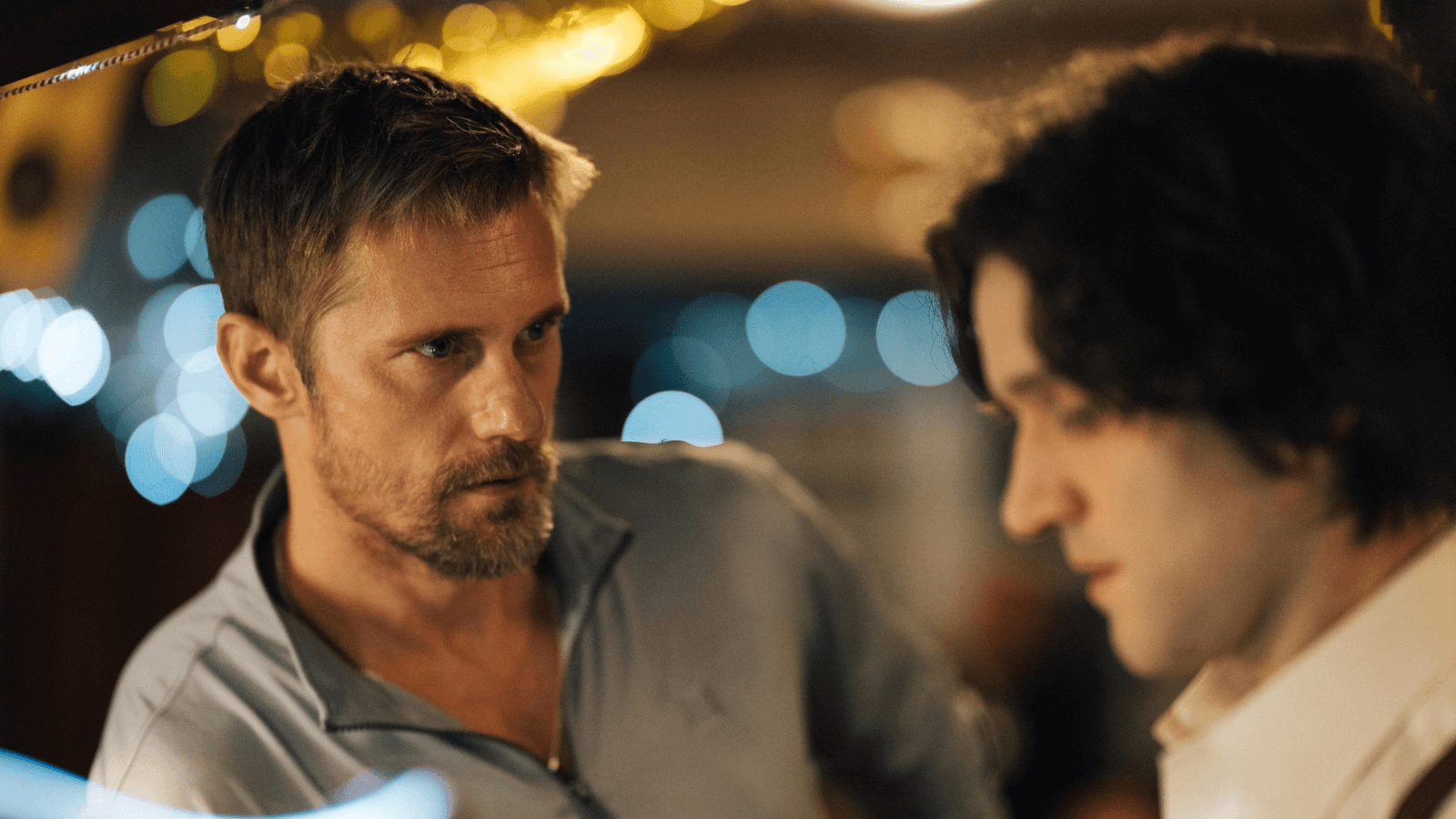
Then Colin meets Ray (Skarsgård), the aforementioned biker, who unceremoniously invites him out on Christmas Day, leading to an alleyway encounter where he yields to Ray’s command-question: “Do you give?” Standing 6’4” and built like a Viking vampire, Ray never articulates the dynamics or rules of their D/s relationship, and his comparatively diminutive new pupil learns as he goes, quietly amused and excited about their experiences. He pursues Ray, who soon invites Colin to his townhouse, where Colin will prepare Ray’s meals, sleep at the foot of his bed, and perform a series of domestic tasks. Initial discomforts aside, Colin soon learns he has “an aptitude for devotion” that extends to wrestling, close-trimmed hair, leather, and a chain with a padlock around his neck. Ray has the key. Colin has never experienced such pleasure, but their relationship hardly meshes with the rest of his life.
Even as Colin learns to crave Ray’s commands, he also yearns for aspects of a more traditional relationship. Most people would avoid introducing their parents to the source of their kink, but Colin feels pulled between his sexual desire and his need for a domesticated, storybook love. One of the funniest yet heartbreaking moments in Pillion entails Colin trying to justify this unconventional behavior to his parents, Peggy above all, as she only sees Ray as someone who treats her son like a servant. Peggy doesn’t understand, and that makes her suspicious of Ray. When she confronts her son’s beau, it doesn’t go well. “Deciding that what makes you uncomfortable is bad for your son is backward,” Ray tells Peggy, before calling her line of thinking “ignorant.” That reasoning could be applied to any number of situations, and it cuts into parents who want their children to be mirror reflections of themselves. Fortunately, Pete is accepting and less judgmental of his son’s choices.
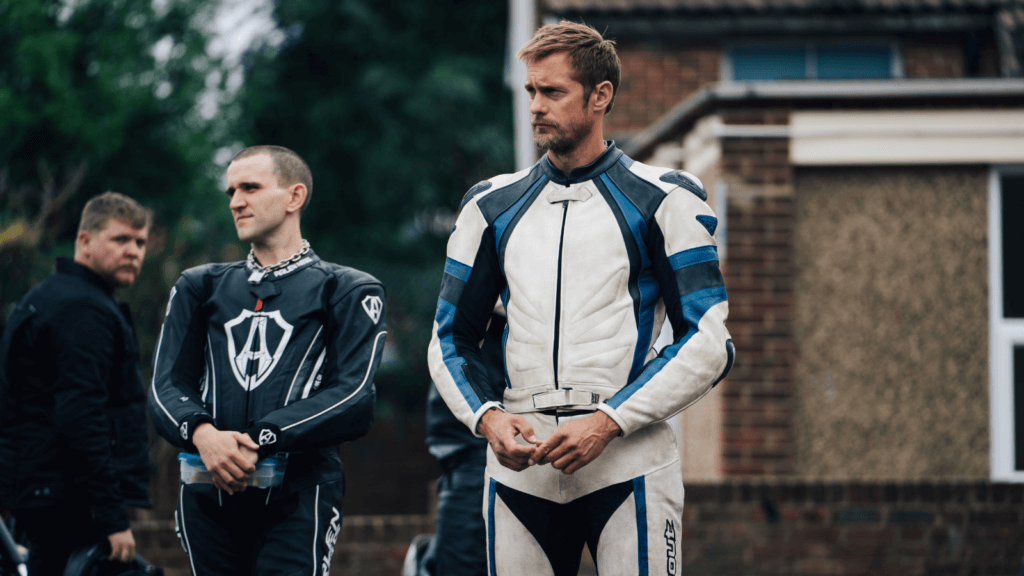
Lighton’s script never declares this or any kind of relationship to be unhealthy. For some in Ray’s circle of BDSM friends, this manner of power-based coupling works. One wonders, though, how sustainable such a lifestyle will be in the long term. Lighton doesn’t explore the longevity of these relationships. Even Colin begins to test his boundaries with Ray after his mother passes, and Ray proves initially unreceptive to his need for emotional support. “That’s not what this is, Colin,” Ray tells him. “That’s not the point.” Even so, Ray’s eventual, compassionate acquiescence to Colin’s request for “a day off” provides a clear indicator that, in some way, the affection between them runs deeper than Colin fulfilling Ray’s every desire. Then again, is tenderness what Ray needs out of his relationship with Colin?
Working with cinematographer Nick Morris and editor Gareth C. Scales, Lighton’s filmmaking is precise and meticulously cut, with a color palette that alternates between chilly remoteness and surprising warmth, much like the relationship at the center. The visual technique is less memorable than the acting, with Melling’s inwardness and sensitivity drawing the viewer in, while Skarsgård delivers one of his best performances to date—a seemingly one-note character whose dimensionality emerges in a shattering moment, revealing the role’s complexity. The sex scenes between the two, orchestrated by intimacy coordinator Robbie Taylor Hunt, while graphic, never feel cheap or unearned emotionally. Though explicit, they’re layered with the body language and unspoken rapport between Colin and Ray, who both need very different things from their pairing, and watching them fulfill those needs is less about the physical acts but the feelings behind them.
Pillion is about making connections and, further, understanding that those connections often involve an exchange of power in relation to desire and feelings. From a certain perspective, Ray’s withholding of love only makes it more meaningful when it’s given; from another, it’s the cruelest choice imaginable to consciously withhold love. Lighton’s achingly romantic story of self-exploration and fulfillment is, in the end, a moving, romantic story that feels universal despite its specific setting in the queer BDSM community. Anyone who has had a meaningful love and learned about themselves after the relationship ended should be able to relate. Best of all, neither Lighton nor his movie turns this lifestyle into a voyeuristic sideshow; instead, Pillion relies on finely attuned performances and nuanced emotional stakes to enrich a thoughtful, sensitive drama about self-discovery.
Thank You for Supporting Independent Film Criticism
If the work on DFR has added something meaningful to your love of movies, please consider supporting it.
Here are a few ways to show your support: make a one-time donation, join DFR’s Patreon for access to exclusive writing, or show your support in other ways.
Your contribution helps keep this site running independently. However you choose to support the site, please know that it’s appreciated.
Thank you for reading, and for making this work possible.
Brian Eggert | Critic, Founder
Deep Focus Review