A Magnificent Life
By Brian Eggert |
It’s unclear to me who decided to release French animator Sylvain Chomet’s latest film in the US with a dubbed English soundtrack, featuring mostly British accents, rather than the original French and English subtitles. But whoever made the decision, they made a bad one. Sony Pictures Classics is handling US distribution of Chomet’s A Magnificent Life, a film about playwright, filmmaker, and novelist Marcel Pagnol. They released Chomet’s earlier hand-drawn animated films, The Triplets of Belleville (2003) and The Illusionist (2010), in their original language, and both were nominated for the Academy Award for Best Animated Feature. I doubt Chomet’s new film will earn any such nominations, at least in the form supplied to US critics. The script follows a predictable biopic formula, providing a thin overview of its subject’s life and work, even some of the flavor of his Marseille-based dramas. But something is lost in translation. The poetry of the French language is essential to Pagnol, and it’s tragically missing from the US version of the film.
Back in 2010, Chomet resurrected renowned filmmaker Jacques Tati in a painterly work of animation, The Illusionist, based on an unproduced screenplay by Tati. Chomet received some criticism from Tati’s remaining family, who claimed he ignored that Tati never meant to shoot the script. Chomet had his own reasons for wanting to make the film. When Tati wrote the script in 1950, he was having problems connecting to his estranged daughter, Helga. And when Tati’s other daughter, Sophie, brought the script to him, Chomet was also feeling estranged from his teen daughter, so the material resonated. The filmmaker once again explores one of his cinematic idols in A Magnificent Life. Pagnol’s work has clearly impacted Chomet’s passion for this brand of nostalgic, transportive storytelling that’s so dependent on a distinct time and place, the first half of the twentieth century in particular.
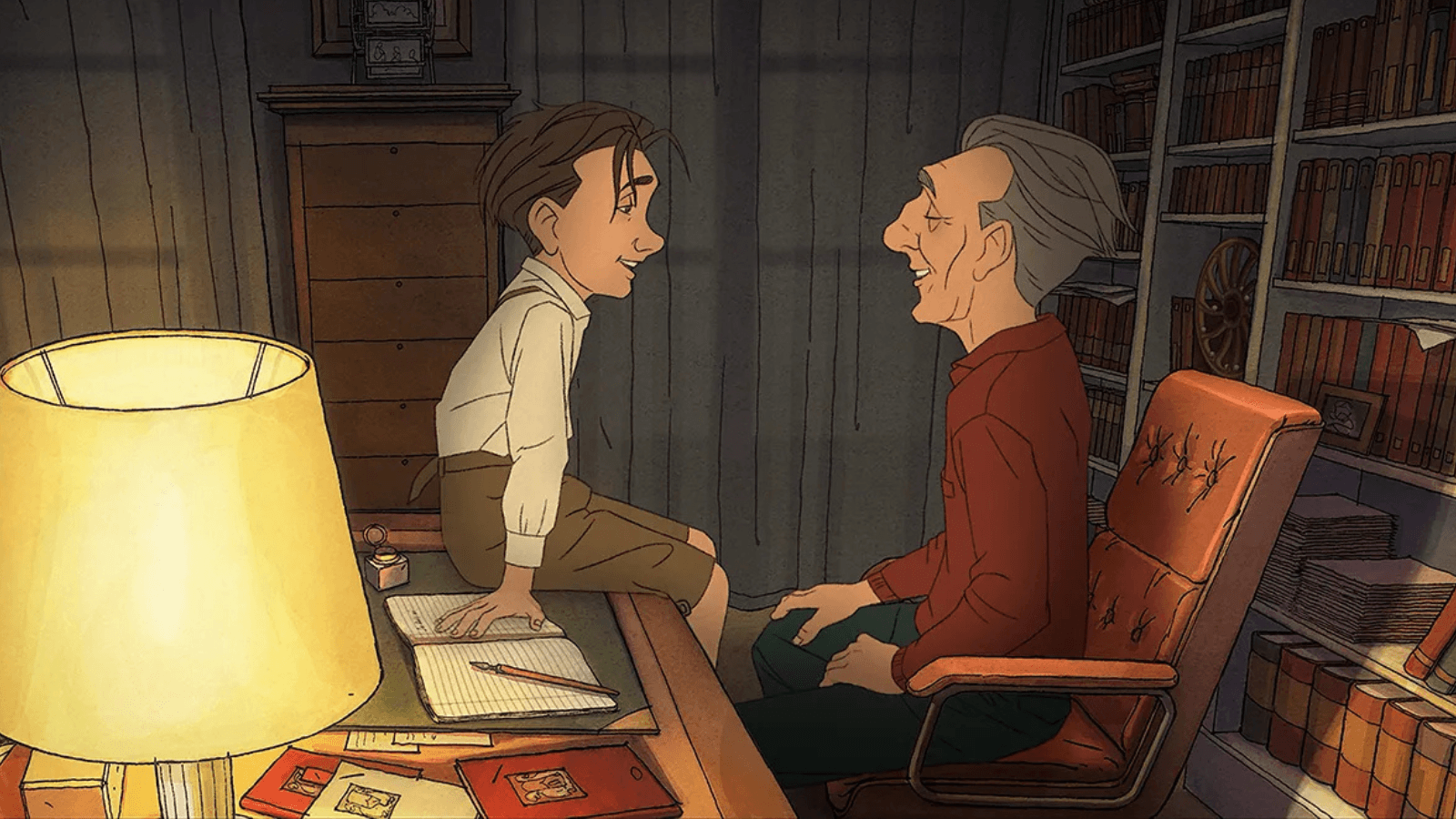
The narrative structure Chomet employs is generic and overdone, recalling any number of biographies where the main character looks back on their life during a career twilight. The framing device finds Pagnol in his early sixties. He’s at the age when you realize your perspective is out of touch, and those from younger generations will soon replace you, if they haven’t already. The year is 1956, and an editor from Elle wants Pagnol to write a memoir for the magazine. He agrees but procrastinates until a bike messenger arrives at his home to collect the first chapter. Pagnol stalls, while a bird squawks at him: “Pagnol. Quicker.” This will be the only talking animal in the film, along with one of the only whimsical asides. Another is a semi-transparent entity—a projection of Pagnol’s idealized boyhood self—who visits the older man to help conjure his fading memories of the past.
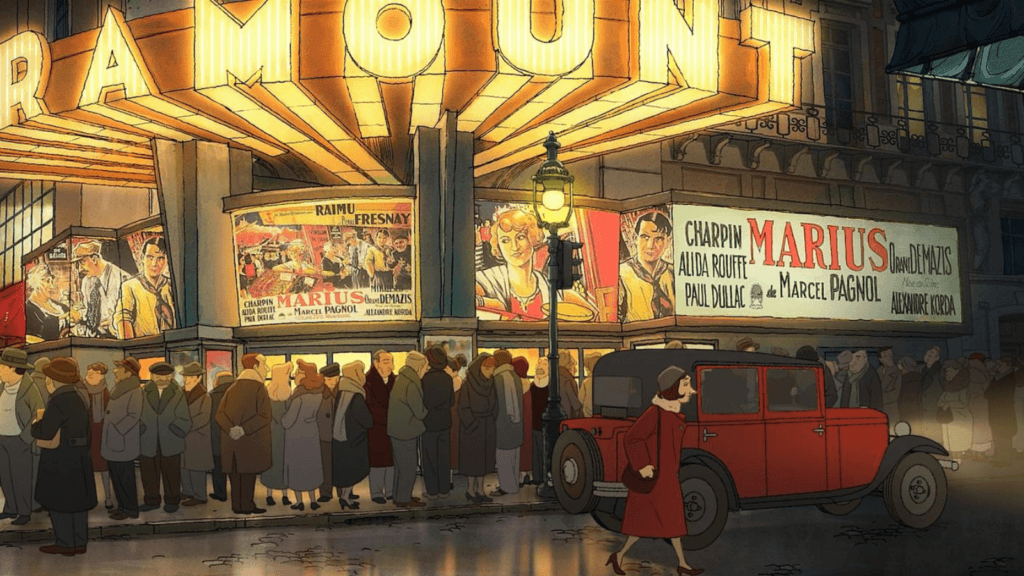
Chomet then takes us back to 1905, offering a glimpse of Pagnol’s early life in Marseille that would influence much of his most iconic work. As a child, he was determined to become a famous millionaire, despite the protests of his father, a devoted teacher and intellectual. At first, the boy follows in his father’s footsteps and teaches, earning a post in Paris, where he then struggles to write plays on the side. By the mid-1920s, he set aside teaching to produce successful plays, many of which he later turned into films. However, cinema seems pointless to a playwright so dependent on the written word, until Pagnol finds himself seduced by the possibilities of talkies after seeing The Broadway Melody (1929) in London. Soon after, he makes a deal with a grotesque Paramount Pictures executive for Alexander Korda to shoot Marius (1931). As the biopic continues and Pagnol’s film career has ups and downs, Chomet touches on the Nazi Occupation in World War II, including a bizarre scene where the young Pagnol spirit scares the bejesus out of a Nazi propaganda minister.
The film’s dull application of story might be overlooked next to Chomet’s inspired animation style, which has a sketch-like quality, vaguely reminiscent of Toulouse-Lautrec. The character movements look a little less natural and more wooden than those in his earlier films, which one could mistake for rotoscoping. In terms of color, he captures the sun-dappled palette of Southern France. Those familiar with director Yves Robert’s screen adaptations of Pagnol’s autobiographical novels, My Father’s Glory (1990) and its sequel, My Mother’s Castle (1990), will see their influence on Chomet. Another major aesthetic influence is Pagnol’s Marseille Trilogy: Marius, Fanny (1932), and César (1936), some of whose scenes have been projected onto animated cinema screens. Elsewhere, dreamy sequences in Pagnol’s head play out in animated asides meant to look like a silent film; however, because the character’s physical movements look so stifled, and silent cinema relies on large theatrical gestures, the effect doesn’t quite work.
Of all the ways A Magnificent Life disappoints, I can think of no greater irony for this film than the choice to present it in English. At one point in the film, Pagnol worries about preserving the distinct French identity of his art amid the postwar cultural colonization of France by American movies from Hollywood. Yet A Magnificent Life downplays its own French characteristics to appease English-speaking audiences—a self-sabotage of the most maddening order. Even the live-action footage from Pagnol’s films in French has been dubbed, which creates an odd visual effect. Are people really so averse to subtitles? Don’t many English speakers today watch English-language films with subtitles just to understand accents better and not miss any dialogue? Why should a French movie be any different? Language aside, this is the kind of movie that will play better for those familiar with Pagnol or with the films based on Pagnol’s writing that inspired Chomet. But even for those of us versed in Pagnol’s life and work, the outcome is a letdown in its dubbed form.
Thank You for Supporting Independent Film Criticism
If the work on DFR has added something meaningful to your love of movies, please consider supporting it.
Here are a few ways to show your support: make a one-time donation, join DFR’s Patreon for access to exclusive writing, or show your support in other ways.
Your contribution helps keep this site running independently. However you choose to support the site, please know that it’s appreciated.
Thank you for reading, and for making this work possible.
Brian Eggert | Critic, Founder
Deep Focus Review