The Definitives
This Is Spinal Tap (1984)
Essay by Brian Eggert |
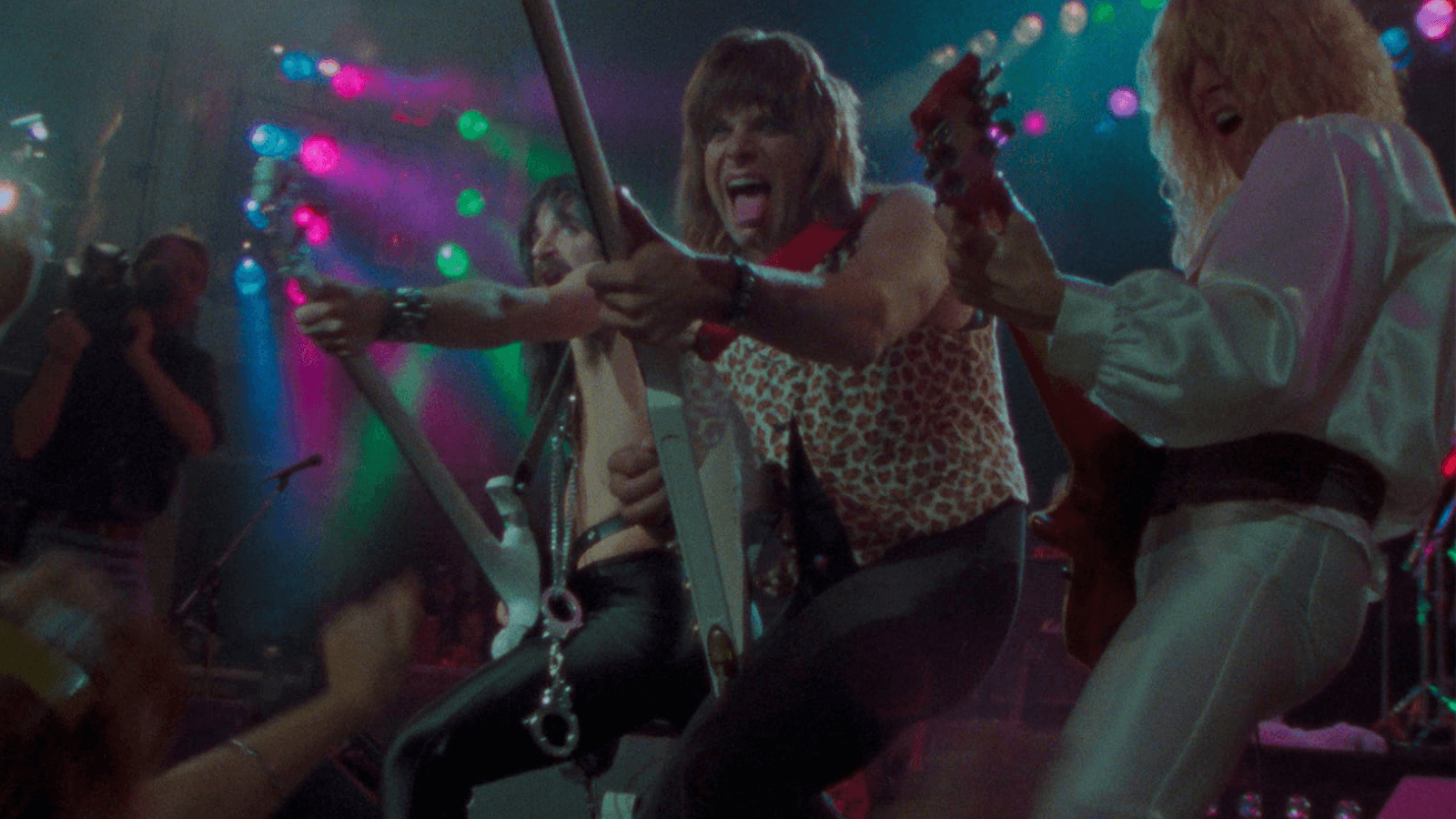
This Is Spinal Tap is a film about such idiotic people that its genius may not be instantly apparent. To quote rocker Nigel Tufnel, it’s “a fine line between stupid and clever.” That’s the premise of director Rob Reiner’s first feature. Starring performers who have as much talent for music as they do comedy (Christopher Guest, Michael McKean, Harry Shearer), the film is the finest mockumentary of its kind, or certainly the loudest. Rooted in documentary aesthetics, convincing heavy metal performances, and improvisational spontaneity, it looks, feels, and sounds like the real thing. If not for the ironies and comic markers throughout to indicate the film’s unserious intent, it might be mistaken for an authentic portrait of a real heavy metal rock band. Many mistook it for the genuine article upon its release in 1984. However, the more accurate it appears, the funnier it is. This Is Spinal Tap endures because it is effective as both satire and parody—the former conveys mockery, often to make a point about the subject, whereas the latter mimics it in either homage or derision. This Is Spinal Tap resolves to be both. It replicates the style of similar documentaries, commenting on musicians and the juvenile, hypermasculine rituals of the heavy metal lifestyle. It is a rich cultural critique of a musical genre, assembled in a convincing format. More importantly, it’s one of the funniest comedies ever made.
This is true not only for the jokes, quotable lines, or convincing rock sound that are purveyed throughout. Although the songs have a polished sound and catchiness, recalling the pop-satirist work of “Weird Al” Yankovic, minus the polka. Reiner’s film is also inspired for its flawless replication of the unironic documentary format. Reiner, his camera crew, and his editors piece together a familiar blend of handheld observational shots, casual interviews, concert and archival footage, and fly-on-the-wall positioning for a behind-the-scenes look at the titular band. To shoot the film, Reiner was inspired by the energy of famous musician docs, including Don’t Look Back (1967), Gimme Shelter (1970), The Last Waltz (1978), and Let It Be (1970). However, the director and his cast weren’t the first to send up such aggrandizing documentaries. Chief among Reiner and company’s antecedents is the 1978 television mockumentary All You Need is Cash, about a Beatles-esque group from the UK—a “pre-fab four” called The Rutles, who “created a musical legend that will last a lunchtime.” Eric Idle wrote, starred in, and co-directed the Lorne Michaels-produced film, which also starred many of Idle’s Monty Python’s Flying Circus cohorts and Michaels’ Saturday Night Live alums.
More than just lampooning their subject, This Is Spinal Tap’s filmmakers set out to explore how the promise of rock and roll as a countercultural social power had sold out, grown old, and run its course, leaving only gimmicks and capitalist drives to be found among the posturing musicians. The band members include lead guitarist Nigel Tufnel (Christopher Guest); David St. Hubbins (Michael McKean) on guitar and lead vocals; bassist Derek Smalls (Harry Shearer), the “lukewarm water” between Nigel and David’s fire and ice; and oddball Viv Savage (David Kaff) on keyboards. Managed by the beleaguered Ian Faith (Tony Hendra), the band features an array of soon-to-be-dead drummers who expire in freak accidents, from choking on someone else’s vomit to spontaneous combustion. Behind the camera, and also conspicuously in front of it, is Reiner’s pretentious onscreen director Marty DiBergi. He introduces the band, which he first learned about in 1966. “Seventeen years and fifteen albums later,” Marty remarks, Spinal Tap has “earned a distinguished place in rock history as one of England’s loudest bands.” The film—“If you will, rockumentary,” Marty clarifies—presents not only a comic take on similar docs but also a scathing commentary on heavy metal culture’s hollow theatrics and misogynist aesthetics, replete with phallic guitars and sexualized lyrics.
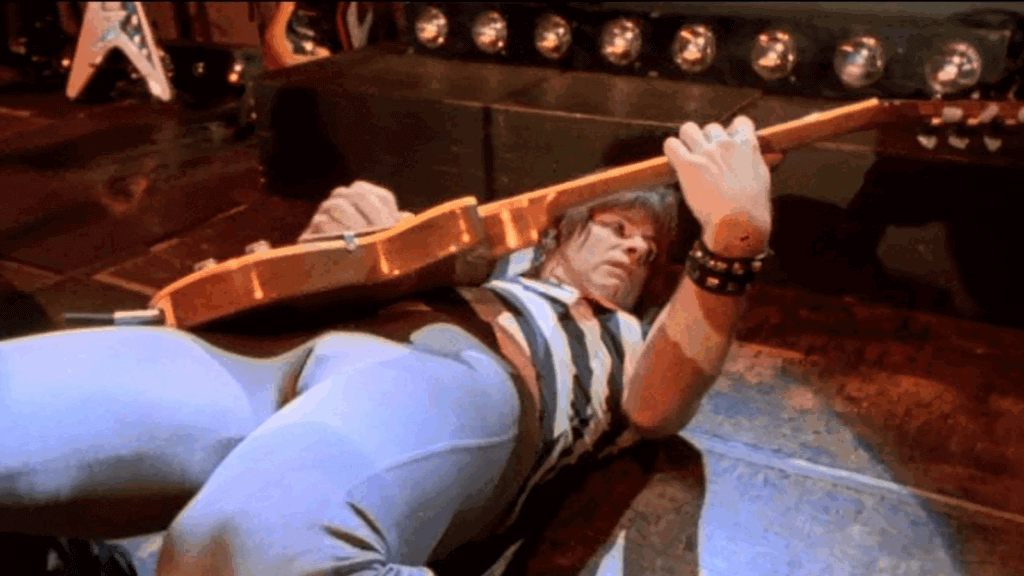
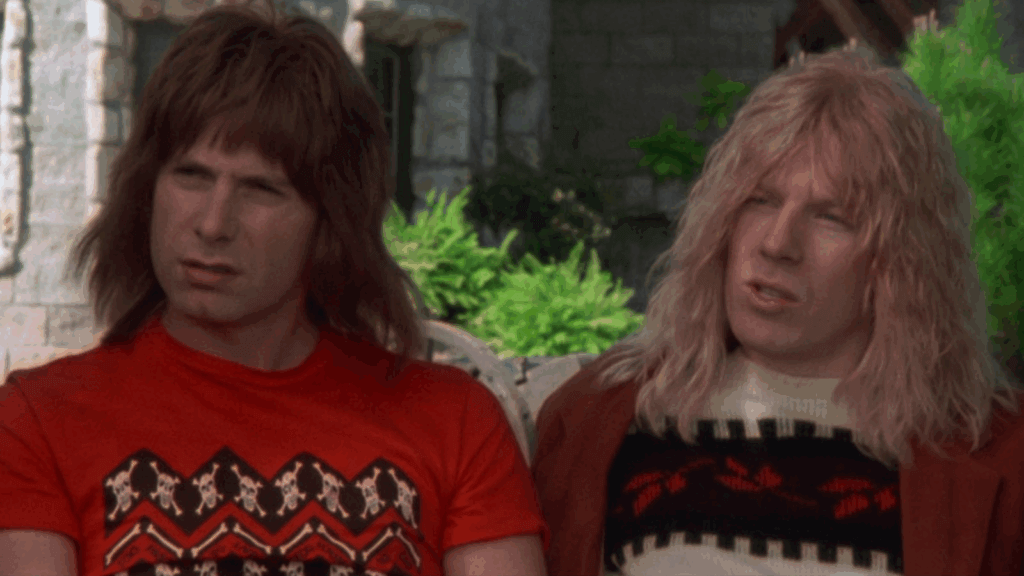
Among the funniest running gags in This Is Spinal Tap is one about the band’s pretensions, despite singing juvenile songs about sex, rebellion, and their penises. Even Marty points out the composition of their fanbase as “predominantly young boys.” Nigel reasons that female fans have fled out of fear: “They see us on stage, with tight trousers. We’ve got, you know, armadillos in our trousers. I mean, it’s really quite frightening—the size. And they run screaming.” Yet, the filmmakers present the band’s masculinity as absurd and contrived, not to mention performative. Spinal Tap’s stage acts feature bombastic demonstrations of their sexuality and showmanship, accompanied by an almost childish sense of play through gimmicky themes. Take a hilarious setup where they plan a synchronized emergence from plastic pods. Nigel and David step out successfully; however, Derek remains locked inside most of the song, with a roadie hammering away at the pod, trying to free the trapped bassist. Finally, Derek is freed just as the song wraps up, cueing him back to the pod at the same moment. Elsewhere, Nigel demonstrates his prowess with ludicrous electric guitar solos, slamming his shoes and a fiddle against his strings to create a piercing, nonmusical sound. During one of his solos, he leans back too far and cannot rise, requiring a roadie to put him upright. In each case, the band endeavors to be taken seriously as rock gods, but instead comes across as pathetic due to their unjustified egos.
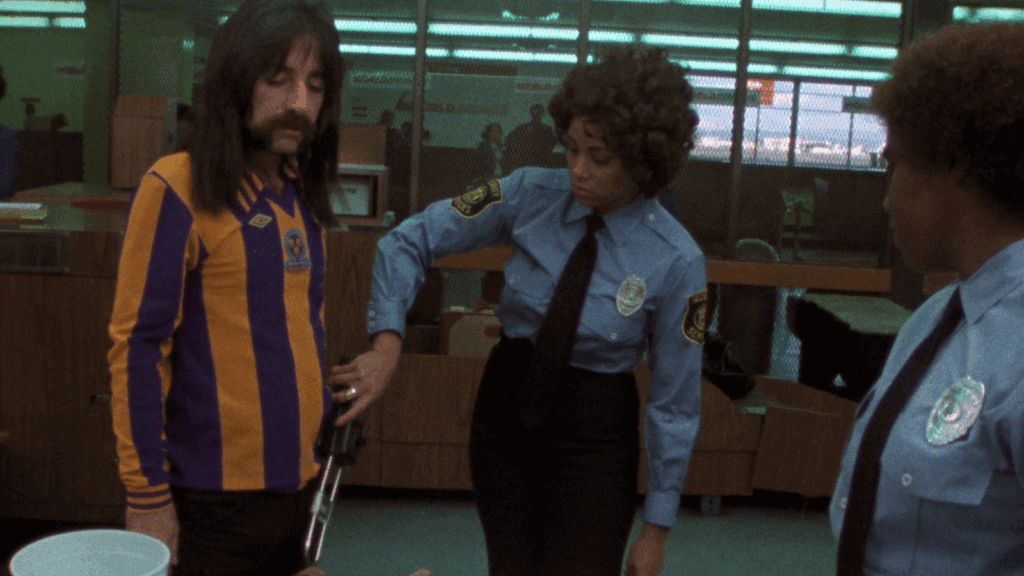
The band operates in a music genre sometimes called “cock rock,” in which their music and stage presence express their sexuality whenever possible, often using microphones and guitars as symbolic penises. Their routine borrows from the likes of David Lee Roth, who, on Van Halen’s debut album cover in 1978, held a microphone in front of his crotch. Early in the 1980s, The Red Hot Chili Peppers performed nude save for a sock over their members, leading to the inevitable concert album titled Rock Out With Your Cock Out—the cover of which features the band walking across Abbey Road in that state, replicating The Beatles’ famous album cover. Spinal Tap engages in similar antics, playing music that portrays women as either nuisances or sex objects, with at least one of their songs reducing a woman to a single body part. Songs such as “Big Bottom” and “Sex Farm” frame sexuality in purely physical terms, in which women remain submissive to the band’s displays of lewd licking gestures, suggestive gyrations, and musical pestering. But it’s all a show—and what a masquerade it is. One of the film’s funniest scenes finds Derek walking through an airport security checkpoint, where he sets off the metal detector. After investigating, the security guard uncovers what’s triggering the alarm: Derek has stuffed his pants with a cucumber wrapped in tin foil.
Indeed, This Is Spinal Tap depicts the band’s attempts to build themselves up, not just as legendary rockers but as virile and well-endowed men who are ultimately emasculated over and over. Reiner and company do not merely caricature hypermasculine rockers of this type but characterize their prowess as part of the act—in some cases, as desperate affectations and grandeur adopted and exaggerated as part of the band’s niche. Their heavy metal garb is every bit a costume, not unlike their early-career pseudo-Beatles or flower-children routines. Much of the film reframes the group as washed-up and passé. They face canceled performances, venues that don’t know their band name (ranging from “Spinal Pap” to “Spinal Tarp”), and underwhelming welcomes. In Chicago, the Holiday Inn’s sign reads “Welcome National Company of the Wiz and Spinal Tap.” At Themeland Amusement Park, the billboard for their show lists them second after a “Puppet Show” for kids. Among the best, most deflating jokes involves the band attempting to pull off a virtuosic druid routine with a towering, onstage replica of a T-shaped structure from Stonehenge—a testament to their maleness and sexuality. When Ian enlists an artist (Anjelica Huston) to build it, she follows Nigel’s napkin drawing and makes an 18-inch, not 18-foot, replica. It’s a perfect encapsulation of the band’s inadequacy.
Given Spinal Tap’s general misogyny, the band treats women as outsiders and others. Take Bobbi Flekman (Fran Drescher), a record company executive who, much to the band’s dismay, refuses to allow the album cover concept for their new release, Smell the Glove, calling it “sexist.” Nigel replies with complete ignorance: “What’s wrong with being sexy?” And so, Ian implements a baffling solution without consulting the band first: The album will be entirely black—no band name, track titles, or text whatsoever. This is just one among many of Ian’s failures that plant seeds of doubt about his abilities. David’s girlfriend, Jeanine Pettibone (June Chadwick), further sours the group’s relationship with women in a Yoko Ono-esque subplot. A New Agey type, she hopes to introduce some of her astrological ideas into their onstage routines. She also wants to manage the band despite her ignorance of the business (she pronounces “Dolby” as “doubly”). Yet, she’s no more incompetent than Ian. Besides the album cover, Ian’s efforts have resulted in canceled and underwhelming venues, hotel room mix-ups, and other debacles. Nigel, above all, views Jeanine as an impossible alternative; she disrupts their boy’s club dynamic. And after the Stonehenge disaster, David and Jeanine suggest she share managing duties with Ian—a proposal that prompts Ian to quit. Lugging around his phallic cricket bat, he refuses to work with “a woman.” Alas, Jeanine fares no better than Ian in the role.
Although the mockumentary may seem like a relatively new phenomenon, its roots run deep in satire and cinematic mimicry. Some sources credit Federico Fellini with inventing the mockumentary with 1970’s The Clowns; however, an earlier example arrived a year prior with Woody Allen’s Take the Money and Run (1969). Other examples appeared as early as the 1930s, such as Luis Buñuel’s Land Without Bread (1933). Self-described as a “cinematic essay of human geography,” Buñuel’s 30-minute short presents an ethnographic study of an isolated Spanish village called Las Hurdes. But instead of scientific objectivity, the film includes derisive observations about the community, such as a ritual involving local men who must tear the heads off chickens: “This bloodthirsty festival undoubtedly conceals several complex sexual symbols that we will not analyze now,” says the narrator. The most famous of these early mockumentaries hails from 1938, when Orson Welles’ Mercury Theatre created faux news broadcasts for its radio production of H.G. Wells’ The War of the Worlds, sending many listeners running for the hills in fear of an alien threat. Welles also created fake newsreel footage a few years later for the famous “News on the March” sequence in Citizen Kane (1942).
Mockumentaries emerged as a satiric, artistic response to the popular format and aesthetics of documentary realism. Their makers attempt to understand the documentary’s narrative and formal techniques when presenting reality, from cinéma-vérité’s objective observer approach to the narrative methods of biographical subjects. Among the most foundational of the early comedic examples is Albert Brooks’ hilarious Real Life (1979), his take on PBS’s first-of-its-kind reality TV series, An American Family (1973). Just as the PBS series did, Brooks, working alongside co-writer Shearer and regular writing partner Monica Johnson, exposes how subjects behave differently once they know they’re on camera, including the filmmakers. Brooks plays the self-obsessed onscreen documentarian who resolves that “reality sucks” and injects himself into the story, tarnishing objectivity with his presence. The model was doubtlessly an influence on Reiner, who has known and admired Brooks since childhood—he even made a documentary about his friend in 2023 called Albert Brooks: Defending My Life. They grew up in the same Hollywood circles, attended the same high school, and had fathers in the entertainment industry: Brooks’ father was radio comedian Harry Einstein, while Reiner’s father was the legendary Carl Reiner.
The mock-band idea for Spinal Tap did not begin with Reiner’s film or even out of appreciation for Brooks’ work, however. It emerged from artistic serendipity—a series of unexpected connections among performers from various improv and comedy troupes. For instance, Guest and McKean met and roomed together while attending the Tisch School of the Arts at New York University. Both had backgrounds in performance, and with McKean’s musical talents, they began writing parodic songs together. Although the stock company that would appear in Guest’s mockumentaries decades later had yet to form, they traveled in many of the same circles and met through a series of chance encounters: Guest met Second City alum Fred Willard on the play Little Murders. McKean met Harry Shearer after moving to Los Angeles, and together they founded the comedy group Credibility Gap. McKean landed a stable role on Laverne and Shirley (1976-1983), and his co-star Penny Marshall was then married to Reiner, who appeared on All in the Family (1971-1983). Guest appeared on both shows.
Poking fun at musicians had interested Guest prior to the Spinal Tap concept. He also co-directed and wrote many of the songs in the off-Broadway play Lemmings, a satire of Woodstock that took its name from Gimme Shelter (1970), when a lawyer describes how zealous fans will respond to the Rolling Stones: “It’ll be like lemmings to the sea.” However, Spinal Tap debuted in 1979 on the pilot of an ABC sketch-comedy hour called The T.V. Show. Their concept originated with Guest and McKean, who, while at NYU together, noted the humor of rock bands who “had pomposity that didn’t pay off,” according to McKean in a 2002 interview. They went from selling out stadiums to slumming it in dive venues. In the comic sketch, a spoof of the televised rock series The Midnight Special (1973-1981), Reiner appears as a Wolfman Jack-esque announcer who introduces his American viewers to the UK band. Singing “Rock & Roll Nightmare,” Spinal Tap appears a little shaggier than they would in Reiner’s film, but their routine has a similar flavor, dependent on silly lyrics, high-concept showmanship, and a general air of stupidity.
Before cameras started to roll on This Is Spinal Tap, the four central creatives—Reiner, Guest, McKean, and Shearer—workshopped their ideas for several years after The T.V. Show appearance. They set out with a few stated ambitions, such as crafting a funny movie that also showcases real musical performances by the onscreen players. They drew upon Bob Dylan’s obvious awareness of, and self-conscious performance for, D.A. Pennebaker’s camera in Don’t Look Back. The Beatles performed in similar for-the-camera roles in A Hard Day’s Night (1964), directed by Richard Lester. But it wasn’t just musician culture; it was also the documentarians. Reiner poked fun at Martin Scorsese in The Last Waltz, who asks his subjects from The Band dull questions and, like Reiner’s character, who adopts Scorsese’s nickname “Marty” for This Is Spinal Tap, behaves with lofty airs to aggrandize both his subject and himself. Finally, when the filmmakers were ready to pitch their project to acquire financing, they used the initial seed money—supplied by British television mogul Sir Lew Grade, who commissioned a script draft—to produce a demo reel. The group realized that their film would be mostly improvised, and that trying to sell the idea based on the screenplay’s broad scene outlines wouldn’t work. However, every studio and financier who saw the demo either didn’t understand the concept or didn’t find it funny.
Reiner then approached producer Norman Lear, creator of All in the Family, who was getting into motion pictures in the 1980s with his company Tandem Enterprises, the purchaser of production and distribution company Avco Embassy. Lear agreed to fund the project for $2 million. The production shot for five weeks in 1983, with Reiner rehearsing scenes to avoid the cast of improvisers from talking over each other. To shoot the picture, Reiner enlisted cinematographer Peter Smokler, one of the cameramen who shot Gimme Shelter, to recreate the verité look of straight documentaries. Meanwhile, some of the feedback the group received about their proof-of-concept short included the need for a stronger story, so the team conceived of David’s girlfriend, Jeanine, whose presence throws the band’s dynamic into disarray with her New Age interests and ambitions to co-manage the group. The film’s loose story structure follows the band on an American tour to promote their new album. Jeanine’s presence prompts Nigel to leave the band, only for him to inevitably return. Reiner shot approximately 100 hours of footage and, alongside editors Kent Beyda, Robert Leighton, and Kim Secrist, discovered the film during the nine-month editing process. The initial cut, sometimes referred to as the “director’s cut,” ran approximately four-and-a-half hours. The final runtime clocked in at 82 minutes.
Although it’s tempting to watch This Is Spinal Tap and look for direct correlations between the onscreen band and real-life rockers, those behind the film still insist their effort sought to be a universal pastiche. However, just as musician biopics all tend to tell the same cliché story—a rise from humble beginnings into superstar status, leading to drug abuse and an emotional fallout, followed by a celebratory finale rooted in the artist’s legacy—bands tend to adopt the same behaviors. Even so, dozens of moments draw from well-established rocker lore and earlier documentaries. When Derek becomes trapped in a pod onstage, the scene draws from an infamous story from 1956 when early shock-rocker Screamin’ Jay Hawkins planned to emerge from a coffin to perform “I Put a Spell on You” but was trapped inside. The sequence where Spinal Tap gets turned around backstage before a show recalls an anecdote about Mötley Crüe getting lost backstage in the early 1980s. And when Marty DiBergi asks about Spinal Tap’s origins, it mirrors the scene in The Last Waltz where the group recalls their former names: The Crackers, The Honkies, etc. Nigel and David started out as The Creatures and soon became The Lovely Lads, The Originals, The New Originals, and The Thamesmen.
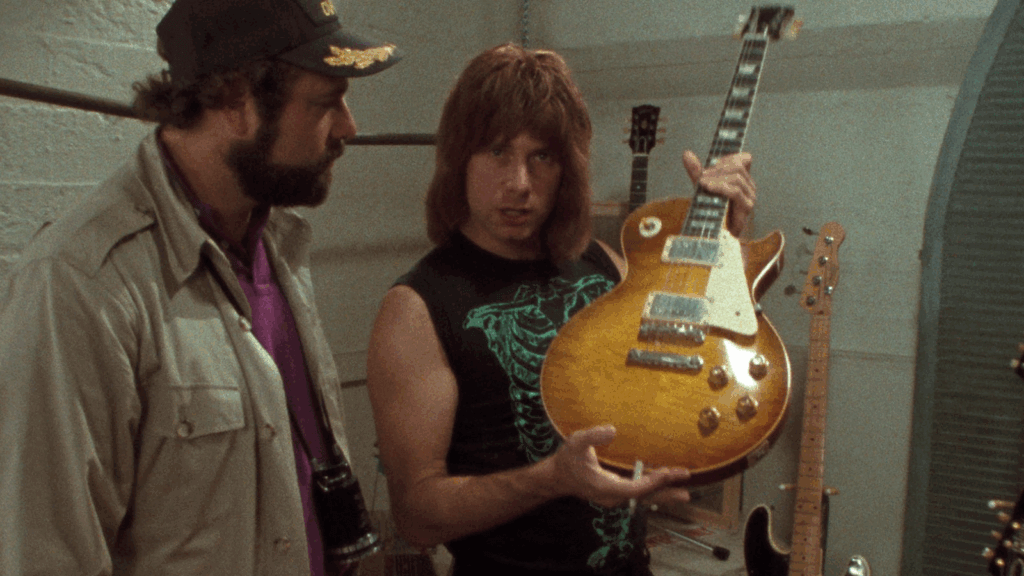
Most impressive is how well This Is Spinal Tap recreates the band’s stage performances with an overall documentary aesthetic, including the vintage footage of Spinal Tap’s earlier iterations and television appearances. In a convincing presentation not unlike the approach in Woody Allen’s Zelig (1983) and later, Robert Zemeckis’ Forrest Gump (1994), Reiner fabricates the band’s appearances on American variety shows, nodding to The Beatles’ early-career appearances on The Ed Sullivan Show and Shindig! by recreating the look and feel of these phases. By blending historical footage with fictionalized images, Reiner employs the 1984 equivalent of a deepfake. Similarly, Smokler’s camerawork never feels like a put-on; his fly-on-the-wall approach looks carefully unpolished with zooms, abrupt cuts, long handheld takes, rack focusing, and lingering close-ups of the dopey band members. Smokler’s style proves indistinguishable from Pennebaker, Albert and David Maysles, Barbara Kopple, and Frederick Wiseman in its unobtrusive, observational techniques. Moreover, the camera doesn’t just articulate jokes but presents moments for the viewer to discover, such as Nigel and David’s herpes-riddled faces or the sly way Nigel demonstrates his ignorance. When Marty interviews Nigel about his guitar collection, it becomes clear Nigel knows little about them. Unlike his contemporaries, ranging from Eddie Van Halen to Slash, who actually have technical skill and knowledge of guitars, Nigel cannot construct or even speak intelligently about his instruments. He prefers to posture with loudness—he demonstrates for Marty that his amps go louder than the usual “10” up to a custom-made “11.” Never mind Marty’s suggestion to just make “10” louder.

Ultimately, Reiner and company show that Spinal Tap learns no lessons from their behavior, having almost broken up over management and a botched US tour. Eventually, after they do break up, Nigel returns with news: Ian has reported that their song “Sex Farm” has topped the charts in Japan, and the band next appears on tour in Tokyo. Though reunited with two managers, Ian and Jeanine, who will perhaps work together after a brief glance between them, the band has learned nothing and will keep rocking in their unselfconscious mode. What’s surprising is how likable the band members remain despite their deplorable behavior. Guest, McKean, and Shearer do not portray them as aggressive or hateful, despite their hypermasculinity, dim behavior, and penchant for extreme onstage antics. If it’s troubling that This Is Spinal Tap shows neither a comeuppance for the band nor any sympathetic portrayals of women, the filmmakers commit to their feature’s subjectivity. This is Marty’s film, and Marty remains a fan, so he adopts the narrative that reinforces the band’s views without critique. The film’s cultural deconstruction of Spinal Tap must be interpreted by the viewer without Reiner and company stating the point. “Most movies lie,” Shearer remarked to author John Kenneth Muir. “It’s nice every once in a while to tell them the truth about how things are.”
When This Is Spinal Tap debuted in 1984, the critics agreed that Reiner and company had delivered a hilarious and convincing film. Actual rockers told the cast that they couldn’t watch the film; it was all too real—a reflection of what it’s actually like on a heavy metal band tour. Indeed, many of the sequences were derived from real-life stories and anecdotes experienced by the cast during their time on tour as musicians and comedians. Some moviegoers missed the joke and wondered why they had never heard of Spinal Tap, particularly after the group appeared on Saturday Night Live as the sketch-comedy show’s musical guest, two months after the film’s premiere. Neither the host Barry Bostwick nor the show states that Spinal Tap is a spoof band; though, doubtlessly, many viewers recognized Guest or McKean from their television appearances. Bostwick interviewed the in-character band for a hilarious segment, where Nigel states that Spinal Tap appeals most to working professionals such as neurosurgeons, stock brokers, and investment bankers “who are serious about life”—and also “14-year-old white boys.” The actors toured as Spinal Tap, produced music videos, and sold albums, committing to the bit.
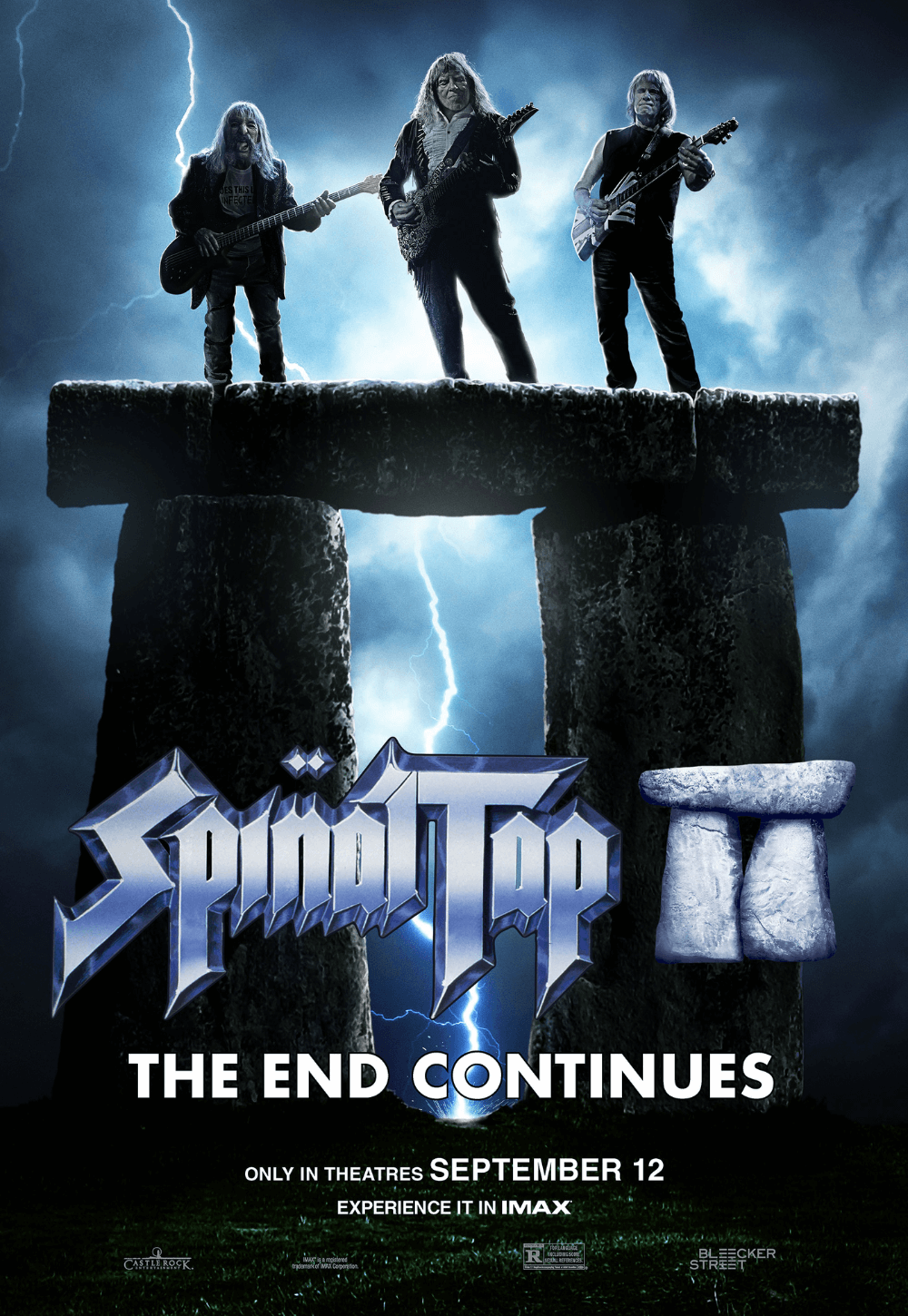
Since its release, This Is Spinal Tap has become one of the most beloved of all comedies and remains endlessly quotable. The line about Nigel’s amp going up to eleven has become so ingrained in our culture that some recognize the phrase “up to eleven” as a synonym for heightened or exaggerated energy, rather than a reference to the film. Of course, This Is Spinal Tap informed Guest’s output as a filmmaker. Along with many of the same players from Reiner’s film, Guest added Eugene Levy, Catherine O’Hara, Jennifer Coolidge, Parker Posey, John Michael Higgins, and Jane Lynch to his new stock company. He made a series of mockumentaries—a term he prefers not to use, claiming it’s too glib—rooted in improvisation. Much like Reiner’s film, Guest and fellow writer Levy omit dialogue from their screenplays and instead rely on a scene-by-scene outline. The result has been some of the funniest movies ever made, such as Waiting for Guffman (1996), Best in Show (2000), A Mighty Wind (2003), and For Your Consideration (2006). After years of setting out and redefining what Reiner made with This Is Spinal Tap, Guest once again teamed with Reiner for Spinal Tap’s surprisingly strong 2025 reunion film, Spinal Tap II: The End Continues.
The legacy of This Is Spinal Tap is multifaceted. Besides marking the debut film of Reiner and the first of many collaborations between Guest and company, it made significant strides in popularizing the mockumentary. Along with Guest’s subsequent output, the film would help inspire a range of pseudo-documentary comedies, including Julie Brown’s unflattering takedown of Madonna: Truth or Dare (1991) with Medusa: Dare to Be Truthful (1992); the sensationalist cultural critiques of Borat (2006) and Brüno (2009), starring Sacha Baron Cohen and directed by Larry Charles; and The Lonely Island’s pop-centric riff on Reiner’s film, Popstar: Never Stop Never Stopping (2016). While some of these other examples have lost staying power over the years, This Is Spinal Tap remains essential today for the truth behind its novel take on the mockumentary, its portrayal of rock musician clichés, its timeless humor rooted in stupidity, and its sly commentary on the adolescent attitude toward sex and rebellion—all of which are evident in today’s musicians and their continued reliance on pretense and gimmicks. Refreshingly, the film never feels like it’s attacking its subject’s jugular. It mocks with a gentle irony and equal measures of admiration and absurdity, making rewatches all the more rewarding and eternally hilarious.
(Note: Many thanks to Martha for commissioning this piece, and thank you for your continued support!)
Bibliography:
French, Karl. This Is Spinal Tap: The Official Companion. Bloomsbury Press, 2000.
Muir, John Kenneth. Best in Show: The Films of Christopher Guest and Company. Applause, 2004.
Plantinga, Carl. “Gender, Power, and a Cucumber: Satirizing Masculinity in This Is Spinal Tap.” Documenting the Documentary, edited by Barry Keith Grant and Jeannette Sloniowski, Wayne State University Press, 2014, pp. 339-355.
Thank You for Supporting Independent Film Criticism
If the work on DFR has added something meaningful to your love of movies, please consider supporting it.
Here are a few ways to show your support: make a one-time donation, join DFR’s Patreon for access to exclusive writing, or show your support in other ways.
Your contribution helps keep this site running independently. However you choose to support the site, please know that it’s appreciated.
Thank you for reading, and for making this work possible.
Brian Eggert | Critic, Founder
Deep Focus Review